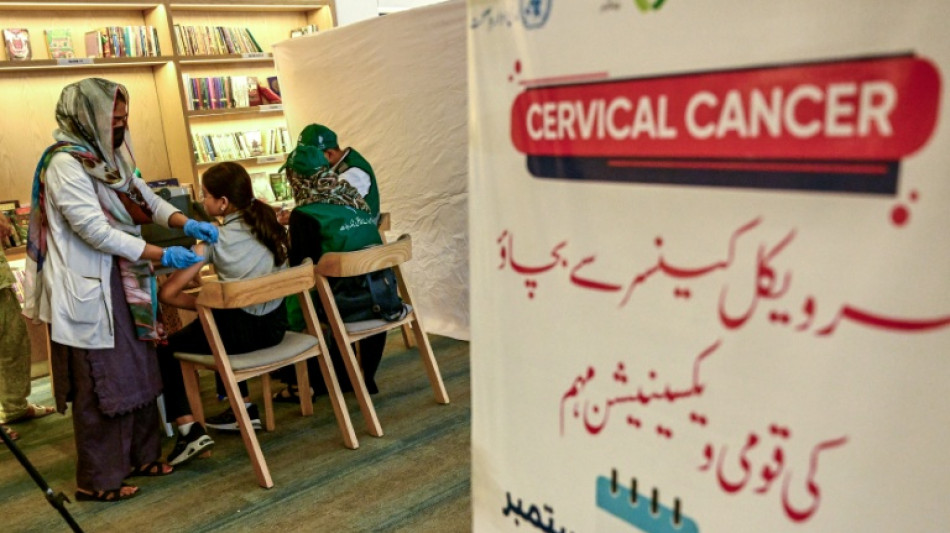
Pakistani parents rebuff HPV vaccine over infertility fears / Photo: Rizwan TABASSUM - AFP

 Drones hit Moscow as Russians go to the polls

 New England boss Fleming says 'wrong' to ask Stokes to end retirement

 Germans vote in elections threatening fresh blow to Merz

 US fears rapid escalation in Mideast after Houthis attack Riyadh

 Japan triathlete Hojo wins first gold of Asian Games

 IOC president impressed by 'beautiful' Asian Games wooden huts

 First Asian Games gold goes to Japan as China's 13-year-old Yu lights up pool

 Data centre command hub keeps AI up and running

 Pope Leo in France: the issues on the table

 Packing for a pope: behind the scenes on foreign trips

 Republicans find transgender issues a powerful political weapon in midterm campaigning

 German state elections threaten new shock waves for Merz

 Chile's Bachelet quits race to be next UN chief

 Raphinha treble fires perfect Barca to win at Sevilla

 Thiam makes winning heptathlon return at Decastar meet

 Czechs beat USA to qualify for Davis Cup finals

 Dortmund sink Stuttgart to climb to Bundesliga summit

 Trump says will not tolerate attempts to slow AI growth

 'It has to stop': runners protest women's murders in S.Africa district

 Fire erupts near Riyadh airport as Houthis claim strikes

 Cuba works to restore power after another blackout

 England thrash Sri Lanka again to return to top of T20 rankings

 Arsenal thrashed by Brighton, sorry Spurs lose again
 South Korea, Austria qualify for Davis Cup finals

 Seare shocks Ingebrigtsen to win world 5km gold

Misinformation plagued the first rollout of a vaccine to protect Pakistani girls against cervical cancer, with parents slamming their doors on healthcare workers and some schools shutting for days over false claims it causes infertility.
The country's first HPV vaccine campaign aimed to administer jabs to 11 million girls -- but by the time it ended Saturday only around half the intended doses were administered.
A long-standing conspiracy theory that Western-produced vaccines are used to curb the Muslim population has been circulating online in Pakistan.
Misinformation has also spread that the vaccine disrupts the hormones of young girls and encourages sexual activity, in a country where sex before marriage is forbidden.
"Some people have refused, closed their gates on us, and even hid information about their daughter's age," vaccinator Ambreen Zehra told AFP while going door to door in a lower-middle-income neighbourhood in Karachi.
Only around half the intended vaccines had been administered, according to a federal health department official who spoke to AFP on condition of anonymity.
"Many girls we aimed to reach are still unvaccinated, but we are committed to ensuring the vaccine remains available even after the campaign concludes so that more women and girls get vaccinated," they said on Friday.
One teacher told AFP on condition of anonymity that not a single vaccine had been administered in her school on the outskirts of Rawalpindi because parents would not give consent, something she said other rural schools had also experienced.
A health official who asked not to be named said some private schools had resorted to closing for several days to snub vaccine workers.
"On the first day we reached 29 percent of our target, it was not good, but it was fine," said Syeda Rashida Batool, Islamabad's top health official who started the campaign by inoculating her daughter.
"The evening of that first day, videos started circulating online and after that it dipped. It all changed."
A video of schoolgirls doubled over in pain after teargas wafted into their classroom during a protest several years ago was re-shared online purporting to show the after-effects of the vaccine.
The popular leader of a right-wing religious party, Rashid Mehmood Soomro, said last week the vaccine, which is voluntary, was being forced on girls by the government.
"In reality, our daughters are being made infertile," he told a rally in Karachi.
- 'This will control the population' -
In 95 percent of cases, cervical cancer is caused by persistent infection with Human Papillomavirus (HPV) –- a virus that spreads through sexual activity, including non-penetrative sex, that affects almost everyone in their lifetime.
The HPV vaccine, approved by the World Health Organization, is a safe and science-based protection against cervical cancer and has a long history of saving lives more than 150 countries.
Cervical cancer is particularly deadly in low and middle income countries such as Pakistan, where UNICEF says around two-thirds of the 5,000 women diagnosed annually will die, although the figure is likely under-reported.
This is because of a significant lack of awareness around the disease, cultural taboos around sexual health and poor screening and treatment services.
It is underlined by the damaging belief that only women with many sexual partners can contract sexually transmitted infections.
In Europe, where the HPV vaccine has been highly effective, there were around 30,000 diagnoses across all 27 EU nations in 2020, of which around one-third of women died, according to the European Commission.
"My husband won't allow it," said Maryam Bibi, a 30-year-old mother in Karachi who told AFP her three daughters would not be vaccinated.
"It is being said that this vaccine will make children infertile. This will control the population."
Humna Saleem, a 42-year-old housewife in Lahore, said she thought the vaccine was "unnecessary".
"All cancers are terrible. Why don't we tell our boys to be loyal to their wives instead of telling our girls to get more vaccines?" she told AFP.
Pakistan –- one of only two countries along with Afghanistan where polio is endemic -– remains stubbornly resistant to vaccines as a result of misinformation and conspiracy theories.
After marking one year without polio cases for the first time in 2023, the crippling disease has resurged with 27 cases reported in 2025 so far.
In response to overwhelming misinformation about the HPV vaccine, Pakistan's minister of health, Syed Mustafa Kamal, took the bold move to have his teenage daughter vaccinated in front of television cameras.
"In my 30-year political career I have never made my family public," he told reporters.
"But the way my daughter is dear to me, the nation's daughters are also dear to me, so I brought her in front of the media."
zz-stm-sma-nz-ecl/dhw
T.Resende--PC