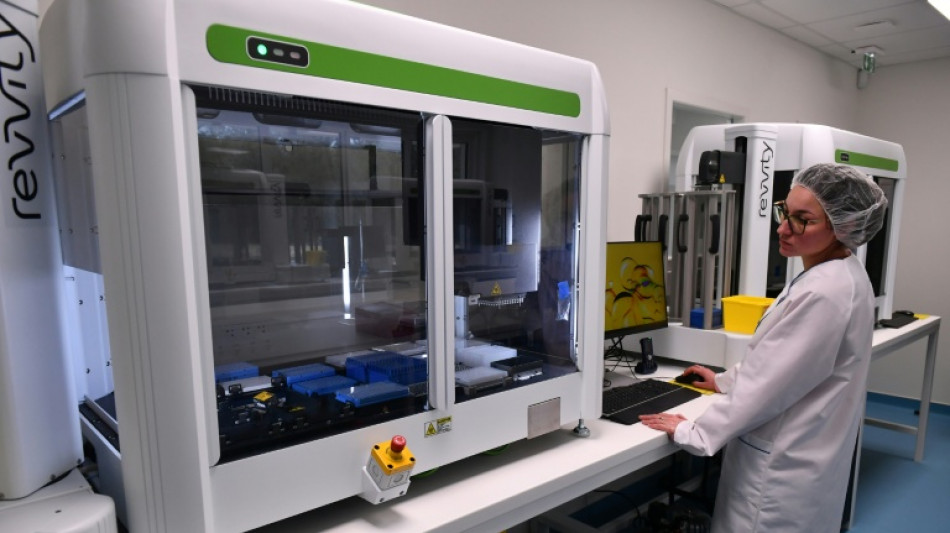
Endometriosis test backed by French government under scrutiny / Photo: GAIZKA IROZ - AFP/File

 Drones hit Moscow as Russians go to the polls

 New England boss Fleming says 'wrong' to ask Stokes to end retirement

 Germans vote in elections threatening fresh blow to Merz
 US fears rapid escalation in Mideast after Houthis attack Riyadh

 Japan triathlete Hojo wins first gold of Asian Games

 IOC president impressed by 'beautiful' Asian Games wooden huts

 First Asian Games gold goes to Japan as China's 13-year-old Yu lights up pool

 Data centre command hub keeps AI up and running

 Pope Leo in France: the issues on the table

 Packing for a pope: behind the scenes on foreign trips

 Republicans find transgender issues a powerful political weapon in midterm campaigning

 German state elections threaten new shock waves for Merz

 Chile's Bachelet quits race to be next UN chief

 Raphinha treble fires perfect Barca to win at Sevilla

 Thiam makes winning heptathlon return at Decastar meet

 Czechs beat USA to qualify for Davis Cup finals

 Dortmund sink Stuttgart to climb to Bundesliga summit

 Trump says will not tolerate attempts to slow AI growth

 'It has to stop': runners protest women's murders in S.Africa district

 Fire erupts near Riyadh airport as Houthis claim strikes

 Cuba works to restore power after another blackout

 England thrash Sri Lanka again to return to top of T20 rankings

 Arsenal thrashed by Brighton, sorry Spurs lose again
 South Korea, Austria qualify for Davis Cup finals

 Seare shocks Ingebrigtsen to win world 5km gold

When France launched its strategy to fight endometriosis in 2022, it widely promoted a simple saliva test that was promised to revolutionise diagnosis of the little-understood disease, which causes debilitating pain in women across the world.
However, after years of financial support from the government, significant questions remain about the effectiveness of the "Endotest" developed by French start-up Ziwig, several researchers have told AFP.
There is no doubt a better test for endometriosis would represent a major medical breakthrough. The chronic disease, in which tissue similar to the lining of the uterus grows outside the womb, affects at least one in 10 women of reproductive age worldwide, significantly raising their risk of infertility.
Yet women often endure a long and difficult journey to diagnose endometriosis, which can currently only be confirmed by an invasive surgical procedure requiring general anaesthesia.
A saliva sample is all that is required for the Endotest, which is marketed as using artificial intelligence and new microRNA technology to diagnose the disease.
Ziwig's founders have vowed a "revolution" that would enable "early detection of all forms of endometriosis, even the most complex".
If successful, this would also mark a meaningful scientific advance -- though the discovery of microRNA in the 1990s earned a medicine Nobel last year, the technology has yet to lead to a significantly impactful pharmaceutical product.
The government's support for the Endotest has not wavered, even during a turbulent few years in French politics.
"The Ziwig project embodies French excellence in medical innovation," former health minister Genevieve Darrieussecq said last year.
Current Health Minister Catherine Vautrin, who visited Lyon-based Ziwig's lab earlier this year, is quoted promoting the test on the start-up's website -- unusual in the biotech sector.
The government also pays to reimburse patients getting the test, a move estimated to cost taxpayers 21 million euros ($25 million).
- What does the research show? -
When Ziwig promotes the test's effectiveness, it normally cites two studies in scientific journals.
One, published in the Journal of Clinical Medicine in 2022, was "only a starting point", according to Kevin McConway, a professor of applied statistics at Britain's Open University.
The other, published in NEJM Evidence in 2023, represented a "useful step along the way", but is not "on its own an adequate external validation" of the test's effectiveness, McConway told AFP.
Other experts said the participants in the research may not be representative. For example, the first study was based on 200 people in France who were already considered likely to have endometriosis.
"Can we generalise a tool that was based on only one population?" asked Bianca Schor, a women's health researcher at Amsterdam University Medical Center.
In evaluating who should be reimbursed for the test, the independent French Health Authority (HAS) said in 2023 that the Endotest demonstrated "validated diagnostic performance".
However, the authority added that another study was needed to "demonstrate its clinical utility".
And rather than recommending the Endotest to detect the disease early -- as it was intended to do -- the authority only reimburses the test after other imaging techniques have failed, as a way to avoid surgery.
- Other avenues ignored? -
Some specialists pointed out that the government is spending just 11 million euros ($13 million) on endometriosis research under its women's health programme, which is around half the amount going to the Endotest.
Ludivine Doridot, a professor at French research organisation Inserm and a coordinator of the programme, criticised this disparity.
"This will not help other companies develop technologies that could have a positive impact in the future," she said.
Other avenues to help diagnose endometriosis, such as improving how ultrasound scans are interpreted, also deserve public support, she added.
France's health ministry did not respond to AFP's request for comment.
Ziwig's president and co-founder Yahya El Mir defended the Endotest.
"There is no other product worldwide that has this quality," he told AFP, maintaining that the published research provides enough evidence of its effectiveness.
Leading scientific journals have also been approached to review Ziwig's clinical data, but this process "takes time", he added.
What do patients think? The French patient advocacy group Endomind has campaigned to make the Endotest available for all patients.
However, Arounie Tavenet, an endometriosis patient and former member of the committee responsible for the government's national strategy, was more critical.
"We could have hoped for accelerated processes for what is presented as a national priority -- rather than exaggeratedly supporting the evaluation of a saliva test that raises ethical concerns and, ultimately, does not represent a major advance for patients," she said.
P.Cavaco--PC