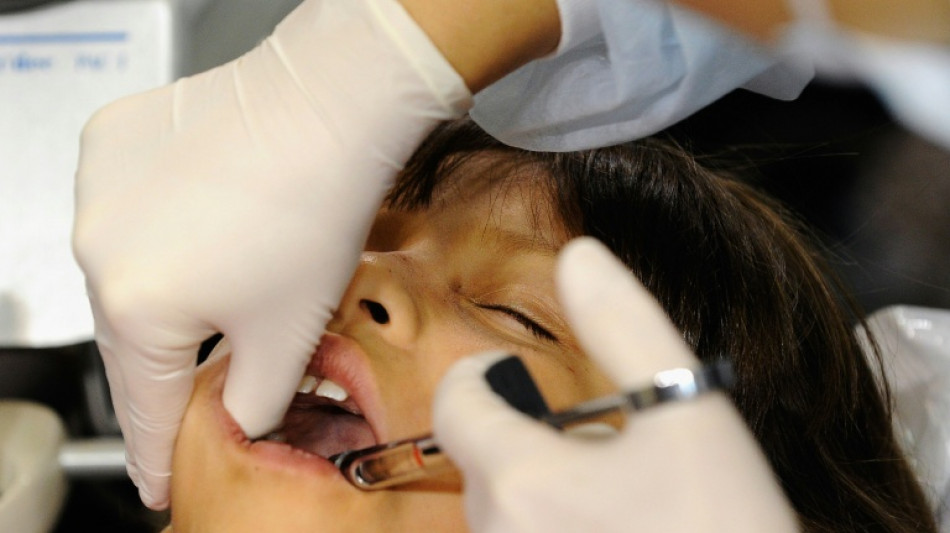
Countries agree to end mercury tooth fillings by 2034 / Photo: KEVORK DJANSEZIAN - GETTY IMAGES NORTH AMERICA/AFP/File

 Drones hit Moscow as Russians go to the polls

 New England boss Fleming says 'wrong' to ask Stokes to end retirement

 Germans vote in elections threatening fresh blow to Merz

 US fears rapid escalation in Mideast after Houthis attack Riyadh

 Japan triathlete Hojo wins first gold of Asian Games

 IOC president impressed by 'beautiful' Asian Games wooden huts

 First Asian Games gold goes to Japan as China's 13-year-old Yu lights up pool

 Data centre command hub keeps AI up and running

 Pope Leo in France: the issues on the table

 Packing for a pope: behind the scenes on foreign trips

 Republicans find transgender issues a powerful political weapon in midterm campaigning

 German state elections threaten new shock waves for Merz

 Chile's Bachelet quits race to be next UN chief

 Raphinha treble fires perfect Barca to win at Sevilla

 Thiam makes winning heptathlon return at Decastar meet

 Czechs beat USA to qualify for Davis Cup finals

 Dortmund sink Stuttgart to climb to Bundesliga summit

 Trump says will not tolerate attempts to slow AI growth

 'It has to stop': runners protest women's murders in S.Africa district

 Fire erupts near Riyadh airport as Houthis claim strikes

 Cuba works to restore power after another blackout

 England thrash Sri Lanka again to return to top of T20 rankings

 Arsenal thrashed by Brighton, sorry Spurs lose again

 South Korea, Austria qualify for Davis Cup finals

 Seare shocks Ingebrigtsen to win world 5km gold

Countries agreed Friday to phase out the use of mercury-based dental amalgams in tooth fillings by 2034, in a move that will change how dentistry is done around the world.
At a conference in Geneva, signatories to a treaty aimed at protecting human health and the environment from mercury pollution decided to call time on mercury amalgams.
Nations agreed "to end the use of dental amalgam by 2034, marking a historic milestone in reducing mercury pollution", the conference announced in its closing statement.
The World Health Organization considers mercury one of the top 10 chemicals of major public health concern, calling it "toxic to human health".
Some countries have already banned its use in dental amalgam, a common filling material for treating tooth decay used for more than 175 years.
The Minamata Convention on Mercury is an international treaty to protect human health and the environment from the adverse effects of mercury and mercury compounds.
More than 150 countries are party to the convention, which was adopted in 2013 and came into force in 2017.
The sixth conference of parties to the treaty, held in Geneva this week, adopted amendments "establishing a global phase-out of dental amalgam by 2034", the closing statement said.
"This science-based, time-bound agreement marks a decisive step toward the total elimination of mercury use in dentistry and a safer future for all communities."
- African initiative -
The treaty already stipulated that signatories must take measures to phase out the use of mercury-based dental amalgams.
However, a bloc of African countries wanted to go further, with a ban on their production, import and export, starting in 2030.
In a video message as the conference opened on Monday, US Health Secretary Robert F. Kennedy Jr. asked why mercury was deemed "dangerous in batteries, in over-the-counter medications and make-up", but acceptable in dental fillings.
"It's inexcusable that governments around the world still allow mercury-based compounds in healthcare -- and safe alternatives exist," he said.
A few countries opposed the idea of a phase-out by 2030, including Iran and India, and Britain, which said it was too soon.
But countries came together and agreed a phase-out by 2034.
"We have just opened the door to another chapter of the mercury history book," said the convention's executive secretary Monika Stankiewicz.
"Mercury pollution is a scourge."
However, "by understanding one another and bridging our differences, we can make a difference in the lives of people everywhere, and indeed in the life of this beautiful planet we share".
The conference's president Osvaldo Alvarez Perez added: "We have set ambitious new goals, and left mercury a little further behind."
Overall, the conference adopted 21 decisions aimed at advancing the convention's objective of protecting human health and the environment from mercury pollution.
A.Motta--PC