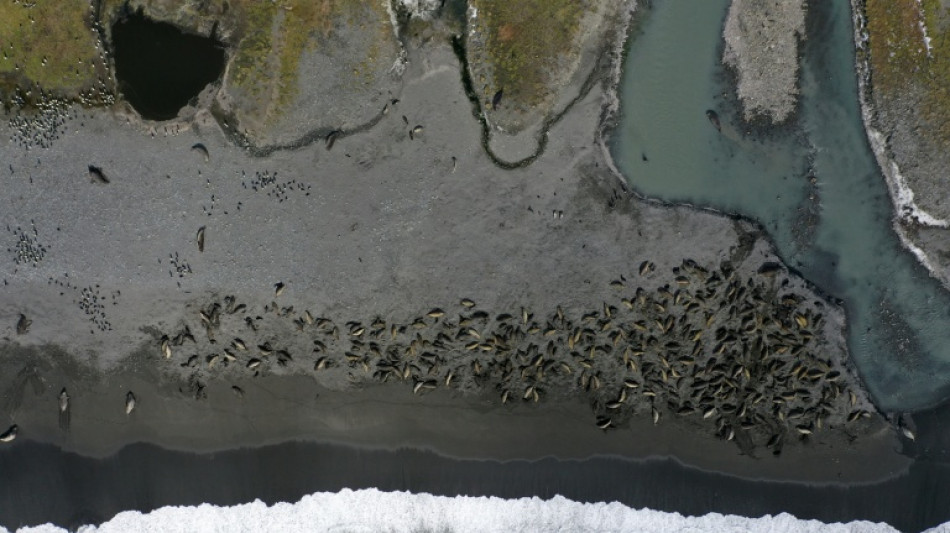
'Bleak' future for seals decimated by bird flu, scientists warn / Photo: Handout - BRITISH ANTARCTIC SURVEY/AFP

 Drones hit Moscow as Russians go to the polls

 New England boss Fleming says 'wrong' to ask Stokes to end retirement

 Germans vote in elections threatening fresh blow to Merz

 US fears rapid escalation in Mideast after Houthis attack Riyadh

 Japan triathlete Hojo wins first gold of Asian Games

 IOC president impressed by 'beautiful' Asian Games wooden huts

 First Asian Games gold goes to Japan as China's 13-year-old Yu lights up pool

 Data centre command hub keeps AI up and running

 Pope Leo in France: the issues on the table

 Packing for a pope: behind the scenes on foreign trips

 Republicans find transgender issues a powerful political weapon in midterm campaigning

 German state elections threaten new shock waves for Merz

 Chile's Bachelet quits race to be next UN chief

 Raphinha treble fires perfect Barca to win at Sevilla

 Thiam makes winning heptathlon return at Decastar meet

 Czechs beat USA to qualify for Davis Cup finals

 Dortmund sink Stuttgart to climb to Bundesliga summit

 Trump says will not tolerate attempts to slow AI growth

 'It has to stop': runners protest women's murders in S.Africa district

 Fire erupts near Riyadh airport as Houthis claim strikes

 Cuba works to restore power after another blackout

 England thrash Sri Lanka again to return to top of T20 rankings

 Arsenal thrashed by Brighton, sorry Spurs lose again

 South Korea, Austria qualify for Davis Cup finals

 Seare shocks Ingebrigtsen to win world 5km gold

The world's largest species of seal has been devastated by bird flu, which has wiped out half of all breeding females at a key wildlife haven near Antarctica, scientists warned Thursday.
The remote island of South Georgia is the home of a majority of all southern elephant seals. Males of these blubbery giants can grow up to two metres (six feet seven inches) long, weigh nearly four tonnes (8,800 pounds) -- and have a distinctive elephant-trunk-like proboscis on their face that earned the mammals their name.
Bird flu arrived on South Georgia in 2023 during an outbreak that has seen the virus spread across the world like never before, killing millions of birds and infecting many mammals, including several humans.
Earlier this year, scientists warned that bird flu had sparked the worst die-off on record for southern elephant seals when it spread among a population on Argentina's coast in 2023.
In a study published in the journal Communications Biology on Thursday, a UK team of researchers gave the first estimate for how hard South Georgia's seals have been hit.
"It paints a pretty stark and harrowing picture," Connor Bamford, a marine ecologist at the British Antarctic Survey and lead author of the study, told AFP.
According to the last count in 1995, South Georgia is home to 54 percent of all southern elephant seals.
On the same day of the year in 2022 and 2024, the scientists used hand-launched drones to take images of the island's three biggest breeding beaches.
After bird flu arrived, the number of breeding females plummeted by 47 percent, a loss of around 53,000 seals, according to the study.
- Sick mothers abandoning pups -
Many pups also died on the beach after being abandoned by their bird-flu-infected mothers.
Scientists at the breeding ground on the Valdes Peninsula along Argentina's coast have determined that 97 percent of elephant seal pups died either from being abandoned or contracting bird flu in 2023.
On the peninsula, an even higher rate of breeding females -- 67 percent -- were estimated to have been wiped out.
"If the South Georgia population responds similarly to the modelled outlook at Peninsula Valdes, the future is bleak," the authors of the new study said.
However, Bamford did not think the elephant seals would be pushed "close to extinction".
The South Georgia population is much larger -- numbering in the hundreds of thousands -- so is likely to be more resilient, he said.
"That being said, the impacts to this population will be felt for many years to come," he added.
For the Valdes seals, scientists have estimated that the aftermath of this bird flu outbreak will likely reverberate until the end of the century.
The researchers believe that the seals are transmitting the virus to each other via water droplets, Bamford said.
While elephants spend most of their time in the water, they breed in densely packed colonies on wide, sandy beaches.
"There are thousands of them together, all coughing and splattering," Bamford said, adding that the seals are also particularly "snotty".
The scientist called for "regular check-ups" on South Georgia's elephant seals.
O.Gaspar--PC