'HIV-free generations': prevention drug rollout brings hope to South Africa
/ Photo: Ihsaan Haffejee - AFP

 Germans vote in elections threatening fresh blow to Merz

 US fears rapid escalation in Mideast after Houthis attack Riyadh

 Japan triathlete Hojo wins first gold of Asian Games

 IOC president impressed by 'beautiful' Asian Games wooden huts

 First Asian Games gold goes to Japan as China's 13-year-old Yu lights up pool

 Data centre command hub keeps AI up and running

 Pope Leo in France: the issues on the table

 Packing for a pope: behind the scenes on foreign trips

 Republicans find transgender issues a powerful political weapon in midterm campaigning

 German state elections threaten new shock waves for Merz

 Chile's Bachelet quits race to be next UN chief

 Raphinha treble fires perfect Barca to win at Sevilla

 Thiam makes winning heptathlon return at Decastar meet

 Czechs beat USA to qualify for Davis Cup finals

 Dortmund sink Stuttgart to climb to Bundesliga summit

 Trump says will not tolerate attempts to slow AI growth

 'It has to stop': runners protest women's murders in S.Africa district

 Fire erupts near Riyadh airport as Houthis claim strikes

 Cuba works to restore power after another blackout

 England thrash Sri Lanka again to return to top of T20 rankings

 Arsenal thrashed by Brighton, sorry Spurs lose again

 South Korea, Austria qualify for Davis Cup finals

 Seare shocks Ingebrigtsen to win world 5km gold

 Brigitte Bardot widower slams sale of star's belongings

 Aston Villa compound Tottenham's misery despite late rally

Kegoratile Aphane did not flinch when the needle pierced the skin of her right buttock, injecting a yellow-coloured drug touted as a revolution that could end the HIV pandemic.
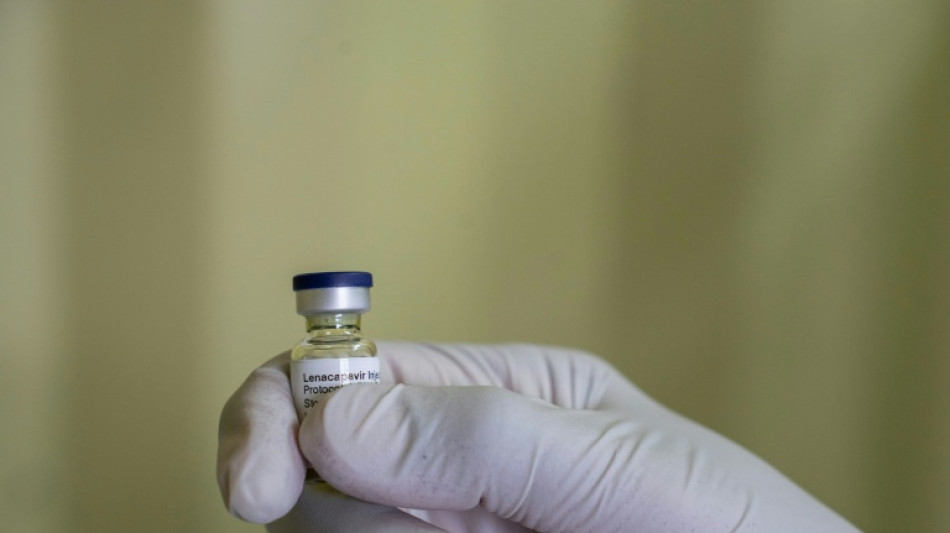
The 32-year-old was among the very first South Africans -- and Africans -- to receive a dose of lenacapavir, a drug taken twice a year that has been shown to reduce the risk of HIV transmission by more than 99.9 percent, making it functionally akin to a powerful vaccine.
"I didn’t even feel any pain," she said with a relieved smile after receiving the two injections that form the first dose.
Five other patients received lenacapavir Tuesday at a clinic outside of Pretoria as part of an implementation study by a Wits University research unit and funded by the international health agency Unitaid, which works on ensuring equitable access to medical innovations.
The study would enrol 2,000 people and "follow them for at least a year to understand how this prevention option works in real life", according to the Wits Reproductive Health and HIV Institute (RHI)'s Saiqa Mullick.
- 'Life-changing' -
With close to one in five adults living with HIV, South Africa has one of the highest rates in the world, and reported last year the highest number of new infections for any single country -- 170,000.
Until now, the best available prevention drug for HIV-negative people was through a daily pill.
The twice-yearly lenacapavir jab would be "life-changing", said the clinic’s manager Magdaline Ngwato, especially for young people who struggled to maintain the daily schedule of the pill and groups like sex workers or LGBTQ patients who wanted to be discreet.
"Now with the injection it will be fine, because you can do it secretly," she told AFP, adding that many people had already expressed interest.
"Even mothers said they will send their children to come get it," Ngwato enthused. "I think we are going to have a lot of HIV-free generations."
For Aphane, the decision to take the groundbreaking treatment was deeply personal.
"I just lost my mom in 2021 -- she was HIV positive," she told AFP with emotion.
"It's a very, very, very painful disease. So that's why I (am) so serious about this. Let me be safe and try this."
Twenty-year-old student Katlego, who asked to speak under a pseudonym, was "proud" to have received one of the very first doses.
A broader national rollout is expected next year, starting with 400,000 doses that would be received through a deal between lenacapavir's manufacturer Gilead Sciences and the Global Fund to Fight AIDS.
While lenacapavir currently costs around $28,000 a year in the United States, generic versions are expected to be available from 2027 at around $40 per year in more than 100 countries through agreements by Unitaid and the Gates Foundation with Indian pharmaceutical companies.
The rollout could usher in a different world for Aphane's daughters and future grandchildren, she said.
"The more they introduce, the more they talk about it, the more they show (it) everywhere, it will save lives," she said.
G.M.Castelo--PC