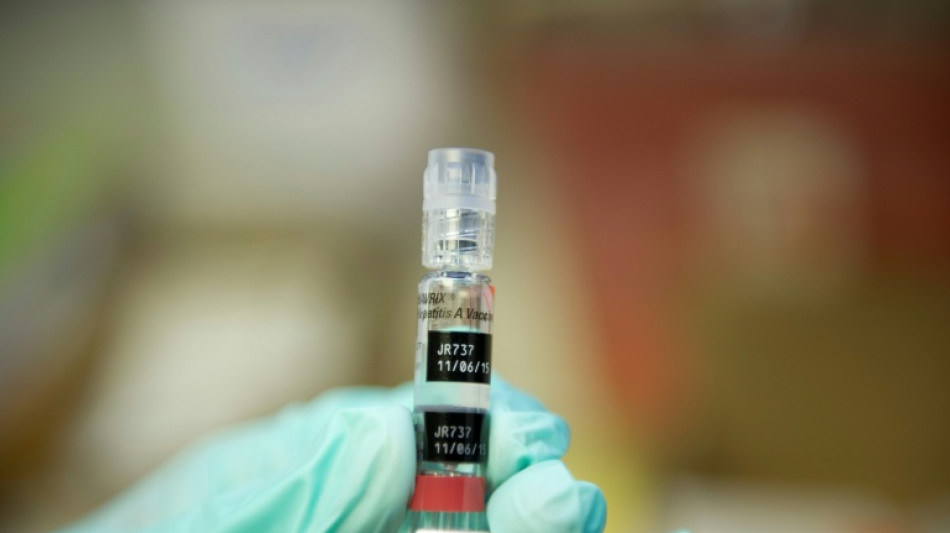
Hepatitis B vaccine for newborns faces scrutiny in US / Photo: ROBYN BECK - AFP/File

 Germans vote in elections threatening fresh blow to Merz

 US fears rapid escalation in Mideast after Houthis attack Riyadh

 Japan triathlete Hojo wins first gold of Asian Games

 IOC president impressed by 'beautiful' Asian Games wooden huts

 First Asian Games gold goes to Japan as China's 13-year-old Yu lights up pool

 Data centre command hub keeps AI up and running

 Pope Leo in France: the issues on the table

 Packing for a pope: behind the scenes on foreign trips

 Republicans find transgender issues a powerful political weapon in midterm campaigning

 German state elections threaten new shock waves for Merz

 Chile's Bachelet quits race to be next UN chief

 Raphinha treble fires perfect Barca to win at Sevilla

 Thiam makes winning heptathlon return at Decastar meet

 Czechs beat USA to qualify for Davis Cup finals

 Dortmund sink Stuttgart to climb to Bundesliga summit

 Trump says will not tolerate attempts to slow AI growth

 'It has to stop': runners protest women's murders in S.Africa district

 Fire erupts near Riyadh airport as Houthis claim strikes

 Cuba works to restore power after another blackout

 England thrash Sri Lanka again to return to top of T20 rankings

 Arsenal thrashed by Brighton, sorry Spurs lose again

 South Korea, Austria qualify for Davis Cup finals
 Seare shocks Ingebrigtsen to win world 5km gold

 Brigitte Bardot widower slams sale of star's belongings

 Aston Villa compound Tottenham's misery despite late rally

Experts appointed by the Trump administration's vaccine-skeptic Health Secretary Robert F. Kennedy Jr are expected to review newborn hepatitis B vaccines on Thursday, considering whether to delay the shots despite opposition from many doctors.
The newly anointed Advisory Committee on Immunization Practices (ACIP) members are slated to meet for two days in Atlanta, Georgia, to follow-up on a September meeting that resulted in new recommendations for Covid-19 and measles vaccinations.
Under Kennedy, ACIP has initiated a broad review of the safety of several vaccines, some of which have been in use for decades.
The shift led by the nation's health chief -- who has long voiced anti-vaccine rhetoric despite his lack of medical credentials -- is causing alarm in the American medical and scientific community.
Experts have warned about dropping immunization rates and the return of deadly contagious diseases like the measles, which caused several deaths in 2025.
"Any changes this ACIP makes will certainly not be based in facts or evidence, but rather ideology," said Sean O'Leary, an infectious disease and pediatric specialist who has been critical of the lack of qualifications among the committee's new members.
- First 24 hours -
Since 1991, US health officials have recommended the administration of the hepatitis B vaccine for newborn infants, as the viral liver disease exposes infected individuals to a high risk of death from cirrhosis or liver cancer.
"Ninety percent of babies infected with hepatitis B will go on to have chronic liver disease. Of those, a quarter will die from their hepatitis B infection. These are entirely preventable deaths," O'Leary said.
But anti-vax groups and President Donald Trump alike have pushed back on the practice, with Trump insisting in September that children should not be vaccinated against hepatitis B until the age of 12, rather than soon after birth, saying: "Hepatitis B is sexually transmitted. There's no reason to give a baby that's almost just born hepatitis B."
Medical experts condemned Trump's assertions, saying newborns can be infected by their mother during pregnancy or childbirth, and delaying vaccines would lead to lower vaccination rates overall because of inconsistent access to medical care in the United States.
An analysis published by a team of researchers from the University of Minnesota this week looked at more than 400 studies, concluding there was no benefit to delaying the hepatitis B vaccine, but there are "critical risks of changing current US recommendations."
- Loss of trust -
The repercussions of the ACIP's vaccine recommendations are broad because the federal guidelines often dictate whether vaccines are paid for by health insurance in the United States, where childbirth can be a major expense and the price of a single vaccine can be hundreds of dollars.
But the committee's influence is waning amid withering criticism from the American scientific and medical community, with Democratic-led states announcing they will no longer follow its recommendations.
"States are forming their own advisory committees because they don't trust anything that's going on under the auspices of Robert F. Kennedy Jr, who is an avowed anti-vaccine activist and science denialist," pediatrician Paul Offit told AFP.
"Everybody that watches the ACIP meetings just holds their breath, waiting to see what dangerous thing they advance next."
S.Pimentel--PC