US vaccine panel upends hepatitis B advice in latest Trump-era shift / Photo: ANDREW CABALLERO-REYNOLDS - AFP

 Germans vote in elections threatening fresh blow to Merz

 US fears rapid escalation in Mideast after Houthis attack Riyadh

 Japan triathlete Hojo wins first gold of Asian Games

 IOC president impressed by 'beautiful' Asian Games wooden huts

 First Asian Games gold goes to Japan as China's 13-year-old Yu lights up pool

 Data centre command hub keeps AI up and running

 Pope Leo in France: the issues on the table

 Packing for a pope: behind the scenes on foreign trips

 Republicans find transgender issues a powerful political weapon in midterm campaigning

 German state elections threaten new shock waves for Merz

 Chile's Bachelet quits race to be next UN chief

 Raphinha treble fires perfect Barca to win at Sevilla

 Thiam makes winning heptathlon return at Decastar meet

 Czechs beat USA to qualify for Davis Cup finals

 Dortmund sink Stuttgart to climb to Bundesliga summit

 Trump says will not tolerate attempts to slow AI growth

 'It has to stop': runners protest women's murders in S.Africa district

 Fire erupts near Riyadh airport as Houthis claim strikes

 Cuba works to restore power after another blackout

 England thrash Sri Lanka again to return to top of T20 rankings

 Arsenal thrashed by Brighton, sorry Spurs lose again

 South Korea, Austria qualify for Davis Cup finals

 Seare shocks Ingebrigtsen to win world 5km gold

 Brigitte Bardot widower slams sale of star's belongings

 Aston Villa compound Tottenham's misery despite late rally

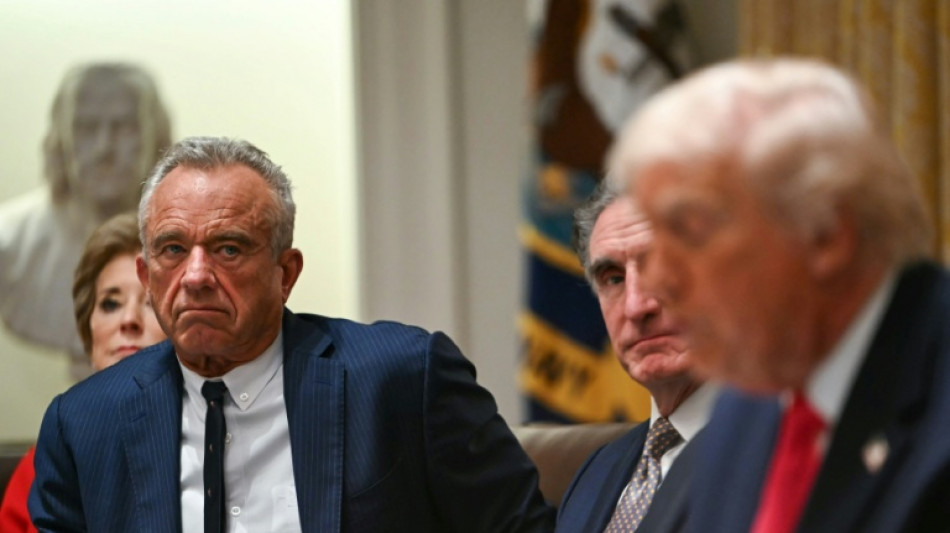
An advisory panel appointed by the Trump administration's vaccine-skeptic health secretary voted Friday to stop recommending that all newborns in the United States receive a hepatitis B vaccine.
The move to end the decades-old recommendation is the panel's latest contentious about-face on vaccine policy since its overhaul by Health Secretary Robert F. Kennedy Jr. earlier this year.
US health authorities previously recommended all babies, not just those born to mothers believed to have hepatitis B, receive the first of three vaccine doses just after birth.
The approach aimed, in part, to prevent transfers from mothers who unknowingly had hepatitis B or had falsely tested negative, and had virtually eradicated infections of the potentially deadly liver disease among young people in the country.
After delaying the vote by a day, the panel on Friday passed its new recommendation for "individual-based decision-making," in consultation with a health care provider, when children are born to mothers testing negatively for the disease.
The decision to vaccinate at birth should "consider vaccine benefits, vaccine risks, and infection risks."
The new recommendation was immediately condemned by several medical groups who noted widespread shortcomings in US maternal health screening as well as the possibility of infections from others.
"This irresponsible and purposely misleading guidance will lead to more hepatitis B infections in infants and children," American Academy of Pediatrics President Susan J. Kressly said in a statement.
The vote was 8-3. Trump-appointed officials at the Centers for Disease Control and Prevention (CDC) are expected to formally adopt the recommendations at a later date.
The panel also voted to recommend that babies who are not vaccinated at birth wait at least two months to get the initial dose, and that blood tests be done to measure antibodies before a second dose.
- Panel overhaul -
After becoming health secretary, Kennedy sacked every member of the once-staid Advisory Committee on Immunization Practices (ACIP), replacing them with figures whose vaccine-skeptic views track more closely with his own.
It has since set to work on reviewing prior recommendations -- already tweaking advice on Covid-19 and measles shots.
Medical experts fear the push could further contribute to declining vaccination rates in the United States.
The panel on Friday also began a broader review of the childhood vaccination schedule, and sparked further controversy by allowing testimony from lawyer Aaron Siri, a close Kennedy associate known for spreading unfounded theories on the subject.
While US President Donald Trump vocally supports Kennedy's policies, some in the Republican Party have pushed back, notably Louisiana Senator Bill Cassidy.
Medical doctor Cassidy condemned the ACIP decision on Friday, noting the original recommendation was never "a mandate" to get the jab.
CDC officials "should not sign these new recommendations and instead retain the current, evidence-based approach," he said on X.
Cassidy's expression of alarm, like his prior statements against Kennedy, provoked criticism after he provided the key vote to confirm the health secretary in February.
- 'Do no harm' -
The United States had urged universal vaccination at birth against hepatitis B since 1991, advice also recommended by China, Australia and the World Health Organization.
But several ACIP members argued Friday's decision would align the United States with other economically developed countries such as France and Britain.
The repercussions of the ACIP's vaccine recommendations are broad because federal guidelines often dictate whether vaccines are paid for by health insurance companies in the United States, where a vaccine can cost hundreds of dollars.
But the committee's influence is waning amid withering criticism from the US scientific and medical community, with Democratic-led states announcing they will no longer follow its recommendations.
Ahead of the vote, Dr. Cody Meissner, one of the few dissenting voices on the advisory committee, urged his colleagues not to change the current recommendations.
"Do no harm is a moral imperative. We are doing harm by changing this wording," he warned.
M.Gameiro--PC