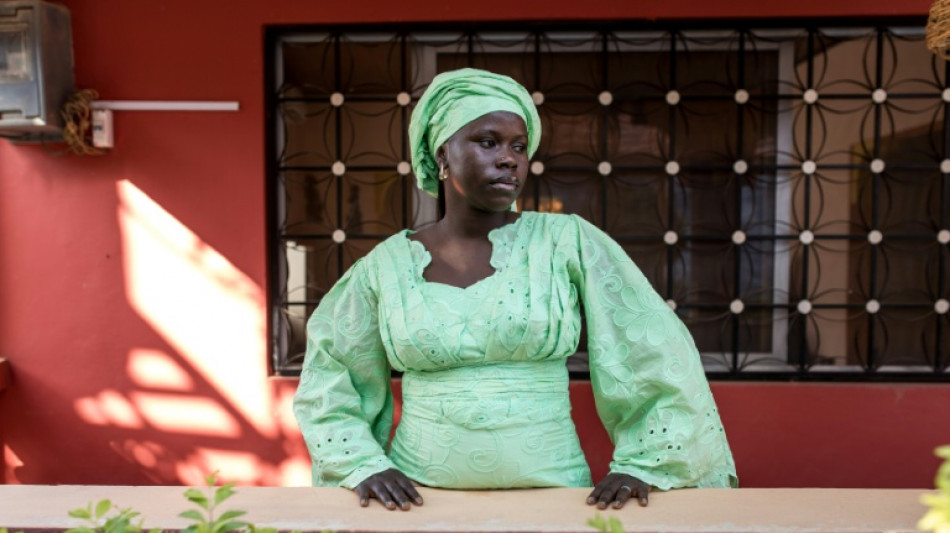
'Everything was removed': Gambians share pain with FGM ban in balance / Photo: MUHAMADOU BITTAYE - AFP

 Germans vote in elections threatening fresh blow to Merz

 US fears rapid escalation in Mideast after Houthis attack Riyadh

 Japan triathlete Hojo wins first gold of Asian Games

 IOC president impressed by 'beautiful' Asian Games wooden huts

 First Asian Games gold goes to Japan as China's 13-year-old Yu lights up pool

 Data centre command hub keeps AI up and running

 Pope Leo in France: the issues on the table

 Packing for a pope: behind the scenes on foreign trips

 Republicans find transgender issues a powerful political weapon in midterm campaigning

 German state elections threaten new shock waves for Merz

 Chile's Bachelet quits race to be next UN chief

 Raphinha treble fires perfect Barca to win at Sevilla

 Thiam makes winning heptathlon return at Decastar meet

 Czechs beat USA to qualify for Davis Cup finals

 Dortmund sink Stuttgart to climb to Bundesliga summit

 Trump says will not tolerate attempts to slow AI growth

 'It has to stop': runners protest women's murders in S.Africa district

 Fire erupts near Riyadh airport as Houthis claim strikes

 Cuba works to restore power after another blackout

 England thrash Sri Lanka again to return to top of T20 rankings

 Arsenal thrashed by Brighton, sorry Spurs lose again

 South Korea, Austria qualify for Davis Cup finals

 Seare shocks Ingebrigtsen to win world 5km gold

 Brigitte Bardot widower slams sale of star's belongings

 Aston Villa compound Tottenham's misery despite late rally
Fatou Sanyang still experiences extreme pain she says feels like "hot water is being poured on me" decades after undergoing female genital mutilation (FGM) as a girl in The Gambia.
The procedure, which involves total or partial removal of girls' external genitalia, ignites strong passions in the tiny west African nation. And it made headlines last year after the death of two babies.
FGM is recognised as a human rights violation by the UN and World Health Organisation.
Nevertheless, religious traditionalists hope to overturn a rarely enforced 2015 ban. The case they brought before the Supreme Court in December is due to resume any day now.
The court battle pits Islamic leaders who maintain FGM is an important religious and cultural freedom against those who point to the damage wrought to women's health, sexuality and well-being.
- 'Everything was removed' -
At age six, Sanyang was told she was going to visit family. Instead she ended up at an unknown location "filled up with old women", traditional cutters in Gambian society.
During the procedure "everything was removed", the 30-year-old said, referring to her external genitalia.
Blindfolded, she did not at first understand what was happening.
But she could hear "the sound of cries of other girls that were also there", she told AFP from her home in the city of Brikama, some 40 kilometres (25 miles) from Banjul.
Now "I feel a very big pain when I'm seeing my menstruation first," she said.
"And again, when I'm having intimacy with my husband at some point I feel like hot water is being poured on me."
Generally performed on minors, FGM can lead to infections, bleeding, urinary problems, sexual issues, childbirth complications and even death.
The Gambia has one of the world's highest FGM rates: 73 percent of females age 15 to 49 reported having undergone the procedure in a 2020 survey, according to UNICEF.
Yet fewer than a dozen cases have been prosecuted since 2015, with the first convictions only occurring in 2023.
- Bleeding to death -
As a child in the 1990s, Jaha Dukureh watched her one-week-old sister bleed to death from FGM.
"She started getting pale, we took her to the hospital, but, you know, by then she had already bled too much", Dukureh, who now lives in the United States, told AFP.
Today she is a regional UN Women ambassador for Africa and the founder of the non-profit Safe Hands for Girls. Due to unrelenting harassment however, she has pivoted to working at an AI and genomics tech firm.
The World Health Organization classifies FGM into types, which range from removal of part of the clitoris, to removal of the clitoris and labia, to narrowing of the vaginal opening by cutting and repositioning the labia with or without clitoris removal.
Dukureh is a member of the Soninke tribe, which she says practises the latter type due to "conservative" values centred on virginity. When married, a woman is cut back open.
"They cut you open with no anaesthesia, and then they tell your husband that he has to force his way through in the same day so you don't end up getting resealed again", said Dukureh, who was married off to an older man at the age of 15.
- 'Religious freedom' -
Activist Mariama Fatajo, 28, suffered two tears due to FGM during the birth of her two children. They were so severe she wants no more babies.
Decriminalising FGM would be "traumatic" as a survivor, especially because it would no longer be "protecting young girls", she said.
Although some of the 30 countries in Africa, the Middle East and Asia where FGM is practised have criminalised it, overturning a ban is virtually unheard of.
In The Gambia's first-ever successful prosecution against FGM in 2023, a traditional cutter and two mothers plead guilty in a case that provoked a national backlash.
Afterwards lawmaker Almameh Gibba introduced legislation in Parliament to decriminalize FGM, which failed in a July 2024 vote. So he and other plaintiffs turned to the Supreme Court.
Kalipha Dampha, an imam at the Gambia Supreme Islamic Council, which oversees Islamic religious matters in the country, supports the case.
"Female circumcision is part of our religious beliefs. Whoever blocks it -- you block our religious freedom," he told AFP from the headquarters in Kanifing, west of Banjul.
"Everything in Islam is based on cleanliness" which he said included "circumcision, be it a man or a woman".
Oumie Jagne, programme coordinator at Gambia-based NGO Think Young Women, rejects that argument.
"FGM is not a religious requirement, neither is it an obligation" under Islam, she said.
With international advocacy seen by many as an imposition of foreign values, Dukureh believes that patient dialogue by Gambians with such imams and others is key.
"If I'm trying to change societal norms and mindsets around a particular issue that is as entrenched as FGM is, I cannot only talk to people who agree with me", she said.
F.Moura--PC