Melting glaciers, fast-disappering gauge of climate change

 Trump's beef policies irk Texas ranchers, testing their loyalty

 Nvidia, OpenAI CEOs to attend Xi dinner at White House

 Anthropic picks Accenture for in-house AI safety evaluation

 Balogun returns as Monaco beat Lens to continue strong Ligue 1 start

 'Pause' on overt repression in Venezuela, but reforms still needed: HRW

 Global stocks mixed as yen falls despite Bank of Japan rate hike

 Cuba hit with seventh major blackout of the year

 Murray out with concussion so Wentz will start for Vikings

 UN chief 'deeply regrets' US visa refusal to Abbas for annual meeting

 England quick Carse to face no charges over alleged nightclub assault

 Mancini brings nine newcomers into the first squad of his Italy comeback

 Czechs level Davis Cup tie against USA as South Korea eye Finals

 New France boss Zidane confirms Mbappe as captain after naming first squad

 California governor signs order to explore AI 'kill switch'

 Head leads run spree as Australia win Zimbabwe ODI series

 In-form Raphinha wants to finish career at Barcelona

 Warren Buffett steps down as Berkshire Hathaway chairman

 Carrick confident Man Utd can 'work through' tough time

 Mbappe ends Nike partnership to join Swiss brand On

 Liverpool boss Iraola puts Bournemouth love affair on hold

 'A disaster' if Man City do not win says Maresca after flawless start

 Kerry James Marshall: American 'blackness' painter celebrated in Europe

 Spain coach De la Fuente offers 'full support' to people of Ceuta

 Russia seizes assets of Nestle, French firms over West's Ukraine support
 England can build on World Cup 'spirit', says Tuchel

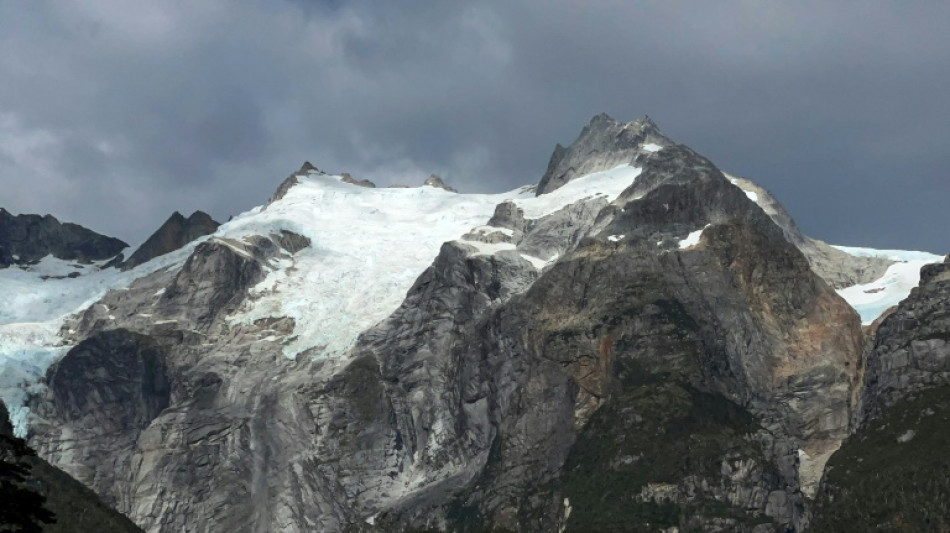
A crack widens in the San Rafael glacier in Chile's extreme south, and a ten-storey iceberg crashes into the lake by the same name -- a dramatic reminder of the impacts of global warming.
In the lake San Rafael, about 100 icebergs float today, pieces broken off from the glacier that 150 years ago stretched out over two-thirds of the body of water now free of ice cover.
The San Rafael glacier is one of 39 in the Northern Patagonian Ice Field (3,500 square kilometers or 1,350 square miles), which with the Southern Patagonian Ice Field (11,000 km2) in Chile's Aysen region forms one of the world's biggest ice masses.
According to the European Space Agency satellite images show San Rafael to be one of the world's most actively calving glaciers and the fastest-moving in Patagonia, "flowing" at a speed of about 7.6 kilometers (4.7 miles) per year -- "receding dramatically under the influence of global warming."
Glaciers are bodies of slowly-moving ice on land that can be several hundred or several thousand years old.
Seasonal glacier melt is a natural phenomenon that with global warming has accelerated "significantly," Jorge O'Kuinghttons, a regional head of glaciology at Chile's water directorate, told AFP.
- 'Excellent indicator' -
At the moment, Patagonia's glaciers are retreating faster than anywhere else in the world.
"Glaciers are an excellent indicator of climate change," said Alexis Segovia, another government glaciologist who works in the remote region of southern Chile.
All but two of Chile's 26,000 glaciers are shrinking, he said, due to rising temperatures caused by manmade greenhouse gas emissions.
It is a vicious cycle.
Ice-covered surfaces of Earth reflect excess heat back into space, and if these are reduced through melting, temperatures rise even more.
Melting glaciers also add to sea level rise, which increases coastal erosion and elevated storm surges.
And water dammed by glaciers can be released by a sudden collapse.
"Areas are being flooded these days that were never flooded before," said O'Kuinghttons.
To learn more about what to expect in the future, glaciologists study the evolution of Chile's glaciers, which contain a frozen record of how the climate has changed over time.
According to the WWF, more than a third of the world's remaining glaciers will melt before 2100 even if mankind manages to curb emissions from the burning of fossil fuels.
- The heat is 'strong' -
East of San Rafael, on the lake General Carrera that is shared by Chile and Argentina, small-scale sheep and cattle farmer Santos Catalan has been living on the forefront of the change.
To augment his income, he criss-crosses the lake in a wooden boat with glacier-watching tourists.
Over the last 15 to 20 years, he told AFP, the landscape has become a lot less white as the ice has melted and snow dwindled.
"Things have changed a lot," he said. "The heat is very strong."
A.Silveira--PC



