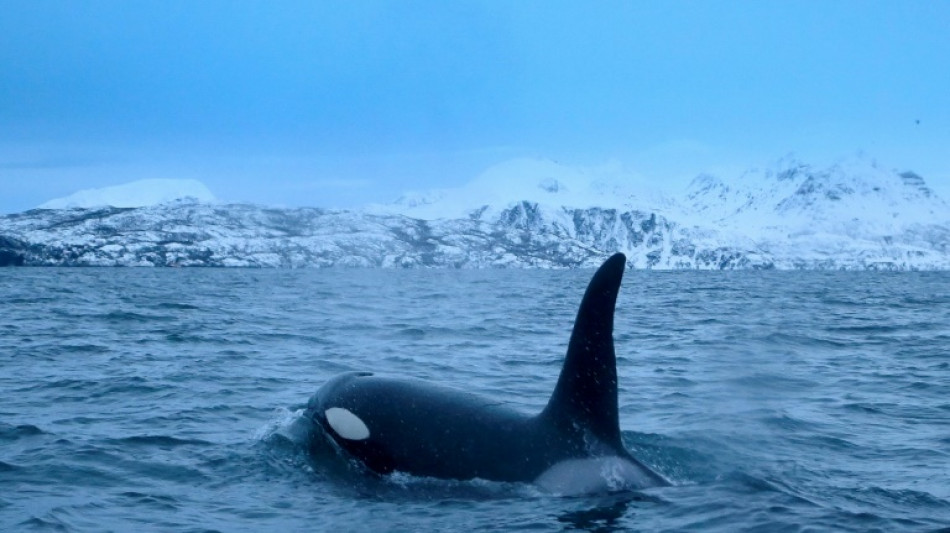
'Surgical' shark-killing orcas fascinate off South Africa / Photo: Olivier MORIN - AFP

 Ed Sheeran returns to stage after Palestinian controversy

 Asian Games to open in Japan after troubled build-up

 Drone owners rush to offload devices ahead of Beijing ban

 Trump's beef policies irk Texas ranchers, testing their loyalty

 Nvidia, OpenAI CEOs to attend Xi dinner at White House

 Anthropic picks Accenture for in-house AI safety evaluation

 Balogun returns as Monaco beat Lens to continue strong Ligue 1 start

 'Pause' on overt repression in Venezuela, but reforms still needed: HRW

 Global stocks mixed as yen falls despite Bank of Japan rate hike

 Cuba hit with seventh major blackout of the year

 Murray out with concussion so Wentz will start for Vikings

 UN chief 'deeply regrets' US visa refusal to Abbas for annual meeting

 England quick Carse to face no charges over alleged nightclub assault

 Mancini brings nine newcomers into the first squad of his Italy comeback

 Czechs level Davis Cup tie against USA as South Korea eye Finals

 New France boss Zidane confirms Mbappe as captain after naming first squad

 California governor signs order to explore AI 'kill switch'

 Head leads run spree as Australia win Zimbabwe ODI series

 In-form Raphinha wants to finish career at Barcelona

 Warren Buffett steps down as Berkshire Hathaway chairman

 Carrick confident Man Utd can 'work through' tough time

 Mbappe ends Nike partnership to join Swiss brand On

 Liverpool boss Iraola puts Bournemouth love affair on hold

 'A disaster' if Man City do not win says Maresca after flawless start

 Kerry James Marshall: American 'blackness' painter celebrated in Europe

Scores of disembowelled sharks have washed up on a South African beach putting the spotlight on a pair of shark-hunting killer whales whose behaviour has fascinated scientists and wildlife enthusiasts.
Marine biologists were alerted to the find by beach walkers who stumbled upon the grim sight last week in Gansbaai, a small fishing port 150 kilometres (93 miles) south east of Cape Town.
"The dead sharks are torn open at the pelvic girdle, they have Orca teeth marks known as rake marks on their pectoral fins and their liver is missing," said Alison Towner, 37, a shark scientist with the Dyer Island Conservation Trust.
All evidence points to "Port" and "Starboard", an infamous pair of killer whales spotted off Gansbaai only three days earlier.
Recognisable by their twisted dorsal fins, the animals are well known to locals, who have developed a penchant for sharks.
"We found in total 20 sharks," said Ralph Watson, 33, a marine biologist with local conservation and diving group Marine Dynamics.
Victims included 19 broad nosed seven-gill and one spotted gully sharks, he added.
Towner said the slaughter was noticeable as it was the first time that Port and Starboard had hunted those species in the area and "so many of them washed out after one visit."
Yet, it wasn't the orcas' most daring hunt.
Experts credited the duo with having caused white sharks, one of the world's largest sea predators, to disappear from some of the waters near Cape Town.
Last year, Starboard and another four orcas were captured on camera chasing and killing a great white off Mossel Bay, a southern port town.
- Unusual behaviour -
The unusual behaviour had never been witnessed in detail before.
Orcas, the ocean's apex predator, usually hunt dolphins in these parts and have been known to prey on smaller shark species. But evidence of attacks on great whites was previously limited.
Port and Starboard were first spotted near Cape Town in 2015.
"They probably came from somewhere else. West Africa, east Africa, the Southern Ocean, we don't know," said 45-year-old Simon Elwen, who heads Sea Search, a scientific collective.
Unlike other killer whales, the pair likes to hunt near the coast -- something that has made their peculiar fins a common sight in the region.
"Within southern Africa, Port and Starboard have been seen from as far west as Namibia to as far east as Port Elizabeth," said Elwen.
The marine mammals' killing technique is "surgical", added Watson, explaining the pair targets sharks' liver, "a very nutritious organ, full of oils."
"They tear open the pectoral girdle chest area... then the liver flops out," said Watson.
The 2022 video showing Starboard in action has worried biologists, for it suggested the practice was spreading with studies having established that the black and white animals have the capacity to teach hunting techniques.
Some Antarctic orcas use the cunning tactic of hunting in packs and making waves to wash seals off floating ice, according to researchers.
In the Antarctic two orca populations -- not subspecies, but different groups that overlap at the margins -- used very different hunting techniques, taught across generations.
Such behaviour is not hard-wired, but learned -- one of the arguments for suggesting that whales have 'culture'.
In the clip, the other four orcas shown were not known to have attacked white sharks before.
"This is now an additional threat to shark populations on coastal South Africa," said Towner.
Elwen said it was "fascinating, and frustrating" to see "a rare, endangered animal killing another endangered species".
Still, the overall danger Port and Starboard posed to South Africa's shark population remained very limited.
Hundreds of thousands of sharks are fished out of the sea every year, said Watson.
"Two killer whales are not going to wipe out a species," Elwen said.
A.Magalhes--PC