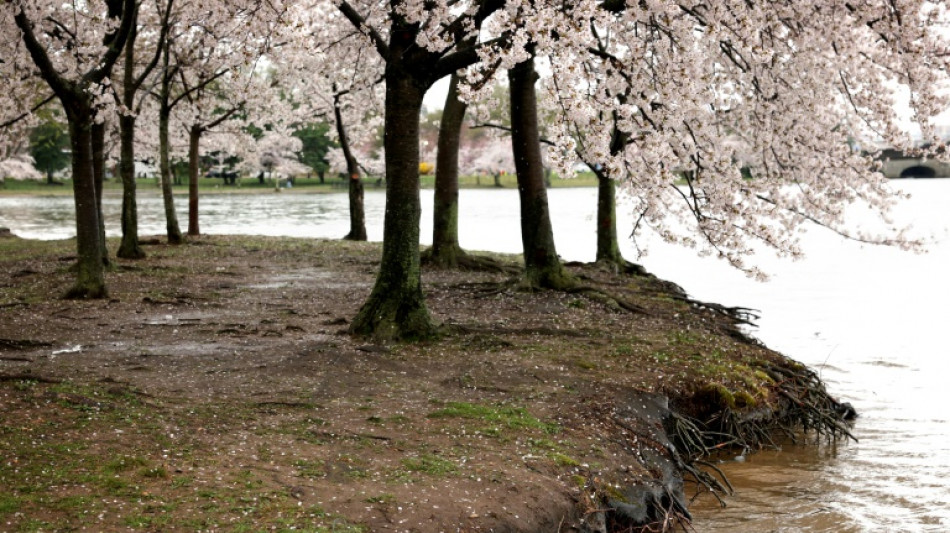
Living near green space makes you 2.5 years younger: study / Photo: ALEX WONG - GETTY IMAGES NORTH AMERICA/AFP

 Indians living in Japan on stand-by to house Asian Games athletes
 Trump signs bill authorizing sweeping Russia sanctions

 Protesters form human chain at Kennedy Center after Trump threat

 Death toll from attack at police HQ in Pakistan rises to 31

 Trump says Denmark to give US 'permanent control' over Greenland security

 Kennedy Center: future unclear for iconic Washington arts hub

 Trump claims 'infinite' Greenland security deal with Denmark

 Helicopters battle wildfire threatening Ecuador's capital

 Brentford batter Chelsea to undo Alonso's promising start

 Kane hits Bundesliga century as Bayern rout Union

 Trump says CNN, MS NOW, Politico banned from White House

 Hushing and hedging: US companies retreat on climate

 Springboks to face Fiji before 2027 Rugby World Cup

 Nigeria miners struggled to breathe in cell before 37 died: survivors

 McIlroy on the charge at PGA Championship as Reed withdraws

 McIlroy on the charge at PGA Championship

 Crisis-wracked Volkswagen warns of 10-bn-euro hit to profits

 Costa Rica's Grynspan tops third informal poll for UN chief: diplomat

 Stock markets retreat after central bank rate hikes

 Russia labels director of Cannes Grand Prix winner a 'foreign agent'

 Macron warns of Russian 'hybrid' threat after meeting presidential hopefuls

 UN holds third informal poll for new chief

 Kulusevski return can spark Spurs: De Zerbi

 Shakira to cap off world tour with Madrid 12-gig run

 Isolated Syrian-Druze city blames Damascus for shortages

City parks and green spaces help counter heat, boost biodiversity, and instill a sense of calm in the urban jungle.
They also help slow biological aging, with people who have access to green spaces found to be on average 2.5 years biologically younger than those who do not, according to a new study published Wednesday in Science Advances.
"Living near more greenness can help you be younger than your actual age," Kyeezu Kim, the study's lead author and a postdoctoral scholar at Northwestern University's Feinberg School of Medicine, told AFP.
"We believe our findings have significant implications for urban planning in terms of expanding green infrastructure to promote public health and reduce health disparities."
Exposure to green spaces has previously been linked with better cardiovascular health and lower rates of mortality.
It's thought that more physical activity and social interactions are at play, but whether parks actually slowed down aging on a cellular level has been unclear.
To investigate, the team behind the study examined DNA chemical modifications known as "methylation."
Prior work has shown that so-called "epigenetic clocks" based on DNA methylation can be a good predictor of health conditions such as cardiovascular disease, cancer, cognitive function, and a more accurate way of measuring age than calendar years.
Kim and colleagues followed more than 900 white and Black people from four American cities -- Birmingham, Chicago, Minneapolis, and Oakland -- over a period of 20 years, from 1986-2006.
Using satellite imaging, the team assessed how close the participants' residential addresses were to surrounding vegetation and parks, and paired this data with blood samples taken in years 15 and years 20 of the study, to determine their biological age.
The team constructed statistical models to evaluate the results, and control for other variables, such as education, income, and behavioral factors like smoking, that might have affected the results.
They found that people whose homes were surrounded by 30 percent green cover within a five kilometer (three mile) radius were on average 2.5 years younger biologically compared to those whose homes were surrounded by 20 percent green cover.
The benefits were not evenly shared. Black people with more access to green space were only one year biologically younger, while white people were three years younger.
"Other factors, such as stress, qualities of the surrounding green space, and other social support, can affect the degree of benefits of green spaces in terms of biological aging," said Kim, explaining the disparities required further study.
For example, parks in deprived neighborhoods used for illicit activities might be less frequented, negating the benefits.
Next steps might involve investigating the link between green spaces and specific health outcomes, she added. It's also not yet clear how exactly greenery reduces aging -- only that it does, added Kim.
Epidemiologist Manuel Franco, of the University of Alcala and Johns Hopkins, called the research a "well designed study."
"We have more and better scientific evidence to increase and promote the use of urban green spaces," added Franco, who was not involved in the study.
F.Cardoso--PC



