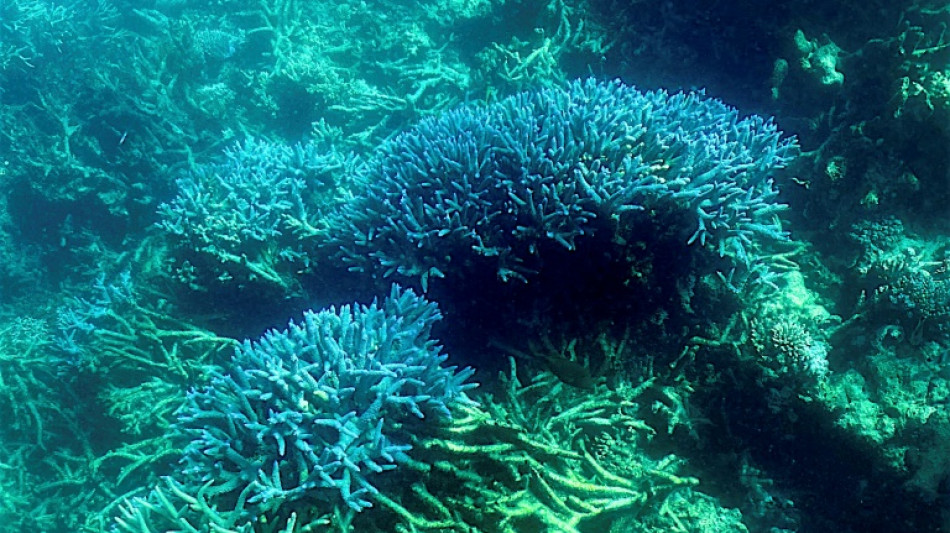
El Nino could imperil Australia's Great Barrier Reef / Photo: Glenn NICHOLLS - AFP

 Abdul El-Sayed declares victory in Michigan Senate contest

 Democrats capture US Congress in sweeping midterm victory

 Manchester United rallies past Roma as PSG dominates in Champions League

 Qatar sees tentative opening for renewed regional diplomacy

 Qatar Tourism joins Pacific Asia Travel Association at London travel market

 Abdul El-Sayed Wins Michigan Senate Seat in Historic Election

 Qatar media bodies discuss support for humanitarian initiatives

 Galloway accuser could not foresee publishing-sector fallout, lawyer argues

 New York City Center revives In the Heights as a timely community story

 Godzilla Minus Zero shifts focus toward postwar human drama
Australia's Great Barrier Reef could deteriorate if warming ocean temperatures spark another mass coral bleaching event later this year, the country's top marine science body said Wednesday.
Sections of the reef had been showing promising signs of recovery until a bleaching event in 2022 turned swathes of the vibrant coral a sickly, pale white.
The Australian Institute of Marine Science said that, although the reef's condition had stabilised during a "relatively mild" summer in 2023, it remained in a precarious position.
Institute research director David Wachenfeld said the reef was at "increased risk with climate change driving more frequent and severe bleaching events".
Australia's weather bureau has said it is "likely" an El Nino weather pattern will develop over the country in the coming weeks, bringing warmer ocean temperatures to the Pacific -- and the renewed risk of coral bleaching.
Globally, the average ocean temperature has been topping seasonal heat records on a regular basis since April.
Wachenfeld said the reef was "only one large-scale disturbance away from a rapid reversal of recent recovery".
Australia was given a brief reprieve earlier this year when a team of United Nations experts left the fading wonder off a list of heritage sites considered "in danger".
The reef is one of Australia's premier tourist drawcards and putting it on the in-danger list could substantially tarnish its allure for international visitors.
World heritage body UNESCO considered listing the reef after a damning report in 2021 but held off following intense lobbying from Australia's previous conservative government.
Instead, UNESCO has set up a monitoring mission within Australia to assess the impact of pollution, fishing, climate change and coral bleaching.
It first raised the alarm about the reef's deterioration in 2010.
Marine heatwaves have caused mass coral bleaching on the Great Barrier Reef in 2016, 2017, 2020 and 2022.
Researcher Mike Emslie said even the most minor bleaching event was enough to "put the brakes" on the reef's recovery.
"This means the reef is still at risk of decline from more frequent disturbances," he said.
A.Silveira--PC



