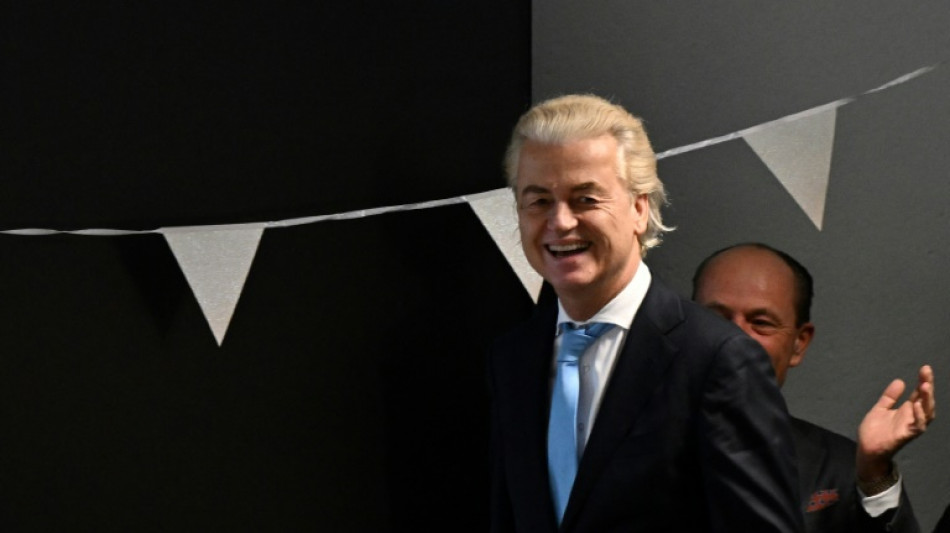
Wilders' win sets 'textbook' example for European populist right: analysts / Photo: JOHN THYS - AFP

 Indonesia accepts Malaysia's help to tackle wildfires

 Indians living in Japan on stand-by to house Asian Games athletes

 Trump signs bill authorizing sweeping Russia sanctions

 Protesters form human chain at Kennedy Center after Trump threat

 Death toll from attack at police HQ in Pakistan rises to 31

 Trump says Denmark to give US 'permanent control' over Greenland security

 Kennedy Center: future unclear for iconic Washington arts hub

 Trump claims 'infinite' Greenland security deal with Denmark

 Helicopters battle wildfire threatening Ecuador's capital

 Brentford batter Chelsea to undo Alonso's promising start

 Kane hits Bundesliga century as Bayern rout Union

 Trump says CNN, MS NOW, Politico banned from White House

 Hushing and hedging: US companies retreat on climate

 Springboks to face Fiji before 2027 Rugby World Cup

 Nigeria miners struggled to breathe in cell before 37 died: survivors

 McIlroy on the charge at PGA Championship as Reed withdraws

 McIlroy on the charge at PGA Championship

 Crisis-wracked Volkswagen warns of 10-bn-euro hit to profits

 Costa Rica's Grynspan tops third informal poll for UN chief: diplomat

 Stock markets retreat after central bank rate hikes

 Russia labels director of Cannes Grand Prix winner a 'foreign agent'

 Macron warns of Russian 'hybrid' threat after meeting presidential hopefuls

 UN holds third informal poll for new chief

 Kulusevski return can spark Spurs: De Zerbi

 Shakira to cap off world tour with Madrid 12-gig run

Anti-EU, anti-immigration firebrand Geert Wilders' surprise victory in the Dutch general election this week shows right-wing populism's success in gobbling up support from traditional conservative parties and taking its pet themes mainstream, experts said.
Whether in power -- often in coalition -- in countries including Italy, Hungary or Slovakia, or steadily gaining, as in France, Germany and Spain, momentum appears on the side of far-right parties.
"Election after election, we're seeing the far right win immense successes," French MEP Raphael Glucksmann told broadcaster France 2 on Friday.
"The European Union is in danger of death from within and without," he warned.
In recent months, observers "were very focused on elections in large countries in the EU... Spain this summer or Poland in October" where populists suffered setbacks, said French political scientist Thierry Chopin.
"(But) the reasons that explain the strength or even the rise of far-right parties in some European countries have not gone away," added Chopin, a researcher at France's Jacques Delors Institute.
Rooted in nationalism and opposition to immigration, the rise of far-right parties began in the late 1970s, surging in 2015 when hundreds of thousands of Syrians fleeing civil war arrived across the continent.
Geert Wilders' career has been built on anti-Islam rhetoric.
Italy's Giorgia Meloni mostly campaigned on anti-immigration themes.
And Sweden is governed by a coalition supported by the far-right that promises to reduce arrivals.
France, Germany and Spain's politics are often dominated by rows about identity and immigration.
- Anti-elites -
In the Netherlands, the traditional centre-right VVD party "had no power to set the terms of debate on Wilders' preferred themes", said Johannes Hillje, a German electoral strategist and author of "Propaganda 4.0: how far-right populists do politics".
"Other parties in the conservative spectrum across Europe have lost their hegemony on the right."
Chopin pointed to classic themes of populist right politics in Wilders' campaign -- anti-elite rhetoric that breaks with bipartisan consensus, fears about immigration and cultural change, and questioning of welfare and redistribution.
"Times of economic and social insecurity favour far-right parties," said Gilles Ivaldi, a researcher at Paris' Sciences Po university.
During the Covid-19 pandemic, the groups "mobilised a lot of people based on fear, frustration and rejection of the health measures... banking support" for the future, he added.
The Netherlands was also "a textbook example of how not to deal with the radical right", as other parties and the media took their policy positions mainstream, Hillje said.
In the Netherlands, VVD leader Dilan Yesilgoz left the possibility of a coalition with Wilders open before the election, only to rule out being a junior partner when he won.
"Everything they did made Wilders stronger and contributed to his electability," Hillje argued.
- Increasingly mainstream -
Wilders and Italian premier Meloni have followed the "de-demonisation" strategy of French far-right figurehead Marine Le Pen, moderating their rhetoric when it looks electorally useful.
"It's not that they've changed their positions, but they express them a little differently to be more appealing, to overcome the emotional barrier to the middle ground," Hillje said.
Meloni has backed Ukraine and trimmed her hostility to the EU, with one French diplomat recently telling AFP she had been "a welcome surprise" on international issues.
"(But) in domestic politics she's doing just what she promised, cutting welfare benefits, taking a hard line against refugees," Hillje pointed out.
"All these parties signal respectability. They have learned or are learning how to exercise power," Ivaldi said -- while cautioning against handing them "a democratic blank cheque".
Many mainstream conservative parties are also absorbing far-right ideas or considering cooperation.
Politicians from Germany's CDU sometimes openly mull regional coalitions with the far-right Alternative for Germany (AfD), while France's right-wing Republicans often try to outdo the far-right National Rally (RN) in shows of toughness against migrants.
At the European level, "an alliance between the far right and the (centre-right) European People's Party (EPP) is not impossible", Ivaldi said.
"That would be a big shift... on migration policy but also on the environment" given far-right denials of climate change.
Ivaldi nevertheless warned against overstating the common ground between far-right parties in different European countries.
"There are very clear fault lines" on support for or hostility to Russia, economics and values, he said.
"Fundamentally, what holds these right-wing populists together is shared enemies and things they all reject, like migration or ambitious climate policies," Hillje said.
"There are conflicts within this camp that will not lead to unified policy, and that may be the hope for the mainstream camp in Europe".
F.Cardoso--PC



