India hopes cloud seeding can wash away deadly smog / Photo: Money SHARMA - AFP

 Indonesia accepts Malaysia's help to tackle wildfires

 Indians living in Japan on stand-by to house Asian Games athletes

 Trump signs bill authorizing sweeping Russia sanctions

 Protesters form human chain at Kennedy Center after Trump threat

 Death toll from attack at police HQ in Pakistan rises to 31

 Trump says Denmark to give US 'permanent control' over Greenland security

 Kennedy Center: future unclear for iconic Washington arts hub

 Trump claims 'infinite' Greenland security deal with Denmark

 Helicopters battle wildfire threatening Ecuador's capital

 Brentford batter Chelsea to undo Alonso's promising start

 Kane hits Bundesliga century as Bayern rout Union

 Trump says CNN, MS NOW, Politico banned from White House

 Hushing and hedging: US companies retreat on climate

 Springboks to face Fiji before 2027 Rugby World Cup

 Nigeria miners struggled to breathe in cell before 37 died: survivors

 McIlroy on the charge at PGA Championship as Reed withdraws

 McIlroy on the charge at PGA Championship

 Crisis-wracked Volkswagen warns of 10-bn-euro hit to profits

 Costa Rica's Grynspan tops third informal poll for UN chief: diplomat

 Stock markets retreat after central bank rate hikes

 Russia labels director of Cannes Grand Prix winner a 'foreign agent'

 Macron warns of Russian 'hybrid' threat after meeting presidential hopefuls

 UN holds third informal poll for new chief

 Kulusevski return can spark Spurs: De Zerbi

 Shakira to cap off world tour with Madrid 12-gig run

Indian scientists are preparing cloud seeding technology to clean poisonous smog in the capital with rain, but environmental critics fear it is an expensive distraction from tackling root causes.
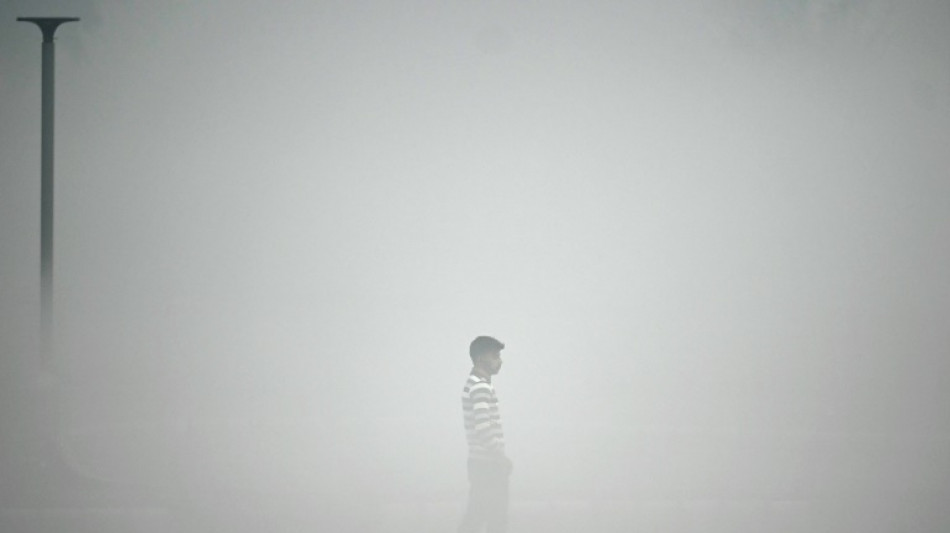
It is the latest measure aimed at alleviating the toxic smog choking the lungs of 30 million residents of New Delhi and its surrounding territories -- consistently ranked as the world's worst capital for air quality.
Sachchida Nand Tripathi, a professor of sustainable energy engineering at the Indian Institute of Technology (IIT) at Kanpur, said aeroplanes equipped with seeding equipment or ground-mounted guns would be used to induce rainfall.
"Even very modest rain is effective in bringing down pollution," he told AFP.
Levels of PM2.5 pollutants -- cancer-causing microparticles that enter the bloodstream through the lungs -- often hit more than 30 times the World Health Organization's danger limits.
Breathing the poisonous air has catastrophic health consequences.
Prolonged exposure can trigger strokes, heart disease, lung cancer and respiratory diseases, according to the WHO.
The average city resident could die nearly 12 years earlier due to air pollution, an August report by the University of Chicago's Energy Policy Institute said.
The Delhi government has had to announce emergency school closures, and ban construction and entry of diesel vehicles into the city in a bid to improve the air quality.
- 'Wasteful expenditure'? -
But with these efforts bearing little result, the government has asked IIT Kanpur to prepare cloud seeding.
The weather modification, also known as "blueskying", involves releasing common salt -- or a mixture of different salts -- into clouds.
The crystals encourage condensation to form as rain.
Tripathi said cloud seeding has produced positive results, and "has not shown any adverse effect wherever it has been tried".
Authorities are waiting for clearances from various government bodies and favourable weather conditions before they can put the seeding plan into action, he said.
But it comes with a hefty price tag.
Exact costs have not been made public, but Indian media suggested it could be as high as 10 million rupees ($120,000) to seed 100 square kilometres (38 miles squared).
Environmental scientist Bhavreen Kandhari said cloud seeding was an "ineffective approach" to the pollution problem.
"It risks becoming a wasteful expenditure of public funds and valuable time," she told AFP.
Smog in Delhi is caused by a melange of factory and vehicle emissions, exacerbated by seasonal agricultural fires.
Eye-stinging pollution worsens during winter from October to February -- when colder air traps pollution -- and residents are advised to wear face masks outside at all times.
- 'Fleeting relief' -
India is not the first.
China extensively uses cloud seeding technology, spending billions of dollars to modify the weather to protect agricultural regions or improve air quality ahead of big events.
Other countries have also invested in the technology, including Indonesia and Malaysia.
Scientists in western India have successfully tried cloud seeding, which resulted in a 20 percent boost in rainfall, Tripathi said.
But Sunil Dahiya, an analyst with the Centre for Research on Energy and Clean Air, said artificial rain was not a "definitive solution" to air pollution.
"The relief it provides is fleeting, as the cessation of rain allows the re-entry of polluted air masses, swiftly elevating air quality back to hazardous levels," Dahiya told AFP.
Dahiya said emissions have to be reduced at their source for any long-term solution to the problem.
"Redirecting our efforts to this strategic approach is crucial for sustained and meaningful improvements in air quality," he said.
But Tripathi said it was a technology "worth trying", especially since other measures had failed.
Delhi set up its first smog tower two years back with much fanfare, a giant fan system sucking in air, but the $2 million structure has been lying defunct with experts saying its impact was limited to a mere 50-metre radius.
"When you have very little respite from very high pollution, and no other method works... what do you do?" Tripathi said.
A.F.Rosado--PC



