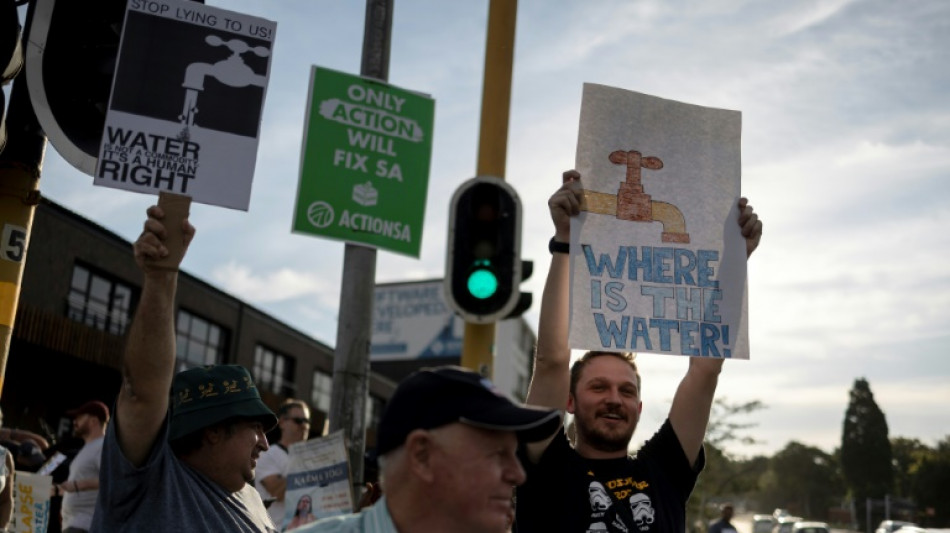
Water cuts add to frustrations ahead of S.Africa vote / Photo: WIKUS DE WET - AFP

 Inter Milan and Italy icon Mazzola dies aged 83

 Saudi capital issues first air raid alert since renewed fighting in Yemen
 Martin edges title rival Marquez for Austrian MotoGP pole
 Indonesia accepts Malaysia's help to tackle wildfires
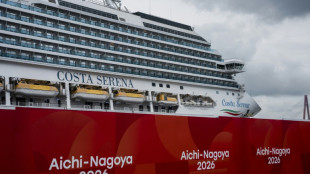 Indians living in Japan on stand-by to house Asian Games athletes
 Trump signs bill authorizing sweeping Russia sanctions

 Protesters form human chain at Kennedy Center after Trump threat

 Death toll from attack at police HQ in Pakistan rises to 31

 Trump says Denmark to give US 'permanent control' over Greenland security

 Kennedy Center: future unclear for iconic Washington arts hub

 Trump claims 'infinite' Greenland security deal with Denmark

 Helicopters battle wildfire threatening Ecuador's capital

 Brentford batter Chelsea to undo Alonso's promising start

 Kane hits Bundesliga century as Bayern rout Union

 Trump says CNN, MS NOW, Politico banned from White House

 Hushing and hedging: US companies retreat on climate

 Springboks to face Fiji before 2027 Rugby World Cup

 Nigeria miners struggled to breathe in cell before 37 died: survivors

 McIlroy on the charge at PGA Championship as Reed withdraws

 McIlroy on the charge at PGA Championship

 Crisis-wracked Volkswagen warns of 10-bn-euro hit to profits

 Costa Rica's Grynspan tops third informal poll for UN chief: diplomat

 Stock markets retreat after central bank rate hikes

 Russia labels director of Cannes Grand Prix winner a 'foreign agent'

 Macron warns of Russian 'hybrid' threat after meeting presidential hopefuls

Anger is mounting in some Johannesburg districts left without water for more than a week, fewer than three months before general elections marked by voter discontent with South Africa's failing infrastructure.
With power cuts and potholes already part of daily life, recent water shortages have increased the frustration of many over poor service delivery -- a key election issue -- in the country's most populous city.
"I haven't had a bath, or a shower or even a wash, for the past 11 days," complained white-haired Cecilia Walsh, as she took out jerry cans from her car before queueing behind a water tanker sent by the city.
"At least now I can give my dog some water... I might get a bucket bath a bit later."
South Africa is the continent's most industrialised nation, but access to basic services such as water, electricity and refuse collection is a recurring source of anger for many of the 62 million inhabitants.
Shouting "We want water" and holding placards reading "No water, this stinks!", a few dozen people protested in a northern Johannesburg district on Tuesday as, some 500 kilometres (300 miles) away in the port city of Durban, students and civil servants demonstrated against blackouts.
"We pay our taxes, now show us what it's for," said Johannesburg protester Niamh Faherty.
"We've waited long enough, it's been 10 days...and we still don't have any water, I mean you can imagine with the two young kids, and it's just frustrating," said Nkosinathi Khumalo, another demonstrator.
- Crippling power cuts -
Due to a shortfall in energy production and frequent breakdowns at its ageing power stations, South Africa has for years suffered from economy-crippling, rolling power cuts that at their worst last up to 12 hours a day.
These eased in recent months, but water troubles soon appeared, further fuelling widespread frustration at the ruling African National Congress (ANC).
Struggling in the polls, the party risks losing its parliamentary majority for the first time since the advent of democracy in 1994 amid accusations of mismanagement and corruption, and high rates of crime, poverty and unemployment.
Some 27.5 million South Africans are registered to vote in national and provincial elections on May 29.
"It's just a shame that we can't sort out our own infrastructure in this place," said Andrew McPhail, another Johannesburg resident who has been without water for a week.
- Pipes and pools -
Tens of thousands of others have been affected by the water crisis that hit around 30 affluent, predominantly-white northern suburbs, where many live in houses with gardens surrounded by high-walls and electric fences to dissuade burglars.
Some have been drawing water from their swimming pools to wash and flush toilets.
Authorities have cited an array of causes for the shortage: dilapidated pipes, a rise in consumption linked to a heatwave and electrical faults affecting pumps.
Built over a massive gold deposit, Johannesburg does not have any major natural water source, such as a river or lake, so the high-lying city is largely supplied by pumping from elsewhere.
Tim Truluck, a local councillor of the main opposition party, the Democratic Alliance, told AFP that it recently took more than a year to replace the pipes in a single Johannesburg suburb, at a cost of about $5 million.
Renovating the entire network would take decades, he said, describing the job as "massive and at the moment insurmountable".
In a retirement home on the outskirts of the city, residents aged 84 on average and often bedridden, have been washed and treated for nine days using water from a well or donations from neighbours.
"There are lots of unanswered questions, and it's difficult to explain it to the elderly who are really suffering," said director Minda van Niekerk.
L.Torres--PC



