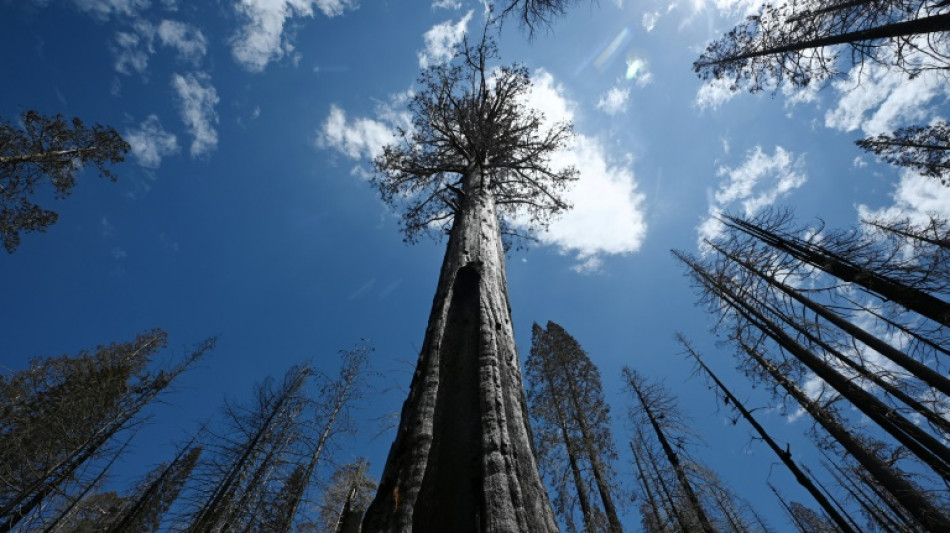
Giant redwoods thriving in the UK: experts / Photo: Robyn Beck - AFP

 Inter Milan and Italy icon Mazzola dies aged 83

 Saudi capital issues first air raid alert since renewed fighting in Yemen

 Martin edges title rival Marquez for Austrian MotoGP pole

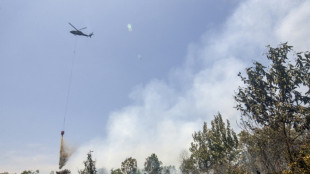 Indonesia accepts Malaysia's help to tackle wildfires

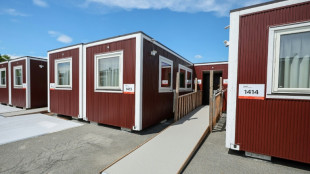
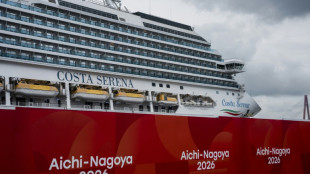 Indians living in Japan on stand-by to house Asian Games athletes
 Trump signs bill authorizing sweeping Russia sanctions

 Protesters form human chain at Kennedy Center after Trump threat

 Death toll from attack at police HQ in Pakistan rises to 31

 Trump says Denmark to give US 'permanent control' over Greenland security

 Kennedy Center: future unclear for iconic Washington arts hub

 Trump claims 'infinite' Greenland security deal with Denmark

 Helicopters battle wildfire threatening Ecuador's capital

 Brentford batter Chelsea to undo Alonso's promising start

 Kane hits Bundesliga century as Bayern rout Union

 Trump says CNN, MS NOW, Politico banned from White House

 Hushing and hedging: US companies retreat on climate

 Springboks to face Fiji before 2027 Rugby World Cup

 Nigeria miners struggled to breathe in cell before 37 died: survivors

 McIlroy on the charge at PGA Championship as Reed withdraws

 McIlroy on the charge at PGA Championship

 Crisis-wracked Volkswagen warns of 10-bn-euro hit to profits

 Costa Rica's Grynspan tops third informal poll for UN chief: diplomat

 Stock markets retreat after central bank rate hikes

 Russia labels director of Cannes Grand Prix winner a 'foreign agent'

 Macron warns of Russian 'hybrid' threat after meeting presidential hopefuls

Endangered giant redwood trees are thriving in the UK but could also be significantly contributing to capturing carbon emissions, according to research published on Wednesday.
The towering giant sequoias, which can soar as high as 90 metres (295 feet) and live for up to 3,000 years, were first planted in the UK in the mid-19th century.
There are now some 500,000 across the country -- more than the 80,000 or so in their native California.
Research by University College London (UCL) and published in the Royal Society Open Science journal, found that "the most massive species" of redwood can potentially pull an average of 85 kilograms of carbon from the atmosphere per year.
It is the first time the growth rate and resilience of the trees have been analysed in the UK.
"Giant sequoias are some of the most massive organisms on Earth and in their native range make up some of the most carbon-dense forests in the world due to their great age," said Ross Holland, the lead author of the research.
"We found that UK redwoods are well adapted to the UK and able to capture a large amount of carbon dioxide."
Sequoias, which have wide trunks and can survive blazes that would wipe out forests of other tree species, were first imported to the UK as seeds and seedlings in 1853.
The trees, which were rare at the time, became a symbol of wealth and power in Victorian-era Britain.
Many were planted at the entrance to large houses and estates.
To assess the adaptability of giant sequoias to the UK's milder climates and varied rainfall patterns, the researchers compiled a map, pinpointing the locations of nearly 5,000 individual trees across the country.
They analysed 97 individual trees at Benmore Botanic Gardens in central Scotland, at Kew Garden's Wakehurst Place in the south of England and at a mixed woodland in Havering Country Park east of London.
Terrestrial laser scanners were used to map the trees in 3D, enabling researchers to accurately measure the heights and volumes of the trees without having to cut them down.
The tallest was approximately 54.87m tall -- towering over most native UK species but modest in comparison to its far older American relatives.
Researchers calculated average growth rates of the trees at the three sites, which they said would be important for the analysis of climate changes in the future.
"Currently, these trees are probably more important for their aesthetic and historical interest than they are for solving the climate crisis," said senior author Mat Disney.
"But as more are planted we need to know how they will grow."
L.Henrique--PC



