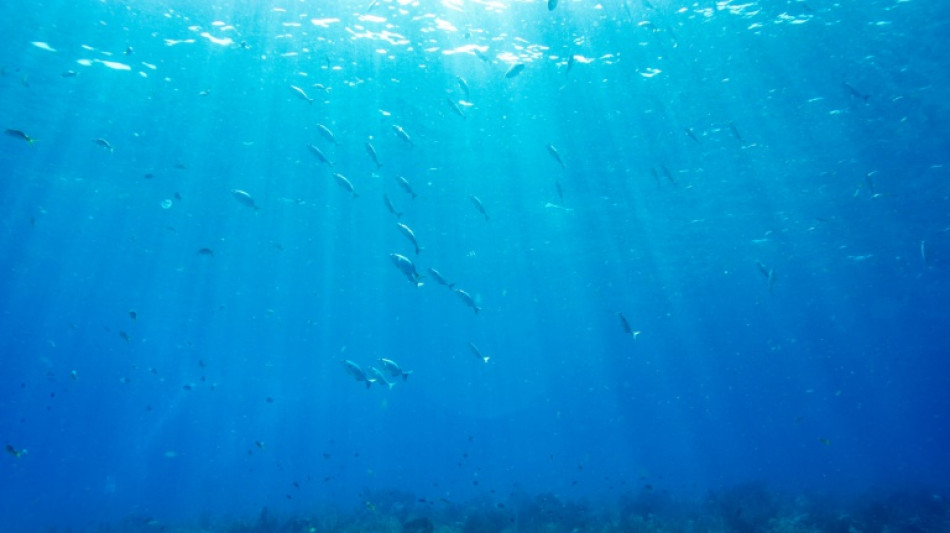
Adagio in sea: Coral larvae 'settle near sounds of healthy reefs' / Photo: Joseph Prezioso - AFP/File

 Inter Milan and Italy icon Mazzola dies aged 83

 Saudi capital issues first air raid alert since renewed fighting in Yemen

 Martin edges title rival Marquez for Austrian MotoGP pole

 Indonesia accepts Malaysia's help to tackle wildfires

 Indians living in Japan on stand-by to house Asian Games athletes

 Trump signs bill authorizing sweeping Russia sanctions

 Protesters form human chain at Kennedy Center after Trump threat

 Death toll from attack at police HQ in Pakistan rises to 31

 Trump says Denmark to give US 'permanent control' over Greenland security

 Kennedy Center: future unclear for iconic Washington arts hub

 Trump claims 'infinite' Greenland security deal with Denmark

 Helicopters battle wildfire threatening Ecuador's capital

 Brentford batter Chelsea to undo Alonso's promising start

 Kane hits Bundesliga century as Bayern rout Union

 Trump says CNN, MS NOW, Politico banned from White House

 Hushing and hedging: US companies retreat on climate

 Springboks to face Fiji before 2027 Rugby World Cup

 Nigeria miners struggled to breathe in cell before 37 died: survivors

 McIlroy on the charge at PGA Championship as Reed withdraws

 McIlroy on the charge at PGA Championship

 Crisis-wracked Volkswagen warns of 10-bn-euro hit to profits

 Costa Rica's Grynspan tops third informal poll for UN chief: diplomat

 Stock markets retreat after central bank rate hikes

 Russia labels director of Cannes Grand Prix winner a 'foreign agent'

 Macron warns of Russian 'hybrid' threat after meeting presidential hopefuls

Audio recordings of healthy reefs -- an underwater chorus of fish songs and crackles from snapping shrimp -- may help efforts to restore coral ecosystems harmed by climate and human impacts, scientists said Wednesday.
With the future of the world's biodiversity-rich coral reefs threatened by climate change, some experts are looking for rehabilitation strategies to go alongside broader efforts to slash planet-heating pollution.
Researchers at Woods Hole Oceanographic Institution say one such method to help reefs rebuild could be sound, after they broadcast audio from a healthy reef to entice coral larvae to settle on the seabed at a degraded reef.
Coral larvae use a range of signals from reefs, including chemical cues, as they swim through the open water in their first stage of life looking for a permanent home, said Nadege Aoki, lead author of the study published in the journal Royal Society Open Science.
"Now we have also demonstrated that the local sound environment is very important for these corals, and that playing reef sounds can potentially be a vital tool in the effort to restore coral reefs," she told AFP.
Researchers had been listening to coral reefs in the US Virgin Islands for over a decade, gaining insights into the distinct sounds that separate lively habitats from those that have been damaged by bleaching, disease or direct human impacts.
"A healthy coral reef will typically feature many low-frequency sounds of croaks, purrs, and grunts produced by fishes against a near-constant background of crackles and pops produced by snapping shrimp," said Aoki. A degraded reef, with fewer species, "will be much quieter".
- Under threat -
The team collected specimens from a hardy species known as mustard hill coral -- named for its lumpy shape and yellow hue.
They then distributed them in cups at three reefs in the US Virgin Islands -- one healthy and two more degraded, with patchy coral growth and fewer fish.
Researchers then set up underwater speakers to broadcast their back catalogue of healthy reef sounds at one of the degraded reefs.
They found that the coral larvae at this location settled at rates 1.7 times higher on average -- and up to seven times more -- than the other two reefs, where no sound was played.
There was still much more to learn about how corals respond to sound, Aoki said, including whether different species behave in the same ways and how they are able to "hear".
But she added the finding suggests audio could become part of efforts to rebuild damaged reefs, although this would need to be monitored and protected, since settlement is just one step in a coral's life.
"At the rate that coral reefs are disappearing, human intervention will be absolutely essential to preserving reefs in anything close to their current states," she said.
Coral reefs support about a quarter of all marine life, as well as the millions of people who rely on them for food and income.
But human-driven climate change is spurring mass coral bleaching as the oceans heat and scientists warn that up to 90 percent of reefs could be lost if warming reaches 1.5 degrees Celsius above pre-industrial levels.
P.Sousa--PC



