
Paris 2024 hopes to be model for lower-carbon Olympics / Photo: STEPHANE DE SAKUTIN - AFP

 Inter Milan and Italy icon Mazzola dies aged 83

 Saudi capital issues first air raid alert since renewed fighting in Yemen

 Martin edges title rival Marquez for Austrian MotoGP pole

 Indonesia accepts Malaysia's help to tackle wildfires

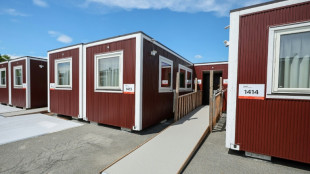
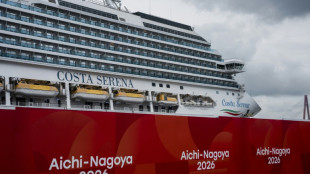 Indians living in Japan on stand-by to house Asian Games athletes
 Trump signs bill authorizing sweeping Russia sanctions

 Protesters form human chain at Kennedy Center after Trump threat

 Death toll from attack at police HQ in Pakistan rises to 31

 Trump says Denmark to give US 'permanent control' over Greenland security

 Kennedy Center: future unclear for iconic Washington arts hub

 Trump claims 'infinite' Greenland security deal with Denmark

 Helicopters battle wildfire threatening Ecuador's capital

 Brentford batter Chelsea to undo Alonso's promising start

 Kane hits Bundesliga century as Bayern rout Union

 Trump says CNN, MS NOW, Politico banned from White House

 Hushing and hedging: US companies retreat on climate

 Springboks to face Fiji before 2027 Rugby World Cup

 Nigeria miners struggled to breathe in cell before 37 died: survivors

 McIlroy on the charge at PGA Championship as Reed withdraws

 McIlroy on the charge at PGA Championship

 Crisis-wracked Volkswagen warns of 10-bn-euro hit to profits

 Costa Rica's Grynspan tops third informal poll for UN chief: diplomat

 Stock markets retreat after central bank rate hikes

 Russia labels director of Cannes Grand Prix winner a 'foreign agent'

 Macron warns of Russian 'hybrid' threat after meeting presidential hopefuls

This year's Paris Olympics will use renewable energy, serve lots of vegetarian meals and heavily restrict plastic bottles, but can an event involving so much construction and international travel ever be environmentally sustainable?
After an extravagant FIFA football World Cup in Qatar in 2022 that featured air-conditioned stadiums, the Paris Games are hoping to present a more sober model for global sports events.
"I hope Paris 2024's efforts to reduce its impacts can demonstrate that it is possible to do things differently," Georgina Grenon, director of environmental excellence for the organising committee, told AFP in a recent interview.
One of the main differences will be in the overall carbon emissions, with organisers aiming for half of the amount generated by the 2012 Olympics in London and the 2016 edition in Rio de Janeiro.
Paris 2024 initially set a target equivalent to 1.58 million tonnes of carbon dioxide, but that ambition has been lowered to around 1.75 million tonnes.
"Something we are uncertain of today is the (carbon impact of) spectators," said Grenon when asked if the latest target can be met.
One of the key factors will be the number of heavily polluting plane journeys linked to the Games and "we haven't yet sold all the tickets," she added.
An outside consulting firm will be tasked with auditing the impact of the travel, the construction, catering and sports equipment, with final figures set to be published in October.
- Diesel savings -
The key to reducing Paris' carbon footprint was contained in the city's original bid.
Organisers promised to use either existing or temporary venues for 95 percent of the sports events, meaning they could avoid building new stadiums from scratch.
The only major new-build projects have been an aquatics centre, a mid-sized venue in Paris for the badminton and gymnastics, and the athletes' village in the deprived Paris suburb of Seine-Saint-Denis.
Contractors for the village had to agree to reduce the emissions resulting from their buildings by 30 percent compared with standard constructions, meaning many of them experimented with low-carbon concrete and wood.
Other changes include connecting up all the sports venues to the electricity mains supply, meaning stadium operators don't rely on diesel generators for power.
"To give you an idea of the volume of diesel for the London Games, there were four million litres burned just for electricity purposes," said Grenon.
Elsewhere, Coca-Cola -- a top Olympics sponsor -- has agreed to install 700 newly designed drink fountains at Olympic venues, meaning that around 50 percent of soft drinks will be served without a plastic bottle.
Elsewhere, meals at sports venues will be 60 percent vegetarian. Recycling and re-use clauses were routinely written into equipment supplier contracts. All of the energy supplied to the Games by national energy group EDF will be from renewable sources.
- Offsetting -
Where Games organisers still face an uphill battle to convince observers is their policy on compensating for their emissions -- something known as "carbon offsetting".
Even if they meet their emissions target of 1.75 million tonnes, it would be the equivalent of the annual carbon footprint of a French town of 200,000 people.
They initially claimed that Paris 2024 would be "carbon positive", meaning that the organising committee would invest in projects such as tree-planting that would capture more carbon dioxide over their lifetimes than the Games would emit.
This target has also been revised down -- the Games now aim to be "carbon neutral" -- and a tender for an offsetting project in France was cancelled late last year for budget reasons, Grenon says.
Offsetting remains controversial because of doubts about the environmental benefits of many schemes, as well as the lack of independent oversight.
Some critics see its main role as supplying clean consciences for polluters.
"There's been a lot of criticism about some certification methodologies, about some countries being more serious than others, so this is why we chose projects that from the onset were particularly serious," Grenon counters.
A forestry project in France has state certification -- "label bas carbone" -- and the international ones have been "audited to death" and will be revealed to the media "soon", Grenon promised.
- Costs vs benefits -
The Olympics have faced protests by environmental groups since the 1980s.
Some oppose it outright, saying any social benefits are outweighed by the ecological costs, while others believe the concept simply needs to be re-thought.
One group of researchers suggested in the Nature Sustainability journal in 2021 that the event should be scaled down, held in the same locations, and with far fewer international travellers.
"There is something around sports and around the Olympic Games that is unique, the emotions, the peace message," Grenon argued.
"The future starts with the present, and the present starts by understanding your impact, and trying to do as much as you can to reduce it," she said.
"That's been our credo since the very beginning."
X.Matos--PC



