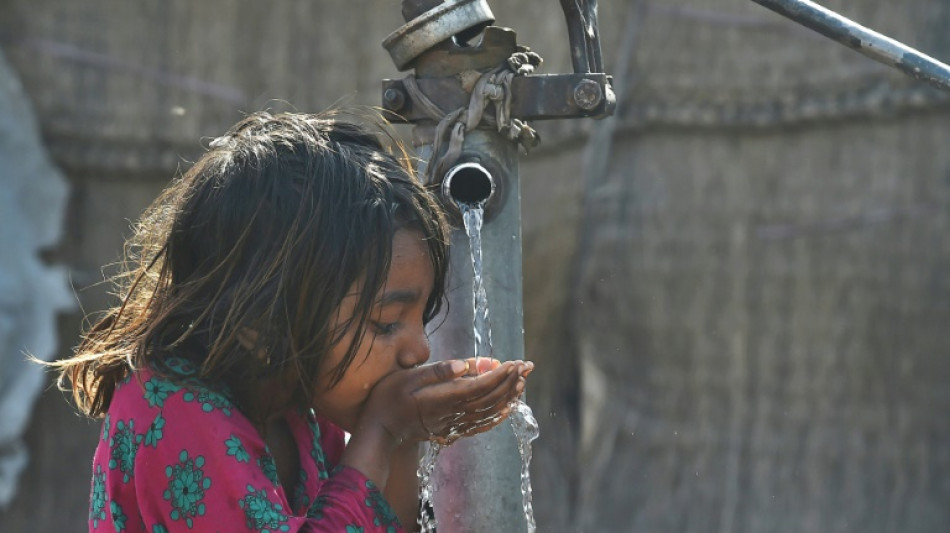
UN warns against thirsty tech to solve water crisis / Photo: ARIF ALI - AFP/File

 Inter Milan and Italy icon Mazzola dies aged 83

 Saudi capital issues first air raid alert since renewed fighting in Yemen

 Martin edges title rival Marquez for Austrian MotoGP pole

 Indonesia accepts Malaysia's help to tackle wildfires

 Indians living in Japan on stand-by to house Asian Games athletes
 Trump signs bill authorizing sweeping Russia sanctions

 Protesters form human chain at Kennedy Center after Trump threat

 Death toll from attack at police HQ in Pakistan rises to 31

 Trump says Denmark to give US 'permanent control' over Greenland security

 Kennedy Center: future unclear for iconic Washington arts hub

 Trump claims 'infinite' Greenland security deal with Denmark

 Helicopters battle wildfire threatening Ecuador's capital

 Brentford batter Chelsea to undo Alonso's promising start

 Kane hits Bundesliga century as Bayern rout Union

 Trump says CNN, MS NOW, Politico banned from White House

 Hushing and hedging: US companies retreat on climate

 Springboks to face Fiji before 2027 Rugby World Cup

 Nigeria miners struggled to breathe in cell before 37 died: survivors

 McIlroy on the charge at PGA Championship as Reed withdraws

 McIlroy on the charge at PGA Championship

 Crisis-wracked Volkswagen warns of 10-bn-euro hit to profits

 Costa Rica's Grynspan tops third informal poll for UN chief: diplomat

 Stock markets retreat after central bank rate hikes

 Russia labels director of Cannes Grand Prix winner a 'foreign agent'

 Macron warns of Russian 'hybrid' threat after meeting presidential hopefuls

The world needs to better manage its freshwater resources but thirsty new technologies touted as solutions could lead to "serious problems" if left unchecked, a UN report warned Friday.
Roughly half of the planet's population is facing grave water shortages, with climate change-linked droughts affecting more than 1.4 billion people between 2002 and 2021, the report for the UN cultural agency UNESCO said.
As of 2022, more than 2 billion people were without access to safely managed drinking water, while 3.5 billion people lacked access to decent toilets, it added.
On top of that, pharmaceuticals, hormones and industrial chemicals are seeping into the world's rivers.
The report, titled "Water for prosperity and peace", called for more water education, data collection and investment to address the crisis.
It also highlighted the limits of new computer-led solutions.
"An array of technologies is available to improve both water supply, water use efficiency and the quality and extension of" sanitation services, it said.
But "several rapidly emerging technologies are highly water-intensive and, if left unchecked, could lead to serious problems in the near future."
Artificial intelligence (AI) had "the potential to enhance (river) basin management, emergency response, and the operation and maintenance of water supply and wastewater treatment plants," said the report.
But "AI and related technologies require large volumes of water for computer cooling systems, in addition to the (often water-intensive) energy required to power the equipment."
- Flawed solutions -
While climate change is projected to intensify patterns of record rainfall and drought in coming years, solutions to tackle that problem were also using up too much water, it added.
One such technique, called carbon capture and storage, syphons off CO2 from the exhaust of fossil fuel-fired power plants and heavy industry such as steel and cement factories in a bid to reduce planet-heating carbon pollution.
But "carbon capture and storage systems... are extremely energy- and water-intensive," the report said.
Energy production accounts for between 10 and 15 percent of global water withdrawals, both to extract fossil fuels and cool thermal and nuclear power stations, it said.
While wind, solar and geothermal energy systems are more water-efficient, they still require lithium batteries for power storage.
Yet the extraction of lithium and other critical minerals for solar panels "is usually highly water-intensive, with significant risks to water quality" especially groundwater, ecosystems and local populations, the report said.
L.Torres--PC



