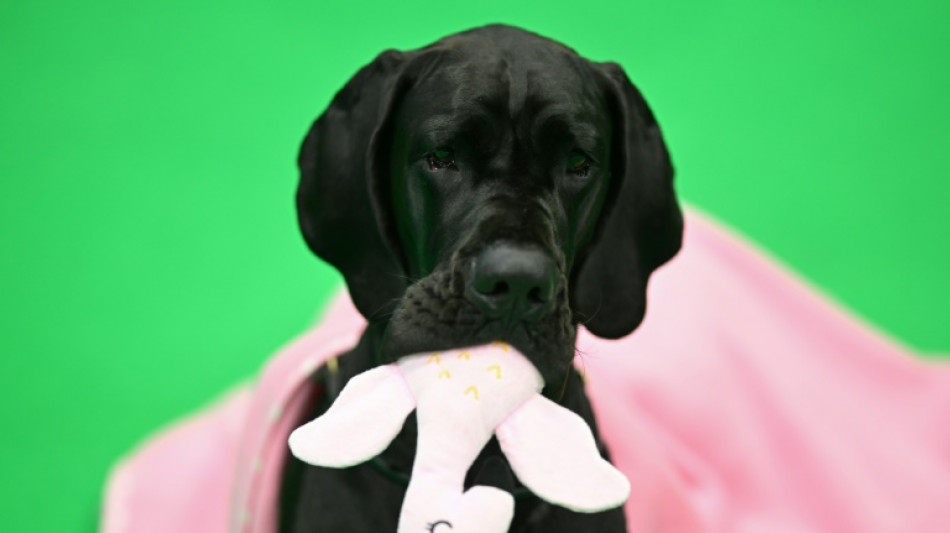
'Good boy!' Dogs do understand us, says new study / Photo: Oli SCARFF - AFP

 Inter Milan and Italy icon Mazzola dies aged 83

 Saudi capital issues first air raid alert since renewed fighting in Yemen

 Martin edges title rival Marquez for Austrian MotoGP pole

 Indonesia accepts Malaysia's help to tackle wildfires
 Indians living in Japan on stand-by to house Asian Games athletes

 Trump signs bill authorizing sweeping Russia sanctions

 Protesters form human chain at Kennedy Center after Trump threat

 Death toll from attack at police HQ in Pakistan rises to 31

 Trump says Denmark to give US 'permanent control' over Greenland security

 Kennedy Center: future unclear for iconic Washington arts hub

 Trump claims 'infinite' Greenland security deal with Denmark

 Helicopters battle wildfire threatening Ecuador's capital

 Brentford batter Chelsea to undo Alonso's promising start

 Kane hits Bundesliga century as Bayern rout Union

 Trump says CNN, MS NOW, Politico banned from White House

 Hushing and hedging: US companies retreat on climate

 Springboks to face Fiji before 2027 Rugby World Cup

 Nigeria miners struggled to breathe in cell before 37 died: survivors

 McIlroy on the charge at PGA Championship as Reed withdraws

 McIlroy on the charge at PGA Championship

 Crisis-wracked Volkswagen warns of 10-bn-euro hit to profits

 Costa Rica's Grynspan tops third informal poll for UN chief: diplomat

 Stock markets retreat after central bank rate hikes

 Russia labels director of Cannes Grand Prix winner a 'foreign agent'

 Macron warns of Russian 'hybrid' threat after meeting presidential hopefuls

Whether dogs truly understand the words we say -- as opposed to things like tone and context clues -- is a question that has long perplexed owners, and so far science hasn't been able to deliver clear answers.
But a new brain wave study published Friday in Current Biology suggests that hearing the names of their favorite toys actually activates dogs' memories of the objects they are associated with.
"It is not so self-evident that dogs would know what a 'ball' is," co-author Lilla Magyari of the Eotvos Lorand University in Hungary, told AFP, using an easy example to explain the motivation behind the research.
With a couple of famous exceptions, dogs have fared poorly on lab tests requiring them to fetch objects after hearing their names, and many experts have argued it isn't so much what we say but rather how and when we say things that pique our pooches' interest.
Yelling "Go get the stick!" and having a dog successfully bring the object back doesn't conclusively prove they know what the word "stick" means.
Even scientists who concede that dogs do pay attention to our speech have said that, rather than really understanding what words actually stand for -- a uniquely human trait -- they are reacting to particular sounds with a learned behavior.
- Brain waves -
In the new paper, Magyari and colleagues applied a non-invasive brain imaging technique to 18 dogs brought to their lab in Budapest.
The test involved taping electrodes to the dogs' heads to monitor their brain activity. Their owners said words for toys they were most familiar with -- for example "Kun-kun, look, the ball!" -- and then showed them either the matching object or a mismatched object.
After analyzing the recordings, the team found different brain patterns when dogs were shown matching versus mismatched objects.
This experimental setup has been used for decades in humans, including babies, and is accepted as evidence of "semantic processing," or understanding meaning.
The test also had the benefit of not requiring the dogs to fetch something in order to prove their knowledge.
"We found the effect in 14 dogs, which shows the effect that we see on a group level is not only driven by a few exceptional dogs," co-author Marianna Boros told AFP.
- Case closed? -
Holly Root-Gutteridge, a dog behavior scientist at the University of Lincoln in England, who wasn't involved in the research, told AFP the ability to fetch specific toys by name had previously been deemed a "genius" quality.
She noted the famous border collies Chaser, who had the largest tested memory of any non-human animal, and Rico, who was the first dog found in tests to retrieve toys by their names.
But Root-Gutteridge said the new study "shows that a whole range of dogs are learning the names of the objects in terms of brain response even if they don't demonstrate it behaviorally," adding it was, "another knock for humanity's special and distinct qualities."
The paper "provides further evidence that dogs might understand human vocalizations much better than we usually give them credit for," added Federico Rossano, a cognitive scientist at UC San Diego.
But not all experts were equally enthusiastic.
Clive Wynne, a canine behaviorist at Arizona State University, told AFP he was "split" on the findings.
"I think the paper falls down when it wants to make the big picture claim that they have demonstrated what they call 'semantic understanding,'" he said, though he praised the "ingenious" experimental setup as a new way to test the full extent of dogs "functional vocabulary."
For example, Wynne said, he needs to spell out the word "w-a-l-k" when he's in front of his dog -- lest his pet get excited for an outing there and then -- but he doesn't need to take the same precautions in front of his wife, whose understanding of the word goes beyond simple association.
"Would Pavlov be surprised by these results?" asked Wynne, referencing the famous Russian scientist who showed dogs could be conditioned to salivate when they heard a bell signaling meal time. "I do not think he would be."
B.Godinho--PC