
US bat decline triggered pesticide surge and over 1,000 infant deaths: study / Photo: Handout - US FISH & WILDLIFE SERVICE/AFP/File

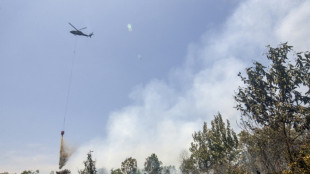 Indonesia accepts Malaysia's help to tackle wildfires

 Indians living in Japan on stand-by to house Asian Games athletes

 Trump signs bill authorizing sweeping Russia sanctions

 Protesters form human chain at Kennedy Center after Trump threat

 Death toll from attack at police HQ in Pakistan rises to 31

 Trump says Denmark to give US 'permanent control' over Greenland security

 Kennedy Center: future unclear for iconic Washington arts hub

 Trump claims 'infinite' Greenland security deal with Denmark

 Helicopters battle wildfire threatening Ecuador's capital

 Brentford batter Chelsea to undo Alonso's promising start

 Kane hits Bundesliga century as Bayern rout Union

 Trump says CNN, MS NOW, Politico banned from White House

 Hushing and hedging: US companies retreat on climate

 Springboks to face Fiji before 2027 Rugby World Cup

 Nigeria miners struggled to breathe in cell before 37 died: survivors

 McIlroy on the charge at PGA Championship as Reed withdraws

 McIlroy on the charge at PGA Championship

 Crisis-wracked Volkswagen warns of 10-bn-euro hit to profits

 Costa Rica's Grynspan tops third informal poll for UN chief: diplomat

 Stock markets retreat after central bank rate hikes

 Russia labels director of Cannes Grand Prix winner a 'foreign agent'

 Macron warns of Russian 'hybrid' threat after meeting presidential hopefuls

 UN holds third informal poll for new chief

 Kulusevski return can spark Spurs: De Zerbi

 Shakira to cap off world tour with Madrid 12-gig run

A collapse in North America's bat population led to a surge in pesticide use by farmers as an alternative way to protect their crops -- in turn triggering a rise in infant mortalities, a study revealed Thursday.
The paper, published in Science, provides evidence supporting predictions that global biodiversity decline will have severe consequences for humans.
"Ecologists have been warning us that we're losing species left and right, and that extinction rates are orders of magnitude higher than what they think they should be, and that that will potentially have catastrophic impacts on humanity," author Eyal Frank, of the University of Chicago, told AFP.
"However, there was not a whole lot of empirical validation to those predictions because it is very hard to go and manipulate an ecosystem at a very large spatial scale."
- Bats are pest control -
For his work, Frank took advantage of a "natural experiment" -- the sudden emergence of a deadly bat disease -- to quantify the benefits that bug-eating bats provide in pest control.
White-nose syndrome (WNS), caused by an invasive fungus, began spreading across the United States from New York in 2006 -- killing bats by waking them during hibernation, when they lack insects to feed on and can't stay warm.
The loss of millions of bats shocked the ecosystem.
Frank tracked the spread of WNS in the eastern US and compared insecticide use in affected counties versus unaffected ones.
He found a staggering 31 percent increase in pesticide use where bat populations had declined.
Frank examined whether increased pesticide use correlated with higher infant mortality rates, a standard measure for studying the health impacts of environmental pollution.
With more pesticides, the infant mortality rate rose by nearly eight percent, translating to 1,334 additional infant deaths -- with contaminated water and air likely serving as pathways for the chemicals to enter humans.
Frank emphasized that the staggered spread of the wildlife disease supports the argument that the bat die-off caused the spike in infant mortality, rather than it being a coincidence.
Any other explanation would have to align with the same expansion path and timing.
- Cascading impacts -
"We need better data on the presence of pesticides in the environment," Frank said, adding that his findings also underscore the need to protect bats.
Vaccines are being developed against WNS, but bats are also threatened by habitat loss, climate change and wind farms.
Frank's work adds to the body of evidence showing the cascading impacts of wildlife loss on ecosystems.
A recent study found that reintroducing wolves in Wisconsin reduced vehicle collisions with deer as wolves establish their patrols along highways.
In Central America, declines in amphibians and snakes have led to spikes in human malaria cases.
"Stemming the biodiversity crisis is crucial to maintaining the many benefits that ecosystems provide for which technological substitutes cannot readily, or perhaps, ever replace," scientists at the University of California, Santa Barbara and University of British Columbia wrote in a commentary.
"Studies like that of Frank are important for understanding the benefits of allocating scarce resources for biodiversity conservation."
A.Magalhes--PC



