Sardinia's sheep farmers battle bluetongue as climate warms / Photo: Filippo MONTEFORTE - AFP

 Indonesia accepts Malaysia's help to tackle wildfires

 Indians living in Japan on stand-by to house Asian Games athletes

 Trump signs bill authorizing sweeping Russia sanctions

 Protesters form human chain at Kennedy Center after Trump threat

 Death toll from attack at police HQ in Pakistan rises to 31

 Trump says Denmark to give US 'permanent control' over Greenland security

 Kennedy Center: future unclear for iconic Washington arts hub

 Trump claims 'infinite' Greenland security deal with Denmark

 Helicopters battle wildfire threatening Ecuador's capital

 Brentford batter Chelsea to undo Alonso's promising start

 Kane hits Bundesliga century as Bayern rout Union

 Trump says CNN, MS NOW, Politico banned from White House

 Hushing and hedging: US companies retreat on climate

 Springboks to face Fiji before 2027 Rugby World Cup

 Nigeria miners struggled to breathe in cell before 37 died: survivors

 McIlroy on the charge at PGA Championship as Reed withdraws

 McIlroy on the charge at PGA Championship

 Crisis-wracked Volkswagen warns of 10-bn-euro hit to profits

 Costa Rica's Grynspan tops third informal poll for UN chief: diplomat

 Stock markets retreat after central bank rate hikes

 Russia labels director of Cannes Grand Prix winner a 'foreign agent'

 Macron warns of Russian 'hybrid' threat after meeting presidential hopefuls

 UN holds third informal poll for new chief

 Kulusevski return can spark Spurs: De Zerbi

 Shakira to cap off world tour with Madrid 12-gig run

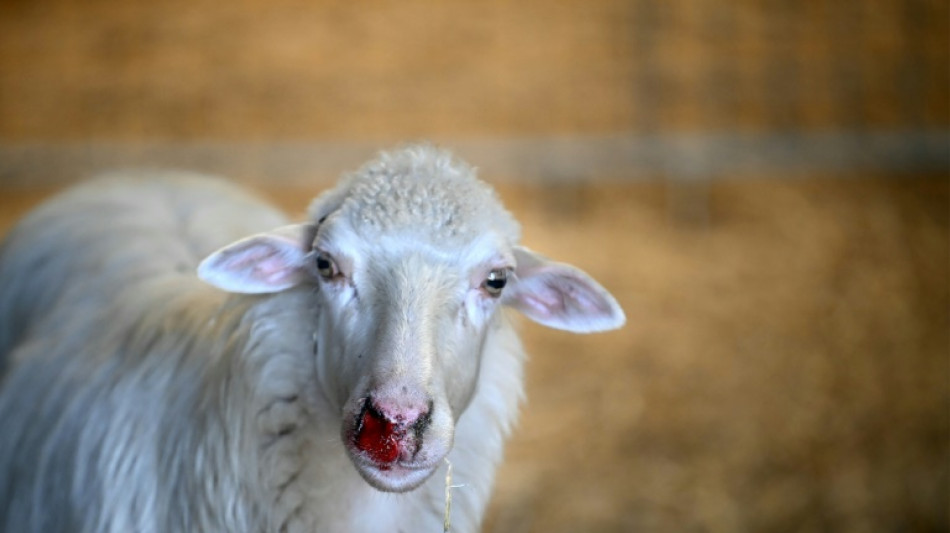
The sheep huddle together, bleeding from the nose, aborting lambs or suffocating on saliva as they succumb to bluetongue, a virus sweeping through flocks on the Italian island of Sardinia.
Some 20,000 sheep have died so far this year on the island, which is home to nearly half Italy's flock and plays an important role in the production of famed Italian cheeses such as Pecorino.
It is another blow for farmers in a region already battered by a drought aggravated by man-made climate change -- which experts say is also fuelling the spread of bluetongue and longer outbreaks.
"The virus hit about two and a half months earlier than usual," 39-year-old farmer Michela Dessi told AFP as she scanned her flock for panting or limping sheep in her fields in Arbus in western Sardinia.
Bluetongue does not present any risks to humans but in animals it causes swollen heads, high fevers, mouth ulcers, difficulty swallowing and breathing, and can turn an infected animal's tongue blue.
It is transmitted between animals by biting midges.
While cattle, goats and deer can get it too, sheep are the most severely affected, according to the World Organization for Animal Health (WOAH).
Infected and pregnant ewes abort or their lambs are born deformed, and survivors can lose their wool.
Sunken sides are a sign the ewes are carrying dead foetuses. The sick animals struggle to expel them.
- Virus peaks -
The infection rate this year on Dessi's farm is about 60 percent, and some 30 percent of her sheep have aborted.
Around 50 of her 650 sheep have died -- and in a way she said was "horrible to watch".
With high fevers, "they refuse food and water and some suffocate or drown in their own saliva", she said, adding that it is illegal to euthanise them.
Nearly 3,000 outbreaks have been recorded so far this year in Sardinia, compared to 371 last year -- and the end is not yet in sight.
Bluetongue used to peak in Sardinia in August but has done so as late as November in recent years, according to the region's veterinary research institute (IZS).
"Climatic conditions heavily influence midge populations," the animal health division at the United Nations' Food and Agriculture Organization in Rome told AFP.
They affect "their biting behaviour and the speed of development of the virus, with climate change likely driving the virus's expansion... and contributing to larger outbreaks".
Cases have been reported this year in other European countries, from neighbouring France to Portugal, Spain, Germany, Belgium and the Netherlands.
Bluetongue has been present in Sardinia since 2000 but Italy's farming lobby Coldiretti says authorities are too slow each year to vaccinate the island's flocks.
The costs of failing to rein it in are high.
A University of Bologna study last year found the 2017 outbreak, which killed 34,500 sheep, cost an estimated 30 million euros ($33 million).
That included damages suffered by farms -- deaths, reduced milk yields, infertility, abortions -- costs to animal health authorities and subventions paid by the region to affected farms.
- Mass graves -
"The first outbreaks occur in the same at-risk areas each year," meaning highly targeted measures could theoretically prevent outbreaks, said Stefano Cappai from research institute IZS.
There are three variants on the island this year, two of which can be vaccinated against, with mortality rates twice as high among unvaccinated sheep.
Flocks should be vaccinated in March or April, Cappai said, but vaccines were only issued by the region in mid-June this year.
By that point, the virus had begun to spread unchecked.
Even if the vaccines had been made available earlier, some farmers fear to use them.
Others only vaccinate part of their flock, which means they fail to reach herd immunity, Cappai said.
And some farmers -- like Dessi -- vaccinated her flock, only for the sheep to catch the variant for which there is no vaccine yet.
Battista Cualbu, head of Coldiretti in Sardinia, who also has an outbreak on his farm, said vaccines are not enough and authorities must disinfect areas and provide midge repellents.
"It would certainly save public money because the region has to pay compensation for dead livestock (and) lost income," he said, including less milk sold and fewer lambs for the slaughterhouse.
Compensation is set at 150 euros per sheep killed by bluetongue -- a figure Coldiretti is battling to increase, although the region has failed to pay up over the past three years, Dessi said.
As temperatures fall, the case numbers are expected to decline but Dessi said the end was weeks away.
"I've dug three mass graves already and I fear the worst is still to come", she said.
H.Silva--PC



