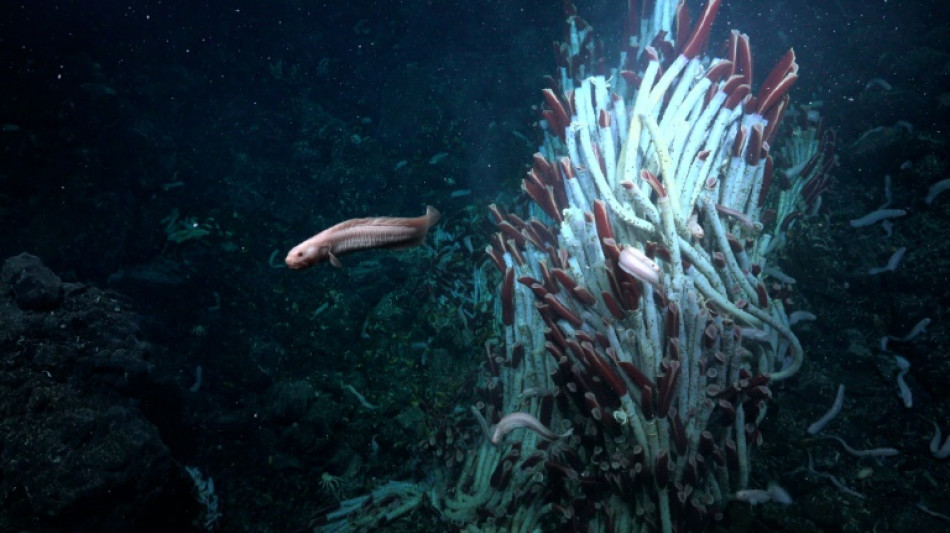
Worms and snails handle the pressure 2,500m below the Pacific surface / Photo: Handout - Schmidt Ocean Institute/AFP

 Indonesia accepts Malaysia's help to tackle wildfires

 Indians living in Japan on stand-by to house Asian Games athletes

 Trump signs bill authorizing sweeping Russia sanctions

 Protesters form human chain at Kennedy Center after Trump threat

 Death toll from attack at police HQ in Pakistan rises to 31

 Trump says Denmark to give US 'permanent control' over Greenland security

 Kennedy Center: future unclear for iconic Washington arts hub

 Trump claims 'infinite' Greenland security deal with Denmark

 Helicopters battle wildfire threatening Ecuador's capital

 Brentford batter Chelsea to undo Alonso's promising start

 Kane hits Bundesliga century as Bayern rout Union

 Trump says CNN, MS NOW, Politico banned from White House

 Hushing and hedging: US companies retreat on climate

 Springboks to face Fiji before 2027 Rugby World Cup

 Nigeria miners struggled to breathe in cell before 37 died: survivors

 McIlroy on the charge at PGA Championship as Reed withdraws

 McIlroy on the charge at PGA Championship

 Crisis-wracked Volkswagen warns of 10-bn-euro hit to profits

 Costa Rica's Grynspan tops third informal poll for UN chief: diplomat

 Stock markets retreat after central bank rate hikes

 Russia labels director of Cannes Grand Prix winner a 'foreign agent'

 Macron warns of Russian 'hybrid' threat after meeting presidential hopefuls

 UN holds third informal poll for new chief

 Kulusevski return can spark Spurs: De Zerbi

 Shakira to cap off world tour with Madrid 12-gig run

Giant worms found wriggling under the Pacific seabed have unveiled a thriving ecosystem in a fiercely hostile environment, according to a study published by Nature.
The team found the booming community 2,515 metres (8,250 feet) below the surface just off the coast of central America.
An underwater oasis has been created under a chain of mountains that run from north-to-south in the Pacific. In this part of the chain, two tectonic plates are moving away from each other, opening up hydrothermal vents that let out water heated by magma and loaded with chemical compounds.
The seabed zone was first discovered in the 1970s. But the latest research found tube worms and molluscs that thrive despite water pressure 250 times greater than at the surface and the total darkness.
The inhabitants of the animal Atlantis live off the nutrients produced by bacteria on the seabed.
Scientists are now trying to understand how the tube worm larvae get around so quickly to colonise new areas around the vents created after each underwater eruption.
- Underwater zoo -
One theory is that the larvae get under the crust with cold deep-sea water where it mixes with the hotter water created by earthquakes and eruptions and "and then they get spilled out at the surface and settle", said Monika Bright, a marine biology professor at the University of Vienna and co-author of the Nature study.
The scientists used a remote-controlled submarine, with its own digger for lifting rocks, to collect samples and sea floor images.
"While trying to collect the rocks we discovered that there are cavities below," Bright told AFP.
The cavities hid an underwater zoo of adult worms, limpets in shells, polychaetes, or bristle worms, and marine snails.
Bright said the team's work showed that "unexpected discoveries" can be made even at places that have been studied for more than 30 years, "probably just because nobody was thinking to look into the crust for animals before."
The cavities are about 10 centimetres (four inches) deep and worms up to 41cm long were found.
Bright said the conditions were similar to those at the surface where tube worms live. "The temperatures we measured were up to 25 degrees Celsius, oxygen was present and also toxic hydrogen sulphide in moderate concentrations."
The study said "larvae can disperse in cavities to potentially colonize lava cracks and the seafloor, or even settle and grow to adults and thereby proliferate" in the shallow vents.
Bright said the researchers believe the animals might not go down very far because the temperature rises, there is less oxygen and higher concentrations of hydrogen sulphide the deeper they go.
"It is important to know who lives there and to be able to protect them from deep-sea mining," said Bright. "This fauna is unique and should be protected."
A.Motta--PC



