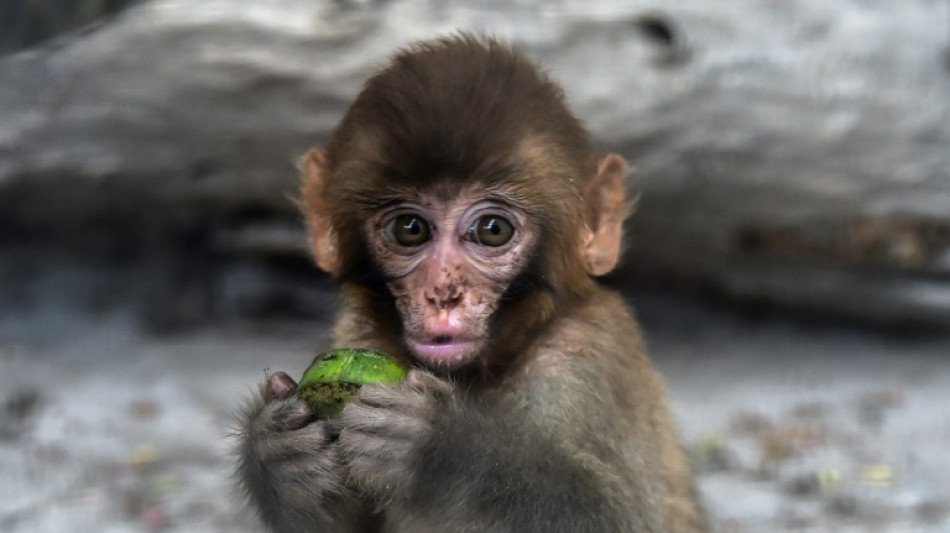
Not enough time in universe for monkeys to pen Shakespeare: study / Photo: Asif HASSAN - AFP

 Indonesia accepts Malaysia's help to tackle wildfires
 Indians living in Japan on stand-by to house Asian Games athletes

 Trump signs bill authorizing sweeping Russia sanctions

 Protesters form human chain at Kennedy Center after Trump threat

 Death toll from attack at police HQ in Pakistan rises to 31

 Trump says Denmark to give US 'permanent control' over Greenland security

 Kennedy Center: future unclear for iconic Washington arts hub

 Trump claims 'infinite' Greenland security deal with Denmark

 Helicopters battle wildfire threatening Ecuador's capital

 Brentford batter Chelsea to undo Alonso's promising start

 Kane hits Bundesliga century as Bayern rout Union

 Trump says CNN, MS NOW, Politico banned from White House

 Hushing and hedging: US companies retreat on climate

 Springboks to face Fiji before 2027 Rugby World Cup

 Nigeria miners struggled to breathe in cell before 37 died: survivors

 McIlroy on the charge at PGA Championship as Reed withdraws

 McIlroy on the charge at PGA Championship

 Crisis-wracked Volkswagen warns of 10-bn-euro hit to profits

 Costa Rica's Grynspan tops third informal poll for UN chief: diplomat

 Stock markets retreat after central bank rate hikes

 Russia labels director of Cannes Grand Prix winner a 'foreign agent'

 Macron warns of Russian 'hybrid' threat after meeting presidential hopefuls

 UN holds third informal poll for new chief

 Kulusevski return can spark Spurs: De Zerbi

 Shakira to cap off world tour with Madrid 12-gig run

If a monkey types randomly at a keyboard for long enough, it will eventually write the complete works of Shakespeare.
This thought experiment has long been used to express how an infinite amount of time makes something that is incredibly unlikely -- but still technically possible -- become probable.
But two Australian mathematicians have deemed the old adage misleading, working out that even if all the chimpanzees in the world were given the entire lifespan of the universe, they would "almost certainly" never pen the works of the bard.
The "infinite monkey theorem" has been around for more than a century, though its origin remains unclear. It is commonly attributed to either French mathematician Emile Borel or British anthropologist Thomas Huxley, and some even think the general idea dates back to Aristotle.
For a light-hearted but peer-reviewed study published earlier this week, the two mathematicians set out to determine what happens if generous yet finite limits were placed on the monkey typists.
Their calculations were based on a monkey spending around 30 years typing one key a second at a keyboard with 30 keys -- the letters of the English language plus some common punctuation.
The "heat death" of the universe was assumed to take place in around a googol of years -- that is a one followed by 100 zeroes.
Other more practical considerations -- such as what the monkeys would eat, or how they would survive the Sun engulfing Earth in a few billion years -- were set aside.
- Monkey labour falls short -
There was only around a five percent chance that a single monkey would randomly write the word "banana" in their lifetime, according to the study in the journal Franklin Open.
Shakespeare's canon includes 884,647 words -- none of them banana.
To broaden out the experiment, the mathematicians turned to chimpanzees, the closest relative of humans.
There are currently around 200,000 chimps on Earth, and the study presumed this population would remain stable until the end of time.
Even this massive monkey workforce fell very, very short.
"It's not even like one in a million," study co-author Stephen Woodcock of the University of Technology Sydney told New Scientist.
"If every atom in the universe was a universe in itself, it still wouldn't happen."
And even if many more chimps who typed much quicker were added to the equation, it was still not plausible "that monkey labour will ever be a viable tool for developing written works of anything beyond the trivial," the authors wrote in the study.
The study concluded by saying that Shakespeare himself may have inadvertently given an answer as to whether "monkey labour could meaningfully be a replacement for human endeavour as a source of scholarship or creativity".
"To quote Hamlet, Act 3, Scene 3, Line 87: 'No'."
L.Carrico--PC



