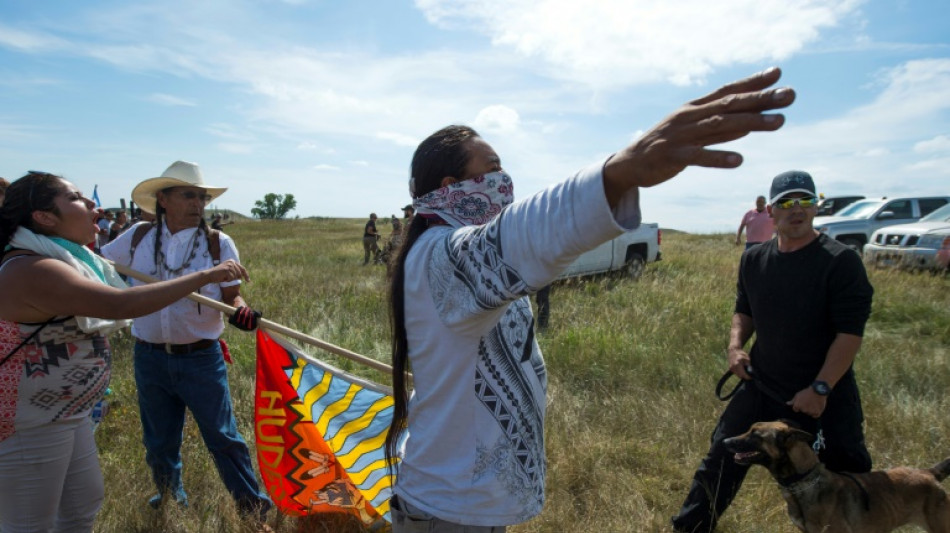
US pipeline case heads to court in high-stakes free speech fight / Photo: Robyn BECK - AFP/File

 Indians living in Japan on stand-by to house Asian Games athletes

 Trump signs bill authorizing sweeping Russia sanctions

 Protesters form human chain at Kennedy Center after Trump threat

 Death toll from attack at police HQ in Pakistan rises to 31

 Trump says Denmark to give US 'permanent control' over Greenland security

 Kennedy Center: future unclear for iconic Washington arts hub

 Trump claims 'infinite' Greenland security deal with Denmark

 Helicopters battle wildfire threatening Ecuador's capital

 Brentford batter Chelsea to undo Alonso's promising start

 Kane hits Bundesliga century as Bayern rout Union

 Trump says CNN, MS NOW, Politico banned from White House

 Hushing and hedging: US companies retreat on climate

 Springboks to face Fiji before 2027 Rugby World Cup

 Nigeria miners struggled to breathe in cell before 37 died: survivors

 McIlroy on the charge at PGA Championship as Reed withdraws

 McIlroy on the charge at PGA Championship

 Crisis-wracked Volkswagen warns of 10-bn-euro hit to profits

 Costa Rica's Grynspan tops third informal poll for UN chief: diplomat

 Stock markets retreat after central bank rate hikes

 Russia labels director of Cannes Grand Prix winner a 'foreign agent'

 Macron warns of Russian 'hybrid' threat after meeting presidential hopefuls

 UN holds third informal poll for new chief

 Kulusevski return can spark Spurs: De Zerbi

 Shakira to cap off world tour with Madrid 12-gig run

 Isolated Syrian-Druze city blames Damascus for shortages

Nearly a decade after activists led one of the largest anti-pipeline protests in US history, the fight shifts to court as Energy Transfer sues Greenpeace for $300 million in a case with far-reaching free speech implications.
At the heart of the lawsuit is the Dakota Access Pipeline, which transports fracked crude oil from North Dakota to refineries and on to markets worldwide.
Contentious from its inception, the project faced fierce opposition from the Standing Rock Sioux tribe, which called it the "Black Snake" and warned of dire threats to ancestral lands.
Beginning in 2016, protests and legal challenges sought to halt construction. By 2017, hundreds had been arrested and injured, prompting United Nations concerns over Indigenous sovereignty violations.
Though the oil has flowed for years, pipeline operator Energy Transfer continues to pursue Greenpeace, accusing the group of leading the protests, conspiring to commit crimes, inciting violence, and defaming the company.
Critics call the lawsuit a clear example of a Strategic Lawsuit Against Public Participation (SLAPP), designed to silence dissent and drain resources.
"Big Oil is trying to send a message to us, and they're trying to silence Greenpeace as well as the wider movement," Sushma Raman, interim executive director of Greenpeace told AFP.
"But let us be clear, the limited interventions that Greenpeace entities took related to Standing Rock were peaceful, lawful, and in line with our values of non-violence and our work for a green and peaceful future."
- A legal war to 'send a message' -
Energy Transfer denies that it is aiming to stifle free speech.
"Our lawsuit against Greenpeace is about them not following the law," the company said in a statement to AFP.
"We support the rights of all Americans to express their opinions and lawfully protest. However, when it is not done in accordance with our laws, we have a legal system to deal with that. Beyond that we will let our case speak for itself."
In 2017, Energy Transfer sued Greenpeace in federal court, invoking the Racketeer Influenced and Corrupt Organizations Act (RICO) -- a law typically used to prosecute organized crime.
CEO Kelcy Warren stated in interviews that his "primary objective" was not financial compensation but to "send a message" -- going so far as to suggest that activists "should be removed from the gene pool."
That case was tossed out by a federal court, but Energy Transfer quickly refiled at the state level in North Dakota -- one of the minority of US states without anti-SLAPP protections.
Waniya Locke, a member of Standing Rock Grassroots, pushed back at the idea Greenpeace led the movement.
"I want it to be very clear that there were no NGOs that started or organized our resistance. And it was matriarch-led. It was led by women who stood strong, who stood on the riverbanks unarmed."
- Greenpeace fights back in Europe -
Greenpeace is fighting back, becoming this month the first group to test the European Union's anti-SLAPP directive by suing Energy Transfer in the Netherlands.
"We are asking the district court of Amsterdam to declare that ET acted wrongfully by engaging in an abusive process," Greenpeace International General Counsel Kristin Casper told AFP.
The case seeks damages with interest and demands that Energy Transfer publish the court's findings on its website.
Similar lawsuits from fossil fuel companies, including Shell and Total, have targeted Greenpeace in recent years. "The good news is that when we fight back, we win," said Casper, citing the dismissal of TotalEnergies v Greenpeace France last year.
More than 400 organizations, along with public figures such as Billie Eilish, Jane Fonda, and Susan Sarandon, have signed an open letter supporting Greenpeace.
"If Energy Transfer is successful in imposing a large monetary penalty on Greenpeace, that would encourage other companies to take similar actions and could significantly chill protests over a variety of issues -- not just climate change," Michael Gerrard, an environmental law professor at Columbia University told AFP.
E.Borba--PC



