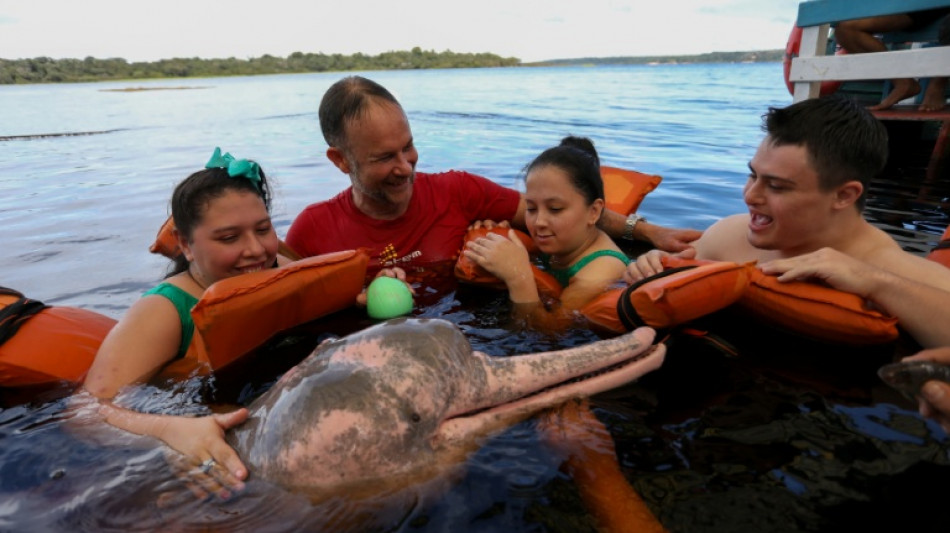
In Brazil's Amazon, dolphin therapy aids people with disabilities / Photo: MICHAEL DANTAS - AFP

 Abdul El-Sayed declares victory in Michigan Senate contest

 Democrats capture US Congress in sweeping midterm victory

 Manchester United rallies past Roma as PSG dominates in Champions League

 Qatar sees tentative opening for renewed regional diplomacy

 Qatar Tourism joins Pacific Asia Travel Association at London travel market

 Abdul El-Sayed Wins Michigan Senate Seat in Historic Election

 Qatar media bodies discuss support for humanitarian initiatives

 Galloway accuser could not foresee publishing-sector fallout, lawyer argues

 New York City Center revives In the Heights as a timely community story

 Godzilla Minus Zero shifts focus toward postwar human drama
Floating in the Rio Negro river in the Brazilian Amazon, Luiz Felipe, who has Down Syndrome, beams as he hugs a pink dolphin during a special therapy session.
Luiz Felipe, 27, is one of several patients with disabilities who traveled from the nearby city of Manaus to take part in the alternative therapy sessions, which have helped some 400 people over the past two decades.
Patients include young people who are autistic, those with cerebral palsy, Down Syndrome and others who have lost limbs.
Physiotherapist Igor Simoes Andrade, 49, who says his special form of animal therapy is "the first in the world," is not a replacement for conventional treatments.
But, it "brings them joy, happiness, contact with nature and a strength you don't have in hospital environments."
The sessions are provided free of charge, with the support of sponsors.
Hannah Fernandes, a neuropsychologist who works with children, said the unique therapy also has "social benefits," as those with disabilities come into contact with people and situations from outside their daily lives.
Before entering the water, Luiz Felipe and two young women taking part in the session, do breathing exercises and yoga to relax before coming into contact with the dolphins.
Fernandes said that the first time Luis Felipe attended one of the sessions he "hadn't dared" to enter the water. Today he is full of self-confidence.
The pink river dolphins -- known as boto -- approach the group out of curiosity, swimming between their legs and floating among them, eager for human attention.
The "bototherapy" sessions have been approved by the Ibama environmental regulator.
Simoes said the therapy helps his patients with "balance, strengthening the spine and psychomotor skills."
"Here we don't treat pathologies but human beings," he said.
L.E.Campos--PC



