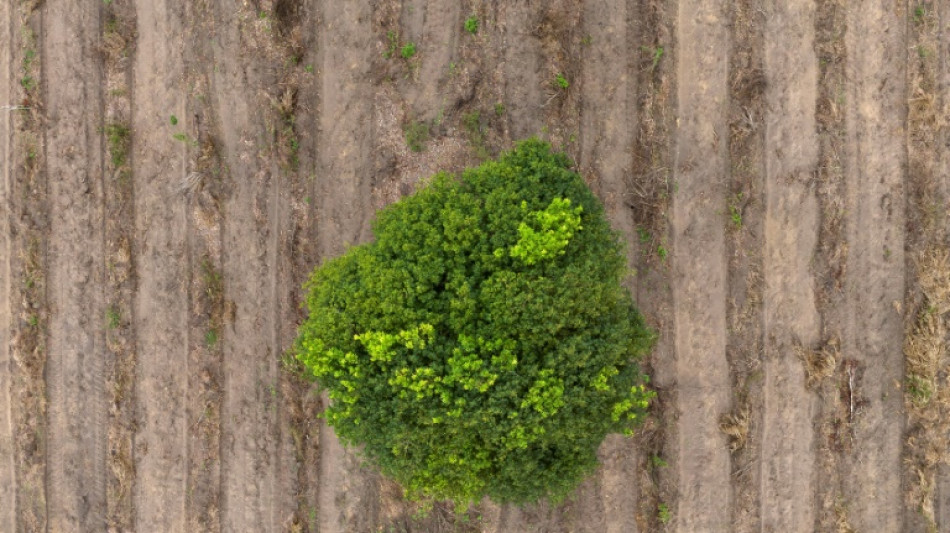
World agrees hard-fought nature funding plan at UN talks / Photo: Pablo PORCIUNCULA - AFP/File

 Indians living in Japan on stand-by to house Asian Games athletes

 Trump signs bill authorizing sweeping Russia sanctions

 Protesters form human chain at Kennedy Center after Trump threat

 Death toll from attack at police HQ in Pakistan rises to 31

 Trump says Denmark to give US 'permanent control' over Greenland security

 Kennedy Center: future unclear for iconic Washington arts hub

 Trump claims 'infinite' Greenland security deal with Denmark

 Helicopters battle wildfire threatening Ecuador's capital

 Brentford batter Chelsea to undo Alonso's promising start

 Kane hits Bundesliga century as Bayern rout Union

 Trump says CNN, MS NOW, Politico banned from White House

 Hushing and hedging: US companies retreat on climate

 Springboks to face Fiji before 2027 Rugby World Cup

 Nigeria miners struggled to breathe in cell before 37 died: survivors

 McIlroy on the charge at PGA Championship as Reed withdraws

 McIlroy on the charge at PGA Championship

 Crisis-wracked Volkswagen warns of 10-bn-euro hit to profits

 Costa Rica's Grynspan tops third informal poll for UN chief: diplomat

 Stock markets retreat after central bank rate hikes

 Russia labels director of Cannes Grand Prix winner a 'foreign agent'

 Macron warns of Russian 'hybrid' threat after meeting presidential hopefuls

 UN holds third informal poll for new chief

 Kulusevski return can spark Spurs: De Zerbi

 Shakira to cap off world tour with Madrid 12-gig run

 Isolated Syrian-Druze city blames Damascus for shortages

Nations cheered a last-gasp deal to map out nature funding to 2030 Thursday, breaking a deadlock at UN talks seen as a test for international cooperation in the face of geopolitical tensions.
Rich and developing countries hammered out a delicate compromise on raising and delivering the billions of dollars needed to protect species, overcoming stark divisions that had scuttled their previous meeting in Cali, Colombia last year.
Delegates stood and clapped in an emotionally-charged final meeting that saw the key decisions adopted in the final minutes of the last day of rebooted negotiations at the UN's Food and Agriculture Organization headquarters in Rome.
"The applause is for all of you. You have done an amazing job," said COP16 President Susana Muhamad of Colombia.
The decision maps out a way forward on funding, two years after a landmark deal to halt the rampant destruction of nature this decade and protect the ecosystems and wildlife that humans rely on for food, climate regulation and economic prosperity.
It sets out two main strands of action in the coming years -- to find billions of dollars in extra funding for biodiversity and to decide on the institutions that will deliver that money.
- 'Hope' -
Scientists have warned that action is urgent.
A million species are threatened with extinction, while unsustainable farming and consumption destroys forests, depletes soils and spreads plastic pollution to even the most remote areas of the planet.
The COP16 agreement on Thursday is seen as a key next step after a landmark 2022 agreement that saw countries agree to halt the destruction of nature by the end of this decade, including protecting 30 percent of the world's land and seas.
But the talks were also seen as a bellwether for international cooperation more generally.
The meeting comes as countries face a range of challenges, from trade disputes and debt worries to the slashing of overseas aid by new US President Donald Trump
Washington, which has not signed up to the UN's Convention on Biological Diversity, sent no representatives to the meeting.
"Our efforts show that multilateralism can present hope at a time of geopolitical uncertainty," said Steven Guilbeault, Canada's Minister of Environment and Climate Change.
The failure to finalise an agreement in Cali was the first in a string of disappointing outcomes for the planet at UN summits last year and comes as trade disputes and conflicts rattle global cooperation.
A climate finance deal at COP29 in Azerbaijan in November was slammed as disappointing, while separate negotiations about desertification and plastic pollution stalled in December.
Muhamad, who has resigned as Colombia's environment minister but stayed on to serve until after the COP16 conference, said members of her team were brought to tears by the last minute agreement.
Countries have already agreed to deliver $200 billion a year in finance for nature by 2030, including $30 billion a year from wealthier countries to poorer ones.
The total for 2022 was about $15 billion, according to the OECD.
O.Gaspar--PC



