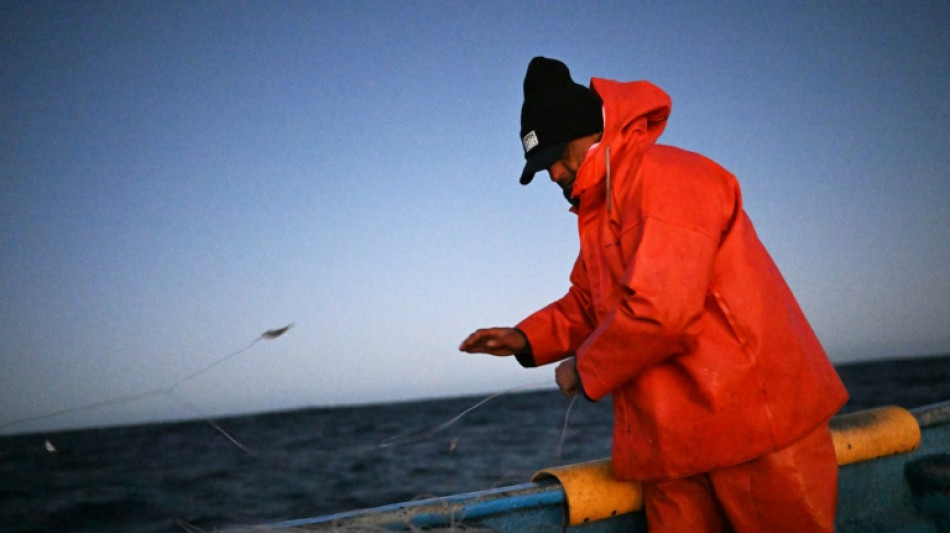
Missing merluza: Chile's battle to save its favorite catch / Photo: RODRIGO ARANGUA - AFP

 Ed Sheeran returns to stage after Palestinian controversy

 Asian Games to open in Japan after troubled build-up

 Drone owners rush to offload devices ahead of Beijing ban

 Trump's beef policies irk Texas ranchers, testing their loyalty

 Nvidia, OpenAI CEOs to attend Xi dinner at White House

 Anthropic picks Accenture for in-house AI safety evaluation

 Balogun returns as Monaco beat Lens to continue strong Ligue 1 start

 'Pause' on overt repression in Venezuela, but reforms still needed: HRW

 Global stocks mixed as yen falls despite Bank of Japan rate hike

 Cuba hit with seventh major blackout of the year

 Murray out with concussion so Wentz will start for Vikings

 UN chief 'deeply regrets' US visa refusal to Abbas for annual meeting

 England quick Carse to face no charges over alleged nightclub assault

 Mancini brings nine newcomers into the first squad of his Italy comeback

 Czechs level Davis Cup tie against USA as South Korea eye Finals

 New France boss Zidane confirms Mbappe as captain after naming first squad

 California governor signs order to explore AI 'kill switch'

 Head leads run spree as Australia win Zimbabwe ODI series

 In-form Raphinha wants to finish career at Barcelona

 Warren Buffett steps down as Berkshire Hathaway chairman

 Carrick confident Man Utd can 'work through' tough time

 Mbappe ends Nike partnership to join Swiss brand On

 Liverpool boss Iraola puts Bournemouth love affair on hold

 'A disaster' if Man City do not win says Maresca after flawless start

 Kerry James Marshall: American 'blackness' painter celebrated in Europe

Before setting sail for the South Pacific, Chilean fisherman Rodrigo Gallardo blesses himself to invoke heavenly protection and luck in his pursuit of an increasingly elusive catch: hake.
Strong winds make for a choppy seven-nautical-mile (13 kilometer) voyage from the port of Valparaiso to deep waters that decades ago were teeming with Chile's favorite fish.
But several hours later, when Gallardo reels in a longline studded with sardines (these small fry are used as bait) just a single hake has bitten.
"In the past, the hold was completely full," the 46-year-old lamented.
The South Pacific hake, or merluccius gayi, provides a living for some 4,000 small-scale fishermen in Chile, a country with over 6,000 kilometers of coastline, which has a voracious appetite for "merluza."
But the attraction for cod's more affordable cousin is proving fatal.
Along central Chile's traditional fishing heartland, more and more boats are returning to port with empty holds as overfishing and climate change decimate hake stocks.
In the past two decades, Chile's hake population has declined by 70 percent according to the Fisheries Development Institute (IFOP).
Gallardo, 46, blames years of regulations that benefitted commercial "bottom" trawlers, which use drag nets to scoop up huge amounts of deep-water fish, like hake, depleting ocean stocks.
Commercial fisheries, for their part, blame illegal fishing by small-scale fishermen like Gallardo.
- Regulations fall short -
Chile has been fighting a high stakes battle against overfishing for years.
With several species in severe decline by the early 2010s, from hake to jack mackerel and jumbo squid, the government introduced annual biomass (weight) quotas designed to determine sustainable fishing levels.
Chile also designated over 40 percent of its waters as Marine Protected Areas, where fishing is restricted, and signed up to the United Nations High Seas Treaty on protecting marine biodiversity.
A decade on, the populations of some species, such as sardines, cuttlefish and horse mackerel -- Chile's biggest fish export -- have begun to recover.
The hake numbers, however, continue to make for grim reading.
An IFOP study from 2024 showed a 17 percent drop in the biomass of hake stocks compared to the previous year.
- Drop in the ocean -
Rodrigo Catalan, conservation director of the Chilean chapter of the World Wildlife Fund, blames a mix of "illegal fishing, over-exploitation and climate change" for making hake increasingly scarce.
In 2023, authorities seized 58 tons of illegal hake, the second-largest seizure by species after anchovies.
The authorities suspect it's just a drop in the ocean.
Because hake is usually caught close to shore, it's easy to quickly reel it in without being noticed.
Much of the illegal catch winds up for sale in small quantities on markets, which also makes it difficult to detect, according to the National Fisheries Service.
Experts say climate change is also wreaking havoc with fish stocks.
Alicia Gallardo, a researcher at the University of Chile, said that rising sea temperatures was causing hake to migrate further south in search of colder currents, and was also affecting reproduction rates.
- Too many nets, too few fish -
Having to share an ever-shrinking catch -- the annual quota for hake now stands at 35,000 tons, down from 118,000 in 2001 -- has caused tempers in Chile to flare.
"There aren't enough fish for so many fishermen," Liesbeth van der Meer, director of the ocean conservation NGO Oceana remarked.
Small-scale fishermen in Valparaiso clashed with police during three days of protests in March over delays in adopting a bill that boosted their share of the catch quota for hake, among other species.
Chile's biggest commercial fishery PacificBlu threatened to close shop, with the loss of 3,200 jobs, if its share was cut but later revoked the threat.
The bill, which increases the quota for artisanal fishing from 40 percent to 45 percent, was finally adopted by the Senate this week.
A.Magalhes--PC



