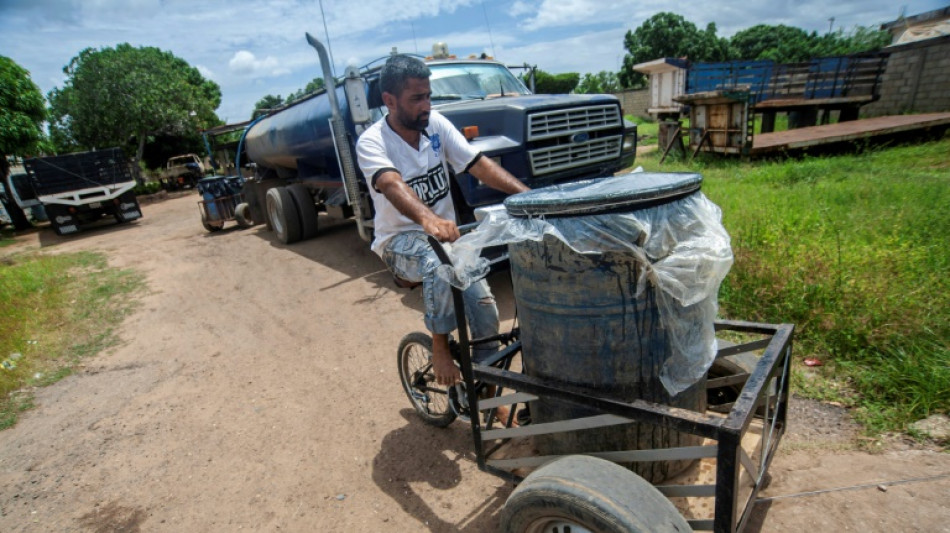
Drilling for water in Venezuela's parched oil town / Photo: Alejandro Paredes - AFP

 Ed Sheeran returns to stage after Palestinian controversy

 Asian Games to open in Japan after troubled build-up
 Drone owners rush to offload devices ahead of Beijing ban

 Trump's beef policies irk Texas ranchers, testing their loyalty

 Nvidia, OpenAI CEOs to attend Xi dinner at White House

 Anthropic picks Accenture for in-house AI safety evaluation

 Balogun returns as Monaco beat Lens to continue strong Ligue 1 start

 'Pause' on overt repression in Venezuela, but reforms still needed: HRW

 Global stocks mixed as yen falls despite Bank of Japan rate hike

 Cuba hit with seventh major blackout of the year

 Murray out with concussion so Wentz will start for Vikings

 UN chief 'deeply regrets' US visa refusal to Abbas for annual meeting

 England quick Carse to face no charges over alleged nightclub assault

 Mancini brings nine newcomers into the first squad of his Italy comeback

 Czechs level Davis Cup tie against USA as South Korea eye Finals

 New France boss Zidane confirms Mbappe as captain after naming first squad

 California governor signs order to explore AI 'kill switch'

 Head leads run spree as Australia win Zimbabwe ODI series

 In-form Raphinha wants to finish career at Barcelona

 Warren Buffett steps down as Berkshire Hathaway chairman

 Carrick confident Man Utd can 'work through' tough time

 Mbappe ends Nike partnership to join Swiss brand On

 Liverpool boss Iraola puts Bournemouth love affair on hold

 'A disaster' if Man City do not win says Maresca after flawless start

 Kerry James Marshall: American 'blackness' painter celebrated in Europe

In Venezuela's oil capital of Maracaibo, a drilling frenzy has led to dozens of new wells -- but the valuable liquid being pumped out is just water, not petroleum.
In a symbol of the woes of Venezuela's crumbling economy, the once flourishing oil town of 2 million people is parched.
Experts blame the nationwide shortage of drinking water on corruption and years of underinvestment and mismanagement by national and local governments, resulting in frequent water cuts.
The corroding infrastructure has led to schools, homes, businesses, churches and health centers all digging their own wells -- at a huge expense.
A private well costs between $1,000 and $6,000, a fortune in the sanctions-hit Caribbean country where the minimum monthly wage is around $200.
As a result, homes that come with a ready-made well and generator -- Venezuelans also live with recurring power cuts -- sell for a premium.
While water rationing has been in place in Venezuelan cities for years, the situation in Maracaibo has become critical, as pumping stations break down, old pipes leak and reservoirs run dry.
- 'It's a blessing' -
No water came out of the taps in certain parts of the city for over a month at the start of 2025.
Manuel Palmar and six other families in the lower-middle-class neighborhood of Ziruma saw the writing on the wall four years ago.
They each paid $2,500 to build a 12-meter-deep (40-foot) well, which can store up to about 80,000 liters (21,000 gallons) of spring water each week.
Now when Palmar turns on the tap, water gushes out for free.
The water is not fit for drinking due to its high salinity -- saltwater from the Caribbean Sea seeps into Lake Maracaibo, a coastal lake used as a freshwater source -- but "it's perfect for washing clothes and flushing toilets," he explained.
"It's a blessing!" the 34-year-old accountant said.
There's a solution of sorts for every budget.
Some residents fill 200-liter drums at official filling stations or communal taps for $2-$3.
Others order a water truck to fill their building's tank for between $40 and $60.
Some even recycle the water produced by the tropical city's ubiquitous air conditioners or collect rainwater.
But those are all quick fixes.
- Brackish drinking water -
Over the past six years, more and more residents have begun digging wells to guarantee their long-term supply for the future.
Gabriel Delgado has built about 20 wells in Maracaibo, including at a heart disease clinic and four private schools.
He also built one at his mother-in-law's home: a gray cement cylinder, one and a half meters in diameter, buried under metal sheeting and rocks.
Cobwebs dangle just above the water level, but as soon as he activates the pump, water pours forth.
It's crystal clear, unlike the yellowish liquid that flows from the city's taps during the rainy season, and Delgado eagerly sips it.
Venezuelans must receive authorization from health and environmental authorities before drilling a well, and they are required to provide water samples for testing to ensure it is fit for consumption once it's built.
But not everyone bothers.
Javier Otero, head of Maracaibo's municipal water department, told AFP that he had come across shallow artisanal wells built near sewers or polluted ravines.
"Some people drink water that is not potable, that is brackish," he told AFP.
The municipality has built seven wells to supply Maracaibo's poorer neighborhoods.
P.Sousa--PC



