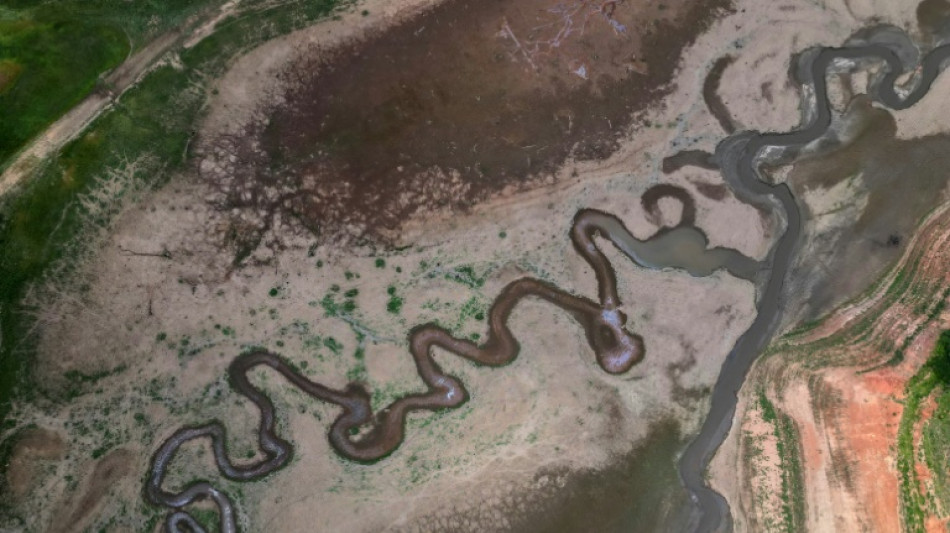
UN report declares global state of 'water bankruptcy' / Photo: Nelson ALMEIDA - AFP

 Trump's beef policies irk Texas ranchers, testing their loyalty

 Nvidia, OpenAI CEOs to attend Xi dinner at White House

 Anthropic picks Accenture for in-house AI safety evaluation

 Balogun returns as Monaco beat Lens to continue strong Ligue 1 start

 'Pause' on overt repression in Venezuela, but reforms still needed: HRW

 Global stocks mixed as yen falls despite Bank of Japan rate hike

 Cuba hit with seventh major blackout of the year

 Murray out with concussion so Wentz will start for Vikings

 UN chief 'deeply regrets' US visa refusal to Abbas for annual meeting

 England quick Carse to face no charges over alleged nightclub assault

 Mancini brings nine newcomers into the first squad of his Italy comeback

 Czechs level Davis Cup tie against USA as South Korea eye Finals

 New France boss Zidane confirms Mbappe as captain after naming first squad

 California governor signs order to explore AI 'kill switch'

 Head leads run spree as Australia win Zimbabwe ODI series

 In-form Raphinha wants to finish career at Barcelona

 Warren Buffett steps down as Berkshire Hathaway chairman

 Carrick confident Man Utd can 'work through' tough time

 Mbappe ends Nike partnership to join Swiss brand On

 Liverpool boss Iraola puts Bournemouth love affair on hold

 'A disaster' if Man City do not win says Maresca after flawless start

 Kerry James Marshall: American 'blackness' painter celebrated in Europe

 Spain coach De la Fuente offers 'full support' to people of Ceuta

 Russia seizes assets of Nestle, French firms over West's Ukraine support

 England can build on World Cup 'spirit', says Tuchel

The world is entering an era of "global water bankruptcy" with rivers, lakes and aquifers depleting faster than nature can replenish them, a United Nations research institute said on Tuesday.
It argues that decades of overuse, pollution, environmental destruction and climate pressure had pushed many water systems so beyond the point of recovery that a new classification was required.
"Water stress and water crisis are no longer sufficient descriptions of the world's new water realities," read a new report by the UN University Institute for Water, Environment and Health (UNU-INWEH).
These terms were "framed as alerts about a future that could still be avoided" when the world had already moved into a "new phase", it said.
The report proposes the alternative term "water bankruptcy" -- a state in which long-term water use exceeds resupply and damages nature so severely that previous levels cannot realistically be restored.
This was reflected in the shrinking of the world's large lakes, the report said, and the growing number of major rivers failing to reach the sea for parts of the year.
The world has lost enormous proportions of wetlands, with roughly 410 million hectares -- nearly the size of the European Union -- disappearing over the past five decades.
Groundwater depletion is another sign of this bankruptcy.
Around 70 percent of major aquifers used for drinking water and irrigation show long-term declines with rising "day zero" crises -- when demand exceeds supply -- the "urban face" of this new reality.
Climate change was compounding the problem, spurring the loss of more than 30 percent of the world's glacier mass since 1970 and the seasonal meltwater relied upon by hundreds of millions of people.
- 'Be honest' -
The consequences were visible on every inhabited continent, but not every country individually was water bankrupt, UNU-INWEH director and report author Kaveh Madani told AFP.
Madani said the phenomenon was a "warning" that a policy rethink was essential.
Instead of approaching water scarcity as something temporary, governments must "be honest" and "file for bankruptcy today rather than delaying this decision", he said.
"Let's adopt this framework. Let's understand this. Let us recognise this bitter reality today before we cause more irreversible damages," Madani added.
The report draws on existing data and statistics and does not provide an exhaustive record of all water problems, but attempts instead to redefine the situation.
It is based on a peer-reviewed report, soon to be published in the journal Water Resources Management, that will formally propose a definition of "water bankruptcy".
The report "captures a hard truth: the world's water crisis has crossed a point of no return", Tim Wainwright, chief executive of the WaterAid charity, wrote in a statement.
Some scientists not involved in the report welcomed the spotlight on water but warned that the global picture varied considerably and a blanket declaration might overlook progress being made at a local level.
H.Portela--PC



