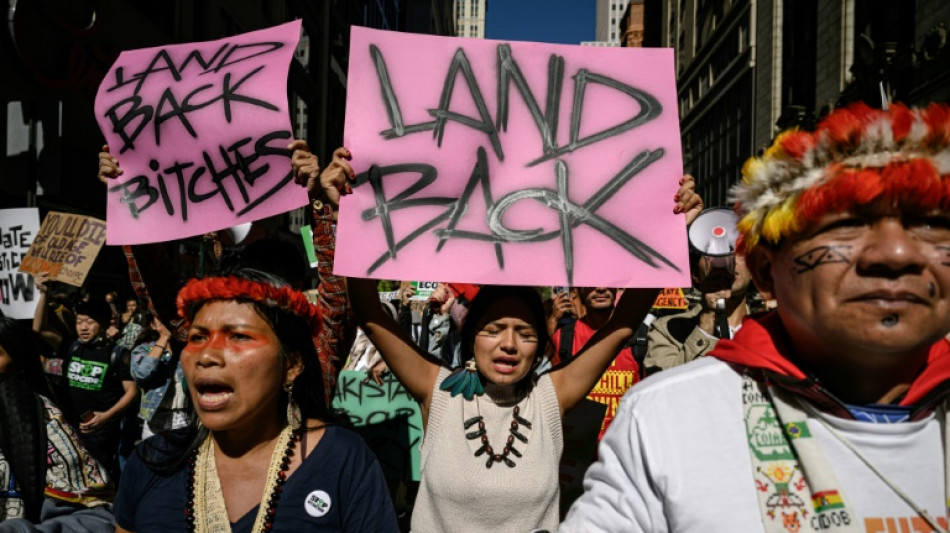
Indigenous activists raise climate awareness on sidelines of UNGA / Photo: Ed JONES - AFP

 Drone owners rush to offload devices ahead of Beijing ban

 Trump's beef policies irk Texas ranchers, testing their loyalty

 Nvidia, OpenAI CEOs to attend Xi dinner at White House

 Anthropic picks Accenture for in-house AI safety evaluation

 Balogun returns as Monaco beat Lens to continue strong Ligue 1 start

 'Pause' on overt repression in Venezuela, but reforms still needed: HRW

 Global stocks mixed as yen falls despite Bank of Japan rate hike

 Cuba hit with seventh major blackout of the year

 Murray out with concussion so Wentz will start for Vikings

 UN chief 'deeply regrets' US visa refusal to Abbas for annual meeting

 England quick Carse to face no charges over alleged nightclub assault

 Mancini brings nine newcomers into the first squad of his Italy comeback

 Czechs level Davis Cup tie against USA as South Korea eye Finals

 New France boss Zidane confirms Mbappe as captain after naming first squad

 California governor signs order to explore AI 'kill switch'

 Head leads run spree as Australia win Zimbabwe ODI series

 In-form Raphinha wants to finish career at Barcelona

 Warren Buffett steps down as Berkshire Hathaway chairman

 Carrick confident Man Utd can 'work through' tough time

 Mbappe ends Nike partnership to join Swiss brand On

 Liverpool boss Iraola puts Bournemouth love affair on hold

 'A disaster' if Man City do not win says Maresca after flawless start

 Kerry James Marshall: American 'blackness' painter celebrated in Europe

 Spain coach De la Fuente offers 'full support' to people of Ceuta

 Russia seizes assets of Nestle, French firms over West's Ukraine support

Uyukar Domingo Peas, an Ecuadorian Indigenous activist, says if there are still "reservoirs of natural resources" in the world, it is "because we have protected them for thousands of years."
Peas has been fighting against the destruction of forests for three decades and regrets that states and companies continue to destroy the Amazon despite the urgency of the climate crisis.
"The Amazon must remain intact for the youth and the rest of humanity," the 58-year-old from the Achuar nation told AFP, lamenting that governments and corporations have not sought the ancestral knowledge of Indigenous peoples to save the planet.
Peas was speaking at Environment Week, a series of independent events involving Indigenous peoples from around the world that is being held in New York on the sidelines of the United Nations General Assembly.
An estimated 80 percent of the world's tropical forests -- about 800 million hectares -- are in Indigenous territories, according to organizations that defend them.
Many Indigenous people blame capitalism for the destruction of their forests.
"We want companies and banks to stop investing for money and invest for the common good" because "climate change harms every human being," he said.
He is calling for funds to implement the Amazon Sacred Headwaters Initiative, which aims to protect 35 million hectares in the Amazon rainforest of Peru and Ecuador, and is home to 30 Indigenous communities with around 600,000 people.
He hopes that the nine countries that share the Amazon -- often referred to as the lungs of the planet, spread over nearly 300 million hectares with three million inhabitants from more than 500 peoples -- will also join this initiative.
- 'Bioeconomy' -
Peas advocates for a new "bioeconomy," with new sources of energy, tourism programs and other initiatives to ensure that Indigenous youth do not migrate away from their homelands.
"We want to take care of the jungle and live off the jungle," he said.
Compared to the large sums needed for the oil and mining projects that pollute their lands and rivers, Peas' initiative requires just $19 million over 10 years.
"Mother Earth does not expect us to save her, she expects us to respect her," said Nemonte Nenquimo, the Ecuadorian chief of the Waorani nation.
- 'Where does the money go?'-
The Covid pandemic and "the collective hysteria of oil-dependent countries" following the conflict in Ukraine have dealt a severe blow to the Indigenous climate struggle, said Levi Sucre, of the Bribri community, an Indigenous people living between Costa Rica and Panama.
With priorities set on economic recovery, Indigenous rights "have regressed alarmingly in the last two, three years," he told AFP.
He said that the most alarming case is that of Brazil, where the government "deliberately ignores the Indigenous peoples."
Indigenous peoples' representatives complain that the resources agreed upon at climate meetings barely ever reached them.
Monica Kristiani Ndoen, a young Indonesian Indigenous leader, said that "the challenge is to access climate funds directly."
"The question is where does the money go?"
For the Venezuelan Gregorio Diaz Mirabal, general coordinator of the Indigenous Organizations of the Amazon Basin (COICA), the problem is that "we are not present in the meetings where the decisions are taken."
"If you want us to continue to provide oxygen, rivers, forests, drinking water, respect our house," he said.
G.M.Castelo--PC



