Russia's nuclear force, the world's biggest

 Trump 'low-key' bets on economic pressure against Iran
 Pitch invaders take selfies with Fernandes during Man Utd friendly

 No-stress Sabalenka won't fret over lackluster 2026 results
 Hometown hero Hudson-Smith basks in Euro glory
 PSG down Aston Villa to retain UEFA Super Cup

 Trump's spokesperson Karoline Leavitt to step down

 'Imposing ignorance': US climate science under siege
 As millions gazed in awe, a swathe of Spain plunged into darkness

 Xavi named first foreign Netherlands coach since 1978

 NBA triple-double king Westbrook to retire after 18 seasons
 'Trying to bury the science': US climate research under siege
 Eurovision to bar countries at war from hosting
 Italian teenager Curtis breaks 50m backstroke world record at Europeans

 New mum Sjostrom wins 50m butterfly for 18th European gold
 Solar eclipse darkens Arctic Russia on course for Spain
 Russian economy rebounds in second quarter despite Ukrainian strikes

 NBA's Los Angeles Lakers to be sold for $12.5 bn: ESPN
 Trump sued over sale of access to Truth Social posts

 Europe looks to the skies as solar eclipse cast its shadow
 At least 44 drown after ferry overturns on Zimbabwe's Lake Kariba
 Grieving Argentine icon Messi unsure about playing on 'much longer'
 Nigeria kidnap victims escape 'hellfire' captivity beaten, malnourished

 Google unveils finder tag, new AI smartphone features
 US equities gain as inflation report eases fear of rate rise

 Colombia declares three days mourning for quake victims
President Vladimir Putin's order to place Russia's strategic forces on high alert has served as a stark reminder that he commands what experts agree is the world's biggest nuclear arsenal.
Here is a snapshot of Russia's nuclear capabilities, and how a strike might be launched.
-- The most warheads --
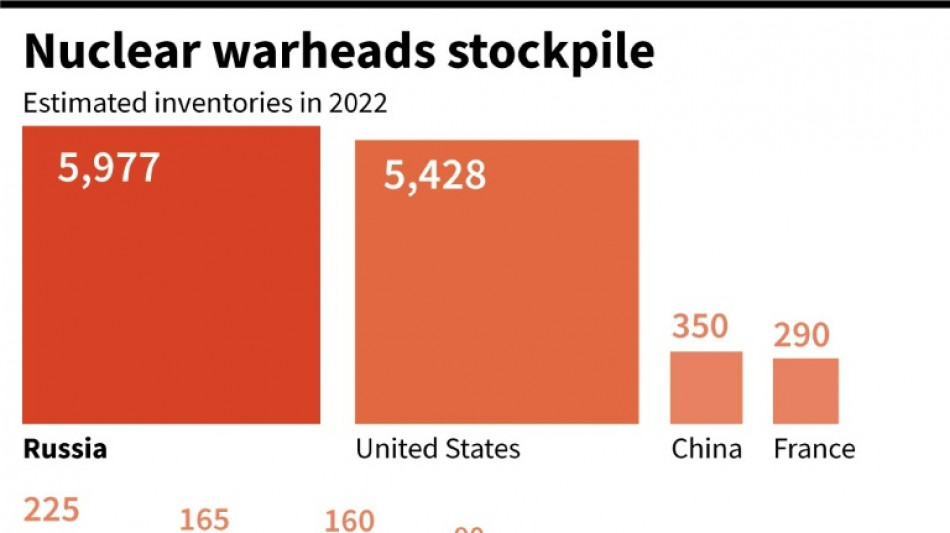
Russia owns the greatest number of nuclear warheads of any country, although the United States has more deployed, or immediately usable, warheads.
The SIPRI peace research institute in Stockholm has counted 6,255 Russian warheads against 5,550 for the US. China follows far behind with 350 and France with 290.
These figures, although widely accepted, are nevertheless estimates, notably because not all nuclear-capable weapons systems actually carry nuclear warheads.
According to the Nobel peace prize-winning International Campaign to Abolish Nuclear Weapons (ICAN), Russia spent $8.0 billion in 2020 on the building and maintenance of its nuclear arsenal.
-- Chain of command --
The Russian constitution gives the president control over nuclear weapons, but the transmission of any order to use them, and the authentification of that order, also involve the defence minister and the armed forces' chief-of-staff.
How such a scenario would play out exactly "we don't know", said Pavel Podvig, a Russian independent military expert.
The two subordinates have "no right to veto, but there is still some kind of deliberation process," he said, adding: "It's not like there is a button on the president's table, there is a procedure."
Even if a nuclear strike order should come down, there is still the question of whether the armed forces would comply.
"They are not mad and they are not sectarians," said Pavel Luzin, a Russian military expert based in Moscow at Riddle, a think tank.
Many Russian government officials may well agree with western analysts who say that Russia would have much more to lose than to gain if it unleashed nuclear war.
"I personally don't think the Russian military elite will cheer at the idea of limited nuclear use in or about Ukraine," tweeted Kristin Ven Bruusgaard at Stanford University's Center for International Security and Cooperation.
"But who will break the news to Putin that this may in fact not work?", she added.
-- Doctrine and reality --
Putin in 2020 adopted a doctrine for the possible use of nuclear weapons, experts Hans Kristensen and Matt Korda recalled in last week's issue of the "Bulletin of the Atomic Scientists".
According to the doctrine, there are four acceptable justifications for going nuclear: A ballistic missile attack against Russia or an ally, the use of a nuclear weapon by an enemy, an attack on a Russian nuclear weapons site, or any attack threatening the existence of the state.
They quoted Putin as saying that Russia -- which claims it has modernised close to 90 percent of its nuclear arsenal -- could never allow itself to "stand idle" in the face of potential enemies.
"You stop for one second and you start falling behind immediately," they quoted Putin as saying.
They added that Russian thinking may already have gone beyond the published doctrine.
"For example, officials explicitly threatened to use nuclear weapons against ballistic missile defense facilities, and in regional scenarios that do not threaten Russia's survival or involve attacks with weapons of mass destruction," they said.
"The real doctrine," they added, "goes beyond basic deterrence and toward regional war fighting strategies, or even weapons aimed at causing terror."
P.Serra--PC