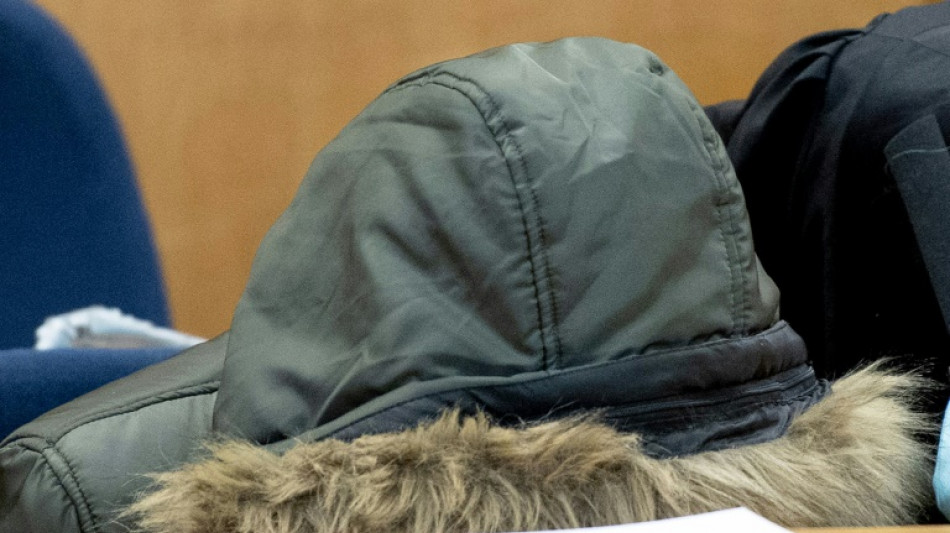
Syrian doctor in German torture trial denies atrocities

 Trump's beef policies irk Texas ranchers, testing their loyalty

 Nvidia, OpenAI CEOs to attend Xi dinner at White House

 Anthropic picks Accenture for in-house AI safety evaluation

 Balogun returns as Monaco beat Lens to continue strong Ligue 1 start

 'Pause' on overt repression in Venezuela, but reforms still needed: HRW

 Global stocks mixed as yen falls despite Bank of Japan rate hike

 Cuba hit with seventh major blackout of the year

 Murray out with concussion so Wentz will start for Vikings

 UN chief 'deeply regrets' US visa refusal to Abbas for annual meeting

 England quick Carse to face no charges over alleged nightclub assault

 Mancini brings nine newcomers into the first squad of his Italy comeback

 Czechs level Davis Cup tie against USA as South Korea eye Finals

 New France boss Zidane confirms Mbappe as captain after naming first squad

 California governor signs order to explore AI 'kill switch'

 Head leads run spree as Australia win Zimbabwe ODI series

 In-form Raphinha wants to finish career at Barcelona

 Warren Buffett steps down as Berkshire Hathaway chairman

 Carrick confident Man Utd can 'work through' tough time

 Mbappe ends Nike partnership to join Swiss brand On

 Liverpool boss Iraola puts Bournemouth love affair on hold

 'A disaster' if Man City do not win says Maresca after flawless start

 Kerry James Marshall: American 'blackness' painter celebrated in Europe

 Spain coach De la Fuente offers 'full support' to people of Ceuta

 Russia seizes assets of Nestle, French firms over West's Ukraine support
 England can build on World Cup 'spirit', says Tuchel

A Syrian doctor on trial in Germany for torture and murder while working in military hospitals in his war-torn homeland on Tuesday denied setting fire to a teenage boy's genitals or operating on detainees without anaesthesia.
Alaa Mousa, 36, who arrived in Germany in 2015 and practised medicine in the country until his arrest five years later, is on trial for crimes against humanity.
Taking the stand, he told judges at the higher regional court in Frankfurt that he "felt sorry" for patients who were beaten and blindfolded.
He firmly denied allegations of dousing a teenage boy's genitals in alcohol before setting them alight, saying he "did not do that".
He also said he did not strike detainees, and "would never" have operated on a patient without anaesthesia, as prosecutors accuse him of doing.
Instead, Mousa told the court he felt sympathy for detainees.
"I saw the military secret service beating injured detainees. I felt sorry for them, but I couldn't say anything, or it would have been me instead of the patient," Mousa told the court.
Mousa stands accused of 18 counts of torturing detainees in Damascus and the western city of Homs in 2011-12.
He also faces one count of murder for allegedly administering a lethal injection to a prisoner who resisted being beaten, according to federal prosecutors.
His case is the second landmark trial in Germany over atrocities committed by the Syrian regime during the country's civil war.
Earlier this month, another German court sentenced a former Syrian colonel to life in jail for overseeing the murders of 27 people and the torture of 4,000 others at a Damascus detention centre a decade ago.
Describing his time at the military hospital in Homs in 2011, after Arab Spring protests against President Bashar al-Assad's regime led to a brutal crackdown, Mousa said so many opposition demonstrators were brought in with injuries that it was "chaos".
Some of the detainees showed signs of having been tortured or beaten, he said.
- 'Inhumane' -
But Mousa, a civilian doctor, never asked questions, having been told by his supervisor that the military secret service was "in control" of the hospital.
On one occasion, Mousa said he witnessed a blindfolded patient, his hands tied behind his back, being beaten by military secret service and some of the military medical staff working at the hospital.
"I was very scared of the military secret service and also of the medical staff that just joined in," he told the court.
He also said he thought it was "inhumane" to keep patients blindfolded while they were being sutured or otherwise treated.
Asked whether he felt sympathy for the demonstrators, Mousa said neither he nor his family were political activists. "But I also wasn't a super supporter of the regime."
The anti-Assad protests started off peacefully, he recalled, but he said they quickly turned more "radical". "I'm against violence on either side," he added.
Mousa will address the other charges he faces on Thursday.
Prosecutors in Frankfurt say Syria's military hospitals play a key role in Assad's state-sponsored torture system, and that Mousa helped to perpetrate "a systematic attack on the civilian population".
Mousa left Syria for Germany in mid-2015, on a visa for skilled workers.
He worked in several places as an orthopaedic doctor, including in the picturesque spa town of Bad Wildungen. He was arrested in June 2020 after Syrian witnesses came forward.
The proceedings in Germany are enabled by the legal principle of "universal jurisdiction", which allows crimes of exceptional gravity to be prosecuted even if they were committed in a different country.
A German woman who moved to Syria aged 15 to join the Islamic State group went on trial in the eastern city of Halle on Tuesday, accused of aiding and abetting crimes against humanity.
J.V.Jacinto--PC