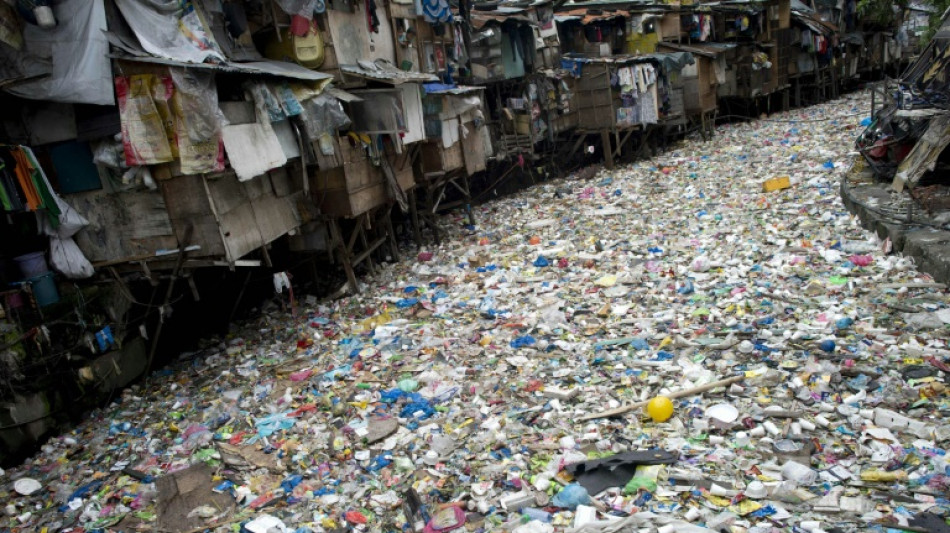
Last chance saloon for global plastic pollution treaty / Photo: Noel CELIS - AFP

 Geri Halliwell-Horner Embraces Queen Camilla at Commonwealth Writing Competition

 Meta Quest 3 and 3S Gain Access to Over 150 3D Movies

 Sarah Bajada Shares Message on Pregnancy Loss

 ALIX LASERS shareholders remove Michael Sobitsch as managing director in view of the circumstances

 Euroseas Q3 Net Profit Falls to $91.4 Million Amid Fleet Reduction

 Daily Horoscope November 20, 2026: Astrological Predictions for All Signs

 Tosca's 2026 Sustainability Report Makes the Case for Packaging as Critical Supply Chain Infrastructure
Negotiators trying to secure a global agreement on tackling the scourge of plastic pollution have less than 24 hours to salvage a deal on Thursday after the talks plunged into total disarray.
Countries wanting bold action to turn the tide on plastic garbage are so far apart from a group of oil-producing nations that the prospects of finding meaningful common ground before Friday -- after three years of talks -- seem low.
With just over a day to go, the talks chair Luis Vayas Valdivieso produced a draft text based on the few areas of convergence, in an attempt to find common ground.
But the draft succeeded only in infuriating virtually all corners and the text was immediately shredded as one country after another ripped it to bits.
For the self-styled ambitious countries, it was an empty document shorn of bold action like curbing production and phasing out toxic ingredients and reduced down to a waste management accord.
And for the so-called Like-Minded Group, with Gulf states leading the charge, it crossed too many of their red lines and did not do enough to narrow down the scope of what they might be signing up for.
Negotiators from 184 countries have been working at the United Nations in Geneva since August 5 to try to conclude a first international accord on dealing with plastic pollution.
The problem is so ubiquitous that microplastics have been found on the highest mountain peaks, in the deepest ocean trench and scattered throughout almost every part of the human body.
A fifth and supposedly final round of talks in South Korea late last year broke up without agreement -- meaning the Geneva talks are already stretching the limits.
- Stomped, spat on and burned -
Presenting his draft, Ecuadorian diplomat Vayas said the text was an attempt at capturing the elements that could lay the foundation for a treaty to be concluded Thursday, saying it "builds on those areas where convergence exists".
Colombia and Chile were first out of the blocks to brand the draft entirely unacceptable, while Panama said the red lines of the majority of countries were "not only stomped, they were spat on and they were burned".
"This is not about closing a treaty at any cost: it is about closing a wound that we're leaving open in our rivers, in our oceans. But the text presented here makes that wound fatal and we will not accept it. This is simply repulsive. It is not ambition: it is surrender."
Kenya said the text had been "significantly diluted and lost its very objective", having no "demonstrable value... to end plastic pollution".
Afterwards, France's Ecological Transition Minister Agnes Pannier-Runacher told reporters the text needed rebalancing and it was still "possible to write a text of 10 pages that takes into account all the main points".
- Remaining hours 'critical'
With ministers in Geneva for the final day of negotiations, environmental NGOs following the talks urged them to grasp the moment.
The World Wide Fund for Nature said the remaining hours would be "critical in turning this around".
"The implications of a watered-down, compromised text on people and nature around the world is immense," and failure on Thursday "means more damage, more harm, more suffering", it said.
Greenpeace delegation chief Graham Forbes called on ministers to "uphold the ambition they have promised" and address "the root cause: the relentless expansion of plastic production".
The Center for International Environmental Law's delegation chief David Azoulay said the draft was a "mockery", and as for eventually getting to a deal, he said: "It will be very difficult to come back from this".
F.Carias--PC