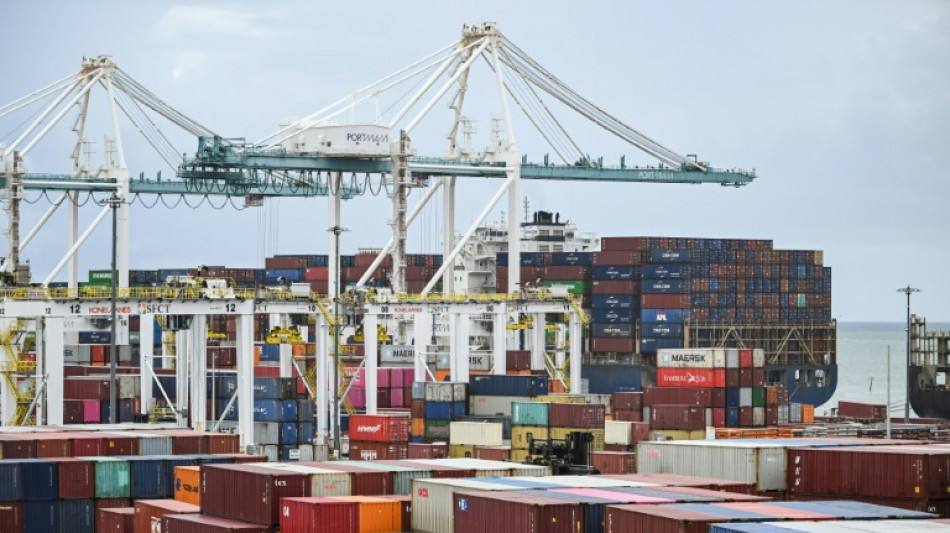
US producer inflation highest in three years in July / Photo: CHANDAN KHANNA - AFP/File

 Geri Halliwell-Horner Embraces Queen Camilla at Commonwealth Writing Competition

 Meta Quest 3 and 3S Gain Access to Over 150 3D Movies

 Sarah Bajada Shares Message on Pregnancy Loss

 ALIX LASERS shareholders remove Michael Sobitsch as managing director in view of the circumstances

 Euroseas Q3 Net Profit Falls to $91.4 Million Amid Fleet Reduction

 Daily Horoscope November 20, 2026: Astrological Predictions for All Signs

 Tosca's 2026 Sustainability Report Makes the Case for Packaging as Critical Supply Chain Infrastructure

US producer price inflation bounced in July to its highest reading since 2022, data showed Thursday, as policymakers seek to gauge effects from President Donald Trump's tariffs.
The advance, which was markedly larger than analysts expected, came as a rise in services costs exceeded that in goods.
Price pressures have been building up for businesses as they grapple with sweeping tariffs after Trump targeted most trading partners with a 10-percent levy this year, alongside steeper levels on sectors like steel and aluminum.
The producer price index (PPI) rose 0.9 percent on a month-on-month basis, hotter than analysts expected, after a flat reading in June, said the Department of Labor.
This was significantly above an analyst consensus forecast by Briefing.com, which expected a jump of 0.2 percent.
The latest numbers took the overall PPI figure to 3.3 percent, said the Bureau of Labor Statistics.
The cost uptick in goods was 0.7 percent while that of services was 1.1 percent -- marking the biggest such jump since March 2022 as well.
While the advance was "broad-based" in July, more than three-quarters of it can be traced to services, the Labor Department said.
Much of this was due to trade services, which log changes in margins for wholesalers and retailers. Economists noted this is a sign that trade disruptions are hitting supply chains.
But prices for final demand goods also made a big advance, with 40 percent of the July increase traced to foods.
"A quarter of the July advance in the index for final demand goods can be traced to prices for fresh and dry vegetables, which jumped 38.9 percent," the report said.
- 'Compounding' impact -
All of this complicates the job of the Federal Reserve as it seeks to balance inflation risks with the health of the labor market as it mulls the right time for the next interest rate cut.
"Input costs for producers jumped in July as price pressures for businesses build from compounding tariff impacts," said Nationwide senior economist Ben Ayers in a note.
"While businesses have assumed the majority of tariff costs increases so far, margins are being increasingly squeezed by higher costs for imported goods," he added.
He said that tariff price hikes were most obvious within metal and food categories, with readings for steel and aluminum -- both targeted with 50-percent levies -- jumping in recent months and adding to cost concerns for manufacturers.
Ayers expects more of the tariff burden borne by companies so far to pass through to consumer prices in the coming months.
"Tariff-exposed goods are rising at a rapid clip, indicating that the willingness and ability of businesses to absorb tariff costs may be beginning to wane," added Matthew Martin, senior economist at Oxford Economics.
G.Teles--PC