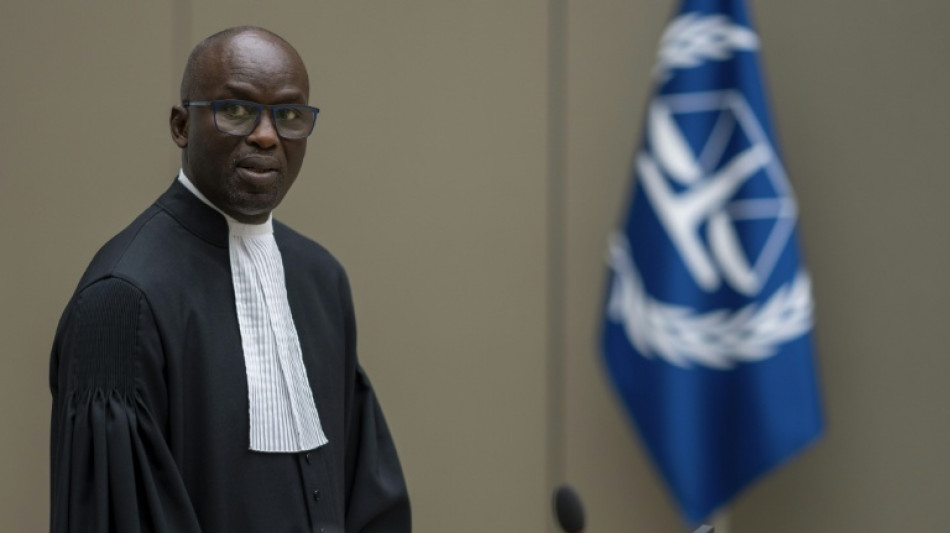
US sanctions equate us with drug traffickers: ICC dep. prosecutor / Photo: Peter Dejong - ANP/AFP

 Swiss voters expected to shun stricter neutrality
 Rapper-turned-PM faces first big test after Nepal disaster
 Tuchel seeks tonic to England World Cup 'scar' in Spain showdown
 'Helps me cope': Catholic baptisms rise among French youth
 Colombians in Santa Marta stay inside after violence wracks the city
 Iran airlines cancel flights as US sanctions hit
 Meta launches camera-free AI glasses amid privacy pushback
 Australian PM says OpenAI hacked government health website

 Xi arrives in US to personal Trump welcome
 Morocco elects new parliament amid social frustration, youth discontent
 Scheffler and Burns to face Im and Lee in Presidents Cup opener
 Crushing wins for Lyon and Barca in women's Champions League
 Rio breaks record for rainiest September amid powerful El Nino
 At UN, tech chiefs urge caution in AI development
 Russian strikes kill seven in Ukraine, Zelensky vows winter campaign
 Venezuelan shot by ICE needs urgent medical care, mother tells AFP
 Zelensky says Putin using fighters from 47 countries in Ukraine war
 Klopp calls on Germany to 'rise above ourselves' as new era begins

 Russian strikes kill seven in Ukraine as Russia vows no 'pause' to war

 ArcPoint Expands Globally with Institutional Intelligence Platform for Modern Investors
 Ronaldo focussing on 'present' ahead of Wales test

 Outgoing UN chief makes final climate push at New York summit
 Grief and pain flow at hearing for Canadian suicide poison vendor
 Ireland boss Hallgrimsson says timing of Israel remarks 'not clever'
 Weinstein resentenced to 15 years in prison for 2006 sex assault
The deputy prosecutor of the International Criminal Court on Friday lashed out at US sanctions, arguing they effectively put top court officials on a par with "terrorists and drug traffickers".
In a wide-ranging interview with AFP, Mame Mandiaye Niang also said it would be "conceivable" to hold an in-absentia hearing against high-level ICC targets such as Israel's Prime Minister Benjamin Netanyahu.
Sixty-five-year-old Niang, along with top ICC judges, is subject to sanctions from the administration of US President Donald Trump, in retaliation at the court's arrest warrants for Netanyahu over Israel's campaign in Gaza.
"You can disagree with what we're doing. That happens all the time," Niang told AFP in a one-to-one interview on the sixth floor of the ICC's building in The Hague.
"But even if we upset you, you should never put us on the same list as terrorists or drug traffickers. That is the message" to Trump.
Niang said the sanctions affected several areas of his personal, family, and financial life.
He found himself unable to charge up his hybrid car because it required a credit card that had been blocked due to the sanctions.
"I have a subscription that has absolutely nothing to do with the United States, but I need a credit card. And my credit card was American Express," he said.
"So I found that all of a sudden, I couldn't even charge up my car."
Niang said he was unable to transfer money to family members for fear their accounts would also be blocked.
Sanctions have a place in international relations, the prosecutor told AFP, but attacking the ICC -- the world's only permanent court to try war crimes suspects -- risks "de-legitimising" the instrument.
- Putin, Netanyahu hearings 'conceivable' -
Niang said it was frustrating that arrest warrants against Netanyahu and Putin has not resulted in a court appearance.
The ICC has no police force and relies on countries to arrest suspects and transfer them to the court -- extremely unlikely in the case of Putin or Netanyahu.
However, he pointed to an unprecedented hearing against fugitive Ugandan rebel leader Joseph Kony earlier this year, held in absentia.
Could such a "confirmation of charges" hearing take place for the leaders of Russia or Israel?
"It's conceivable," said. "We tested it in the Kony case. It's a cumbersome process. But we tried it and we realised it was possible and useful."
The advantages of such a hearing are to preserve evidence and also to give a voice to victims, said the prosecutor.
But any request for such a hearing would require the consent of judges and would not be a trial, just a confirmation of the charges against the suspect.
- 'Poisoned the atmosphere' -
Niang is currently acting chief prosecutor of the ICC, in the absence of Karim Khan, on leave pending an investigation into sexual abuse allegations that he denies.
"Even if they are only accusations, it disturbs us and it has poisoned the atmosphere of the court," said Niang.
"It is all the more unfortunate because it has been exploited to almost sabotage what we are doing, notably in the Palestine case," added Niang.
Israel has alleged Khan issued "baseless and outrageous" warrants against Netanyahu and former defence minister Yoav Gallant to distract from the sexual abuse accusations.
Niang welcomed the investigation into the Khan allegations but said the case was undoubtedly a hindrance.
The accusations "are out there and that is enough to cast a veil of doubt over what we're doing," he said.
- 'Work to do' -
Despite the challenges facing the court, Niang was combative.
"At this time when our existence is under threat, the world needs us more than ever," he argued.
He pointed to successes this year, such as the arrest of former Philippines president Rodrigo Duterte and the conviction of a feared Sudanese militia chief.
For many years, the ICC focused on African suspects but now had investigations running in Latin America, Asia, and even Europe with Ukraine, he noted.
Mass crimes are being committed daily and the court is there to try those crimes, said the Senegalese jurist.
"The court is here and we would love for it not to be needed. Unfortunately, the world is as it is and we still have work to do."
C.Amaral--PC