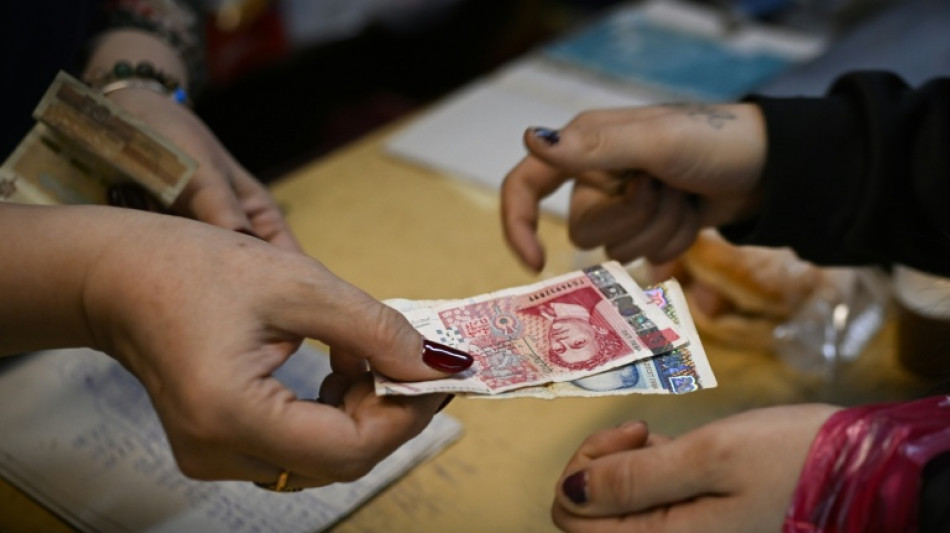
Bulgaria adopts euro amid fear and uncertainty / Photo: Nikolay DOYCHINOV - AFP

 Alex Bodi and Prof. Dr Stefan Haupt agree to collaborate on a legendary art collection in Romania

 Stocks dip, oil rises as traders eye chances of Iran deal

 Israel squeezing UN Palestinian refugee agency ahead of polls: chief

 Dutch to resume Eurovision with new broadcaster
 Man Utd losses jump despite record revenues

 Ethiopia's Tigray rebels seize airports, clash with govt forces
 China prodigy wins third Games gold as North Korea weightlifters roar

 China's Yu, 13, wins third Asian Games gold but has 'some regrets'
 Oil falls, stocks steady as Trump hails 'good' Iran talks
 UK sets up unit to combat disinformation from Russia, AI

 ICC convicts C.Africa rebel leader

 China's Yu, 13, wins third gold with latest Asian Games record
 UK says will revisit Chagos deal after latest Trump criticism

 In first, French presidential candidate gives birth during campaign
 Cambodia no 'safe haven' for cyberscams, PM says
 North Korea weightlifter sets three world records for Asian Games gold

 A Full Moon for Every Child: STARTRADER's STARCARES Brings Support to SOS Children's Village Ho Chi Minh City

 Meta leans into AI, smart glasses amid privacy pushback
 Battered Duerer masterpiece up for five-year revamp

 Trump met with Venezuela's interim leader at UN

 Malaysia furore after Najib wins conditional house arrest

 Italy hope for new dawn under Mancini

 Mongolian herders enlist new tech against harsher, drier climate
 Tata turmoil shines light on India succession woes
 World Cup 'not enough' as Spain begin next chapter

Bulgaria will become the 21st country to adopt the euro on Thursday, but some believe the move could bring higher prices and add to instability in the European Union's poorest country.
A protest campaign emerged this year to "keep the Bulgarian lev", playing on public fears of price rises and a generally negative view of the euro among much of the population.
But successive governments have pushed to join the eurozone and supporters insist it will boost the economy, reinforce ties to the West and protect against Russia's influence.
The single currency first rolled out in 12 countries on January 1, 2002, and has since regularly extended its influence, with Croatia the last country to join in 2023.
But Bulgaria faces unique challenges, including anti-corruption protests that recently swept a conservative-led government from office, leaving the country on the verge of its eighth election in five years.
Boryana Dimitrova of the Alpha Research polling institute, which has tracked public opinion on the euro for a year, told AFP any problems with euro adoption would be seized on by anti-EU politicians.
Any issues will become "part of the political campaign, which creates a basis for rhetoric directed against the EU", she said.
While far-right and pro-Russia parties have been behind several anti-euro protests, many people, especially in poor rural areas, worry about the new currency.
"Prices will go up. That's what friends of mine who live in Western Europe told me," Bilyana Nikolova, 53, who runs a grocery store in the village of Chuprene in northwestern Bulgaria, told AFP.
- 'Substantial' gains -
The latest survey by the EU's polling agency Eurobarometer suggested 49 percent of Bulgarians were against the single currency.
After hyperinflation in the 1990s, Bulgaria pegged its currency to the German mark and then to the euro, making the country dependent on the European Central Bank (ECB).
"It will now finally be able to take part in decision making within this monetary union," Georgi Angelov, senior economist at the Open Society Institute in Sofia, told AFP.
An EU member since 2007, Bulgaria joined the so-called "waiting room" to the single currency in 2020, at the same time as Croatia.
The gains of joining the euro are "substantial", ECB president Christine Lagarde said last month in Sofia, citing "smoother trade, lower financing costs and more stable prices".
Small and medium-sized enterprises stand to save an equivalent of some 500 million euros ($580 million) in exchange fees, she added.
One sector expected to benefit in the Black Sea nation is tourism, which this year generated around eight percent of the country's GDP.
- Stability needed -
Lagarde predicted the impact on consumer prices would be "modest and short-lived", saying in earlier euro changeovers, the impact was between 0.2 and 0.4 percentage points.
But consumers -- already struggling with inflation -- fear they will not be able to make ends meet, according to Dimitrova.
Food prices in November were up five percent year-on-year, according to the National Statistical Institute, more than double the eurozone average.
Parliament this year adopted empowered oversight bodies to investigate sharp price hikes and curb "unjustified" surges linked to the euro changeover.
But analysts fear wider political uncertainty risks delaying much needed anti-corruption reforms, which could have a knock-on effect on the wider economy.
"The challenge will be to have a stable government for at least one to two years, so we can fully reap the benefits of joining the euro area," Angelov said.
N.Esteves--PC