
-
 DiDi Advances Robotaxi Operations in China with New R2 Vehicle and Expanded Safety Infrastructure
-
Kauaʻi Writers Garden Challenges Honolulu-Centric Literary Scene

-
 Freezz Italia Awarded ESA Contract for IRIS(2) Low-LEO Pre-Operational and De-Risk Activities
-
RBI Grants Paytm In-Principle Approval to Revive Wallet Business

-
 French Economy Shrinks 0.1% as Consumer Confidence Slumps
-
China's Factory Activity Contracts as Export Orders Weaken

-
 Wall Street Ends Turbulent Week Higher Despite Inflation and AI Jitters
-
US Retail Sales and Fed Minutes Set Up a Critical Test for Consumers

-
 Kansas City Fed Chief Says Inflation Is Still Running Too Hot
-
MotorTrend’s Top Hybrid Vehicle Picks for 2026

-
 Oil Heads for Second Weekly Loss as Supply Surplus Emerges
-
Asian Markets Slide as AI Concerns Hit Chip Stocks

-
 Middletown High School Football Team Ends Legal Battle After Playoff Forfeit
-
Brazil Faces Debt and Inflation Test as Lula Prepares Fourth Term

-
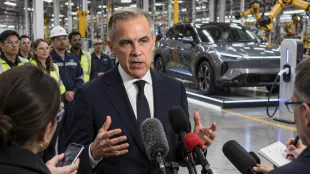 Canada Signals Openness to Chinese Automakers if US Trade Talks Fail
-
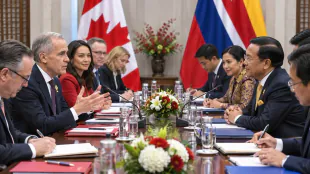
Canada Expands Asian Trade Push as US Negotiations Resume
-
 US Mortgage Rate Falls for Fourth Week but Remains Above 7%
-
Jennie Earns Two Grammy Nominations as Major K-pop Agencies Boycott New Asian Pop Category

-
 US Jobless Claims Rise to 200,000 but Layoffs Remain Historically Low
-
Italy Raises 2026 Growth View but Warns Energy Will Keep Inflation High

China, Canada reach 'landmark' deal on tariffs, visas
Canada's Prime Minister Mark Carney and Chinese President Xi Jinping agreed on a raft of measures from trade to tourism on Friday at the first meeting between the countries' leaders in Beijing in eight years.
The Canadian premier hailed a "landmark deal" under a "new strategic partnership" with China, turning the page on years of diplomatic spats, retaliatory arrests of each other's citizens and tariff disputes.
Carney has sought to reduce his country's reliance on the United States, its key economic partner and traditional ally, as President Donald Trump has aggressively raised tariffs on Canadian products.
"Canada and China have reached a preliminary but landmark trade agreement to remove trade barriers and reduce tariffs," Carney told a news conference after meeting with Xi.
Under the deal, China -- which used to be Canada's largest market for canola seed -- is expected to reduce tariffs on canola products by March 1 to around 15 percent, down from the current 84 percent.
China will also allow Canadian visitors to enter the country visa-free.
In turn, Canada will import 49,000 Chinese electric vehicles (EVs) under new, preferential tariffs of 6.1 percent.
"This is a return to the levels that existed prior to recent trade frictions," Carney said of the EV deal.
Welcoming Carney in the Great Hall of the People, Xi said China-Canada relations reached a turning point at their last meeting on the sidelines of the APEC summit in October.
"It can be said that our meeting last year opened a new chapter in turning China–Canada relations toward improvement," Xi told the Canadian leader.
"The healthy and stable development of China–Canada relations serves the common interests of our two countries," he said, adding he was "glad" to see discussions over the last few months to restore cooperation.
- 'Right track' -
Ties between the two nations withered in 2018 over Canada's arrest of the daughter of Huawei's founder on a US warrant, and China's retaliatory detention of two Canadians on espionage charges.
The two countries imposed tariffs on each other's exports in the years that ensued, with China also accused of interfering in Canada's elections.
But Carney has sought a pivot, and Beijing has also said it is willing to get relations back on "the right track".
The Canadian leader, who on Thursday met with Premier Li Qiang, is also scheduled to hold talks with business leaders to discuss trade.
Canada, traditionally a staunch US ally, has been hit especially hard by Trump's steep tariffs on steel, aluminium, vehicles and lumber.
Washington's moves have prompted Canada to seek business elsewhere.
In October, Carney said Canada should double its non-US exports by 2035 to reduce reliance on the United States.
But the United States remains far and away its largest market, buying around 75 percent of Canadian goods in 2024, according to Canadian government statistics.
While Ottawa has stressed that China is Canada's second-largest market, it lags far behind, buying less than four percent of Canadian exports in 2024.
B.Godinho--PC



