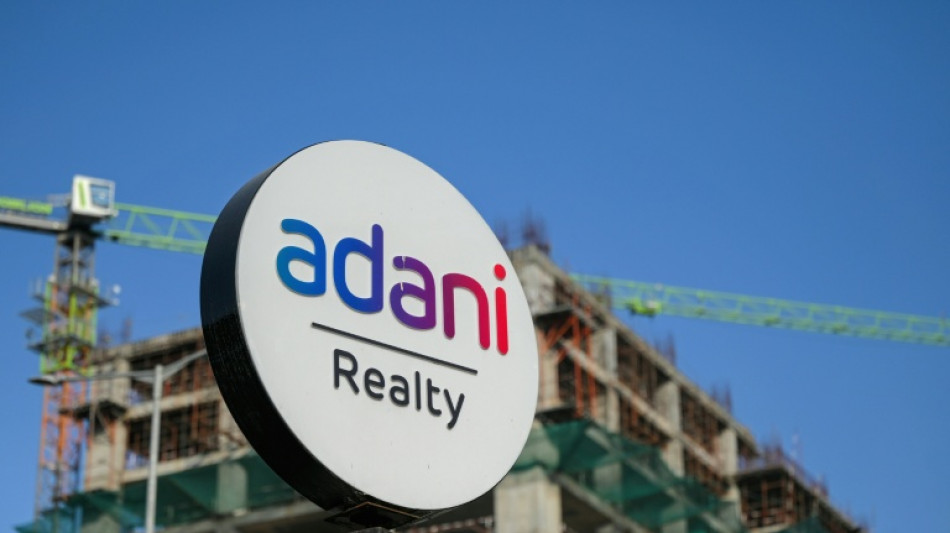
India's solar-panel boom: full throttle today, uncertain tomorrow / Photo: Shammi MEHRA - AFP

 Infantino proposes consulting federations to reform FIFA

 El Nino weather pattern enters record territory: scientist

 OpenAI calls for US to lead global effort on AI standards

 South African ostriches plucked alive for luxury fashion: report

 US networks halt Trump coverage in revolt over White House ban

 Paramount settles with US states to clear Warner Bros. mega-merger
 Climate crisis a job for world leaders, not just activists: UK FM

 US networks halt Trump coverage over White House ban

 French singer accuses Miley Cyrus of plagiarism

 EU fines Google 403 mn euros for location data breach

 'Best is yet to come,' says De la Fuente after Spain extension

 Why diesel prices are rising more than crude oil

 COP31 host says AI's climate footprint to be a summit priority

 Renewables hit record in 2025, but world must move faster: report

 US media outlets to sue Trump administration after White House ban

 Global stocks rally on lower oil prices, US-China hopes

 EU proposes energy rating for data centres

 Schoolgirl Yu scorches to second gold as doping case rocks Games

 Putin's party secures record score in Russia election

 Haupt Koleksiyonu: Paranın Biz İnsanlar Hakkında Anlattıkları

 Spanish PM says unregulated AI could be 'devastating'

 Yu, 13, smashes record again with second Asian Games gold

 Switzerland to play without Xhaka over fake Covid certificate

 From Korean Chipmakers to Leveraged Semiconductor ETFs: STARTRADER Launches 49 New 24/7 Stock and ETF CFDs

 Thai badminton player first doping case at Asian Games: testers

The race for green energy is on. India, driven by soaring electricity demand and a push to reduce reliance on China, is rapidly producing solar panels, fuelling a booming yet uncertain market.
At the Adani Group's factory in Mundra, in India's western state of Gujarat, assembly lines churn out photovoltaic panels around the clock.
Up to 10,000 a day come off the line, with most sent straight to Khavda, further north, where the Indian conglomerate is finishing what will be the world's largest solar park.
But Adani Solar's CEO, Muralee Krishnan, says operations are "actually lagging".
"Our capacity needs to be fully used -- we should work 48 hours a day."
The intensity is matched by other major producers in the world's most populous nation.
At the Tata conglomerate factory in Tirunelveli, in the southern state of Tamil Nadu, 4,000 mostly women employees also work non-stop shifts.
"They operate 24/7, so you get better yield, better efficiency, better productivity," said Praveer Sinha, CEO of Tata Power.
"You cannot stop the production line... there is a rush to produce to maximise the output."
With the twin imperatives of development and lower carbon emissions, India has set itself ambitious renewable energy targets.
Last year, it said half its electricity-generation capacity was now "green", five years ahead of the timeline set in the Paris Agreement on lowering emissions.
But 75 percent of electricity is still generated by coal-fired power plants, with inflexible operations and long-term coal power purchase agreements hampering renewable uptake.
- 'Make in India' -
There are signs of change.
Last year, coal-fired power generation fell three percent, only the second full-year drop recorded in half a decade, according to the Centre for Research on Energy and Clean Air.
Renewable capacity of 230 gigawatts (GW) is set to rise to 500 GW by 2030, including 280 GW of solar.
But Prime Minister Narendra Modi has placed another constraint on the industry: "Make in India."
That means there is no question of importing solar panels from China, which supplies 90 percent of the world's market.
All public tenders require "local" production, which India supports with substantial subsidies that have attracted big businesses.
Tata, a pioneer in solar panels since the 1990s, has been joined by Adani and Reliance, which have built state-of-the-art, highly automated factories.
"The quality of the product is very, very critical," said Ashish Khanna, CEO Adani Green Energy.
"When you are building a project of this size, you also need to be very reassured of the supply chain. We cannot have a disruption or interruption in that particular process."
But for now, the technology and raw materials still come from China.
And Beijing has complained to the World Trade Organization over the subsidies and restrictions on its solar panels.
The solar push is so intense that Adani is considering silicon mining to secure a key raw material, company insiders say, and there are suggestions Tata Power is eyeing in-house silicon-wafer production.
- 'A huge market' -
Growth in the sector is already staggering, with solar manufacturing capacity expected to soon exceed 125 GW, according to consultancy Wood Mackenzie said.
But that is triple current domestic demand, according to Wood Mackenzie analyst Yana Hryshko.
Government incentives have "been highly effective in spurring factory announcements, but the industry is now seeing warning signs of rapid overcapacity", Hryshko said in a report last year.
The sector's long-term sustainability may therefore depend on exports, with some companies already targeting global markets.
"Solar is a huge market: the world will see it doubling, from 2,000 GW to 4,000 GW in four years," said Ashish Khanna, head of the International Solar Alliance.
"The question is now -- will Indian manufacturers be globally competitive compared to China?"
Tejpreet Chopra, from the private power company Bharat Light and Power, points out that "the problem is that it's cheaper to import from China than to buy local".
And the level of manufacturing in China "is so much higher that it's very difficult to match", he added.
The sector also faces "geopolitical" headwinds from US President Donald Trump's tariffs, with Chopra adding that they make it "very difficult to sell to the United States".
Despite these challenges, the head of Tata Power, which does not yet export, remains convinced his business has a bright future.
"We strongly believe," said Praveer Sinha, "that solar will play a very important role in the renewable space of India."
G.Teles--PC