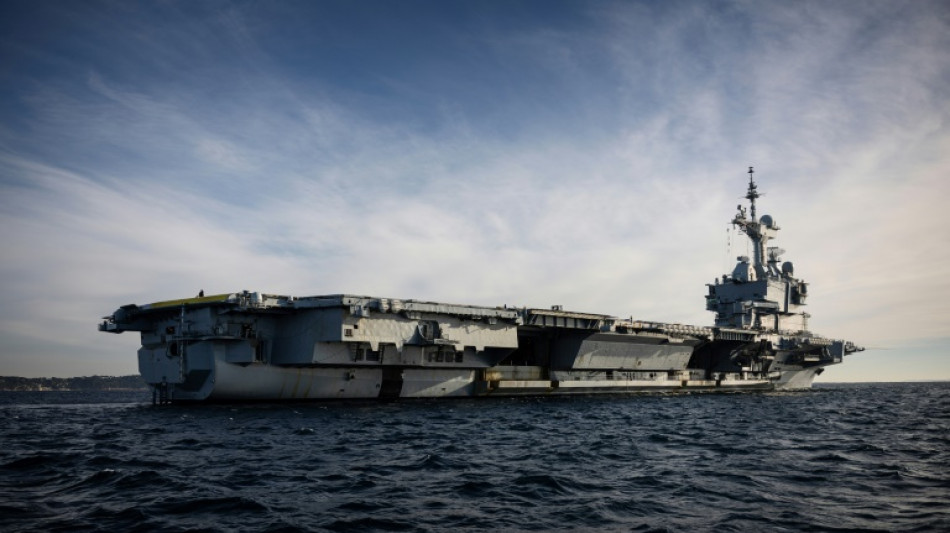
France deploys aircraft carrier to Mediterranean over Iran war / Photo: CLEMENT MAHOUDEAU - AFP/File

 China and Gabon Elevate Ties to 'Shared Future' Amid State Visit

 World Golf Awards 2026 to be Hosted at Egypt’s Madinaty Golf Club

 12 Billion Gallons of Raw Sewage Discharged into Chicago River Despite Deep Tunnel Infrastructure

 Edmund Richardson Wins Baillie Gifford Prize for 'Alexander' Biography

 BYD Drops Rotating Screens in New Models Due to Tech Limits
France is sending its flagship aircraft carrier to the Mediterranean in response to the widening conflict in the Middle East, President Emmanuel Macron announced Tuesday.
"I have ordered the Charles de Gaulle aircraft carrier, its air assets, and its escort of frigates to set course for the Mediterranean," he said in a televised speech a day after he warned of the risk of the conflict spilling over Europe's borders.
The Charles de Gaulle carrier has been pulled out of a deployment in the North Atlantic. It made one stopover in the Swedish port of Malmo last week.
Macron said he was also sending additional air defence units to Cyprus, a day after Iranian-made drones hit the British Royal Air Force (RAF) base of Akrotiri in the Mediterranean island.
He said the frigate Languedoc and the "additional air defence assets" would arrive off Cyprus on Tuesday, as the conflict spreads after the United States and Israel launched attacks against Iran on Saturday. Britain has also put a warship in position off Cyprus.
"The United States of America and Israel decided to launch military operations, conducted outside international law, which we cannot approve of," the French president said.
But "the Islamic republic of Iran bears primary responsibility for this situation," he said, citing Iran's "dangerous" nuclear programme, support for regional proxies, and orders to shoot "its own people" during protests in January.
Iran has responded by targeting Gulf states, Israel and US facilities across the Middle East, as well as threatening shipping in the area.
- 'Self-defence' -
"Today, the Strait of Hormuz is effectively closed. Around 20 percent of the world's oil and liquefied natural gas passes through this strait," Macron said. "The Suez Canal and the Red Sea are also under strain and under threat."
"We have taken the initiative to build a coalition in order to pool the necessary resources, including military ones, so that traffic can be restored and secured in these sea lanes that are essential to the global economy," he added.
Macron said French forces had downed drones "in self-defence" during the opening hours of the conflict.
"We reacted immediately and shot down drones in self-defence in the early hours of the conflict to defend the airspace of our allies, who know they can count on us," Macron said, referring to defence agreements with Qatar, Kuwait and the United Arab Emirates.
Earlier, Foreign Minister Jean-Noel Barrot said France had deployed Rafale fighter jets over the UAE to protect its naval and air bases.
France has hundreds of navy, air force and army personnel in the UAE. Its Rafale aircraft are stationed at Al-Dhafra base near Abu Dhabi.
"These Rafales and their pilots are mobilised to ensure the security of our facilities," Barrot told BFMTV in response to a question on French action over the weekend to neutralise Iranian drones.
Barrot said that a hangar at a French base in the UAE was "hit by a drone" on Sunday.
A.Aguiar--PC