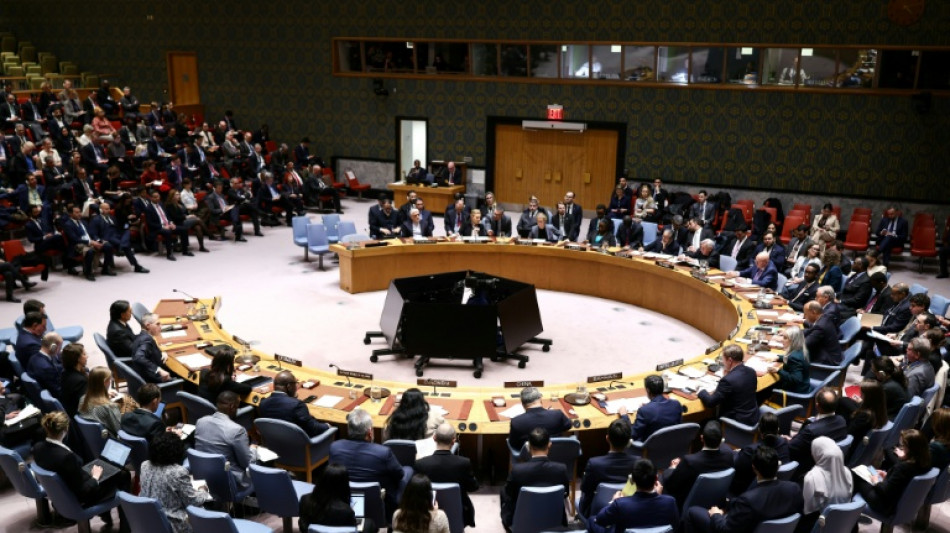
UN Security Council demands Iran halt attacks on Gulf states / Photo: CHARLY TRIBALLEAU - AFP

 China and Gabon Elevate Ties to 'Shared Future' Amid State Visit

 World Golf Awards 2026 to be Hosted at Egypt’s Madinaty Golf Club

 12 Billion Gallons of Raw Sewage Discharged into Chicago River Despite Deep Tunnel Infrastructure

 Edmund Richardson Wins Baillie Gifford Prize for 'Alexander' Biography

 BYD Drops Rotating Screens in New Models Due to Tech Limits
The UN Security Council on Wednesday called for Iran to halt its attacks on Gulf states, in a resolution that did not mention US or Israeli strikes on Iran, prompting Tehran's ambassador to decry a "blatant misuse" of the international body.
The resolution, passed by 13 votes with two abstentions, "demands the immediate cessation of all attacks by the Islamic Republic of Iran against Bahrain, Kuwait, Oman, Qatar, Saudi Arabia, the United Arab Emirates, and Jordan."
It also "condemns any actions or threats by the Islamic Republic of Iran aimed at closing, obstructing, or otherwise interfering with international navigation through the Strait of Hormuz."
Iran has repeatedly struck Gulf states in retaliation to US-Israeli attacks that killed Iranian supreme leader Ayatollah Ali Khamenei and continue to pummel Iranian sites.
The Islamic republic has also fired on commercial ships passing through the Strait of Hormuz, a crucial sea passage for the global fuel trade, in a bid to inflict pain on the global economy.
Jamal Fares Alrowaiei, the UN ambassador of Bahrain, which introduced the resolution sponsored by 135 countries, said its passing reflected the Gulf's key role in the global economy.
"This is why ensuring the security of this region is not merely a regional matter, it is a common international responsibility that is closely linked to the stability of the global economy and energy security," Alrowaiei told the Security Council.
Veto-holders China and Russia both abstained from the Security Council vote, angered that the resolution did not acknowledge US-Israeli hostility towards Iran.
Iranian ambassador Amir Saeid Iravani said adoption of the text represented a "blatant misuse of the Security Council mandate in pursuit of the political agendas" of the United States and Israel.
"Let me make it clear, this resolution is a manifest injustice against my country, the main victim of a clear act of aggression," he said.
The United States, which backed the text, said its adoption reflected a broad condemnation of Iranian strikes.
"Iran's strategy of sowing chaos, of trying to hold their neighbors hostage, trying to shake the resolve of the region, has clearly backfired, as shown by this vote today," said US ambassador Mike Waltz.
X.Brito--PC