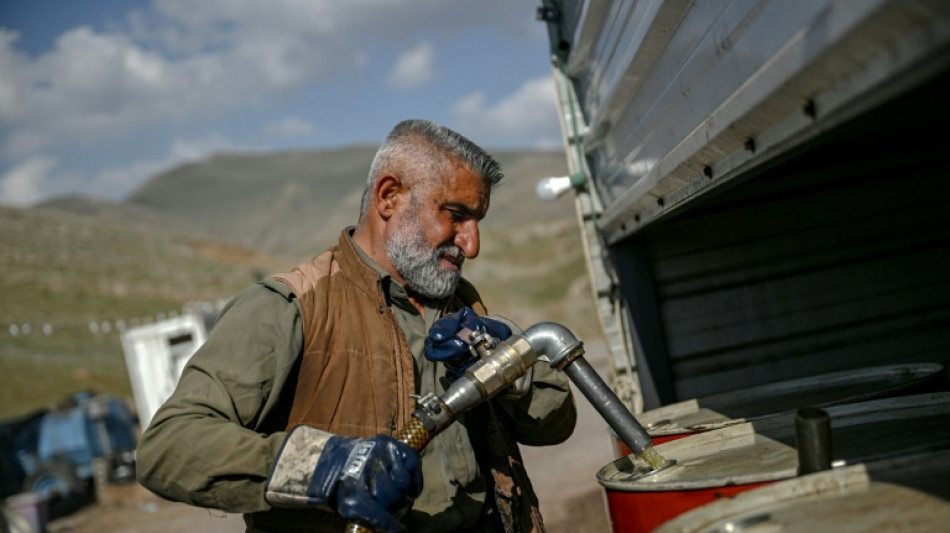
War forces lengthy detours for Iranian truck drivers to Iraq / Photo: Ozan KOSE - AFP

 Germany blames Russia for airport drone incident, hits back with sanctions
 Iran president urges return to truce, hails Russian support

 Aster and World Liberty Financial Launch USD1 RWA Boost: Phase 1, Offering 125M $WLFI + 6.25M USD1 in Rewards

 Tronchon sprints to Vuelta stage 10 win, Mas keeps red jersey

 Germany defender Rudiger announces international retirement
 Musk defends AI data centers, slams EU rules at G20
 Activists blame Kenya for Ugandan opposition figure's plight
 Iran president offers US olive branch, hails Russian support

 TrustFinance Community Choice Awards 2026 Opens Global Voting

 Nepal disaster a climate 'warning signal': foreign minister

 France winger Diaby returns to Leverkusen until 2031

 Barcelona confirm Jesus arrival from Arsenal
 EU official says it's not time to 'normalize' Russia at G20 finance talks
 RedHill Announces Transformational Acquisition of Commercialization Rights to Ferring’s Rebyota® and Clenpiq®
 TrendEadvisor Launches Global Multi-Asset Platform Combining Online Investing with Social Trading

 India's top court drops criminal cases against protesters

 Philippine couple married in hip-deep floodwaters

 Villa sign Senegal winger Mbaye from PSG
 Former Peru minister last-minute contender for UN labour agency helm

 Messi legacy will 'live forever', says Beckham
 'Literally tasting the smoke': Malaysians suffer as haze worsens

 Kyiv's defences, 'hybrid' threat from Moscow headline EU talks
 Oil extends gains, stocks mostly down as Trump issues fresh Iran warning
 ThinkMarkets Expands Weekend Trading Offering, Launches Weekend League Competition

 Tibet activists accuse China of downplaying floods
Rubbing his hands together to warm them, Iranian truck driver Reza curses the more than 300-kilometre detour he was forced to make to enter Iraq after the war closed most of the usually busy border crossings.
Originally from the small town of Piranshahr in northwestern Iran, he normally drives just 20 minutes to the Haji Omeran crossing, but it has been shut since the start of Israeli-US air strikes on Iran on February 28.
"I waited five nights, it never opened," he told AFP on Wednesday in the car park on the Iraqi side of another border crossing further south, Bashmarq, which also connects Iran to Iraq's Kurdistan region.
Like the other drivers who spoke to AFP, Reza is being identified by a pseudonym, having requested anonymity out of concern for his safety.
The roads were quiet, said Reza, adding that his two wives and three sons remained at home.
"The Americans are only targeting military installations," he said from the vast car park near the crossing, where just 20 trucks were waiting, compared to hundreds in normal circumstances.
Services like water, gas and electricity were still running, Reza stressed, as were phones, but "only for local connections", including the domestic intranet.
In a country whose economy has been suffocated for years by international sanctions, the war has brought imports to a halt: the trucks that used to leave from the north no longer go down to Tehran or Bandar Abbas, a major Iranian port in the south, said Reza, who usually hauls food products.
"Prices have gone down, except for chicken," said Akbar Jafari, 37, from Kermanshah, a five-hour drive away.
Unlike Reza, he sent his family, including his wife and seven-year-old son, to his father-in-law's in the countryside when the strikes began.
"The problems are in the city centre," Jafari said.
- Abandoned checkpoints -
"The Basij (paramilitary force) abandoned the checkpoints they had set up in the city after the Mahsa Amini protests," he said, referring to the 2022 mass demonstrations sparked by the death in custody of Amini, who had been arrested for not wearing a headscarf properly.
"And in the evening, they leave their posts for fear of bombing," he said.
Life has gradually slowed down, with schools closed since the start of the air strikes and not reopening until after the break for Nowruz, the Persian New Year, starting on March 21.
Jafari and Reza have already decided against celebrating the important Iranian holiday -- the government has declared 40 days of mourning following the death of supreme leader Ali Khamenei on the first day of the war.
"Anyone who celebrates Nowruz will be in serious trouble," Reza said.
Still, the truck driver said Khamenei's death "changes nothing" in his own life.
"What we want is someone who truly serves the people."
Though Reza "wants the war to end", he said "only the Americans can change the regime", which recently cracked down on a wave of anti-government protests, leaving several thousand dead, according to NGOs.
Fellow trucker Zaheed, 37, said that "in the first few days, people were very afraid of the bombings, but you get used to it: the jets are constantly flying overhead, day and night, but it's like seeing a bird cross the sky".
His town of Mariwan, 30 kilometres (18 miles) from Bashmarq, was bombed, and several civilians were hit, four of whom died, he said.
"At first, many people left, but since then they've come back," he said.
His wife, however, still goes to her father's village with their 10- and 5-year-old children as soon as he hits the road: "She's scared when I leave."
As he climbed back into the cab, he added: "We used to live well in our town, before".
V.Dantas--PC