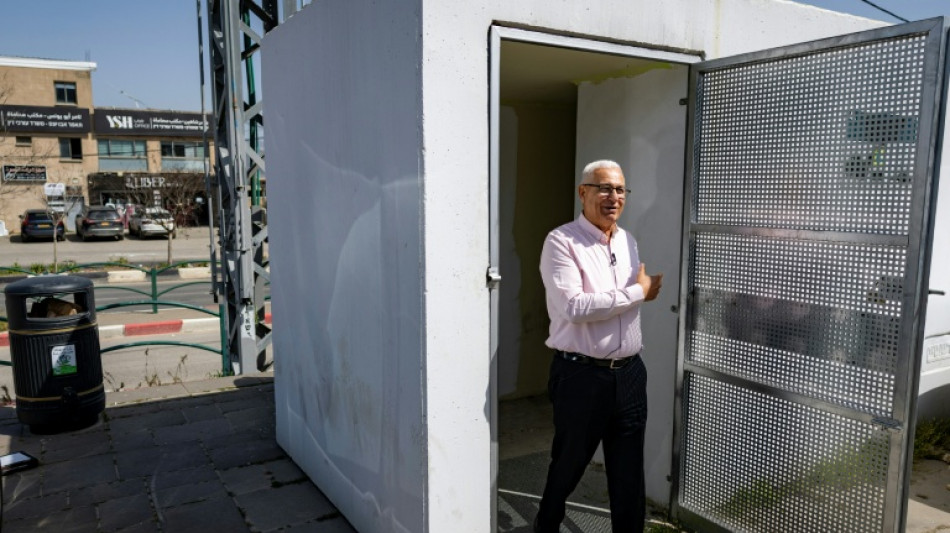
Facing rockets, Arabs in northern Israel fume over lack of shelters / Photo: Odd ANDERSEN - AFP

 Medvedev advances without drama at US Open

 Calhanoglu fires Inter to nervy Cagliari win, Como stun Napoli

 Monaco beat Marseille to go top, Rosenior's Paris FC thump Nice

 Pegula shakes off nerves in US Open first-round win

 FIFA president Infantino 'must go', says ex-UEFA boss Platini
 England v Pakistan second Test: Three talking points
 Rashford's return 'fantastic' for Man Utd, says Carrick

 At least 8 die, more missing, as ferry capsizes off Northern Cyprus

 Pegula shakes off nerves, Ruse in US Open first-round win

 Fernandes treble inspires Man Utd rout, Chelsea beat Brighton in thriller

 Android photo recovery depends on recently deleted folders

 Realme P4s, iQOO Z11 and Nothing Phone 4b compared

 Practical boundaries can reduce group-chat overload

 Eight dead and 23 missing after ferry sinks off Cyprus

 Russell Hobbs dual air fryer discounted to £99

 British woman dies after stabbing at German station

 Beeston pub closes after office fire injures man
 South West Water ranks worst in environmental comparison
 CERN creates quark-gluon plasma with smaller atomic nuclei

 Screen-free fitness bands gain ground as users seek fewer alerts

 Robinson strikes again as England wrap up Pakistan series win

 Red-hot Chelsea not the finished article says Alonso

 Dortmund's Konstantelias to miss 'several months' with knee injury

 Chelsea beat Brighton in seven-goal thriller, Leeds hold Brentford

 At least seven die in ferry capsize off Northern Cyprus; 23 missing

Threatened by volleys of Hezbollah rockets and missiles from Iran, residents of Arab towns in northern Israel are complaining about a lack of public shelters.
"The state is obliged to build public shelters so that the entire population has access to safe havens," Mazen Ghanayem, mayor of the town of Sakhnin, told AFP.
"Yet our town doesn't have a single public shelter worthy of the name."
Located just 20 kilometres from the border with Lebanon, the town's 36,000 residents have grown all too used to the rockets fired by Hezbollah.
Since the militant group joined the Middle East war on the side of its backer Tehran, after Israel and the United States launched attacks on Iran, Sakhnin has lived with the rhythm of air raid sirens.
"Sometimes rocket fragments fall on houses," Ghanayem said.
Perched on a hillside, the town's Arab identity, both Muslim and Christian, is clear to see. The domes of mosques jut into the air alongside church spires.
Its football club, which plays in the Israeli premier league, is a source of pride. So too is an uprising by Israel's Arab minority which, in 1976, forced the state to back down in its attempt to confiscate local land.
- 'Rather get hit' -
When the sirens blare, "residents first take shelter in their homes, as best they can if the house is old or in a secure room if the building is new," explained Kasim Abu Raya, a municipal official.
For those caught out in the open, there are no underground car parks to dash to in this modest town.
Abu Raya showed a video on his mobile phone of his wife and daughter when they were out in the road during an alert.
Frightened and not knowing where to go, they hastily took cover under the steps of a villa whose owners had themselves left everything on the table and hurried off.
To provide more locations to hide, the mayor says that around a dozen schools have been ordered to constantly keep their doors open.
The town also has around a dozen emergency shelters, concrete rectangular boxes measuring three by six metres, close to certain public places.
Resembling something between a reinforced bus stop and a public toilet, some of these mini-bunkers appear to be in an unappealing condition inside.
The shelter in the town hall car park has excrement smeared on the floor and reeks of urine. In others AFP found rubbish piled up at the entrance.
"I'd rather get hit than take shelter in there," joked mayor Ghanayem, not dwelling on who was responsible for their upkeep.
Nevertheless, in emergencies, people do still use them.
In the neighbouring town of Majd el-Kroum, AFP saw around a dozen people abandon their cars and cram like sardines into a shelter during a missile salvo.
- 'Immoral' situation -
"These mini-bunkers can accommodate a handful of people for a few minutes," mayor Ghanayem said.
"But they look more like a trap. This is clearly not a solution for ensuring the safety of my fellow citizens."
The problem with the lack of shelters was known about well before the most recent war with Iran.
According to a 2025 report by the State Comptroller, 33 percent of Israelis have no protected space or compliant shelter.
This figure rises to 50 percent for non-Jewish Israelis, and reaches 70 percent in Arab localities in the north.
In June 2025, during the previous war with Iran, the Association for Civil Rights in Israel expressed concern over the "not only immoral but also unconstitutional" situation.
"While the state allocates significant resources to protecting Jewish communities, including illegal settlements and outposts in the West Bank, it refrains from acting in the same manner in Arab communities," the association said.
That certainly rings true with the mayor of Sakhnin.
"When you look at the Jewish community, in every town, every village, every kibbutz, there are public shelters everywhere," said Ghanayem.
"Not here, and certainly not in Sakhnin."
F.Moura--PC