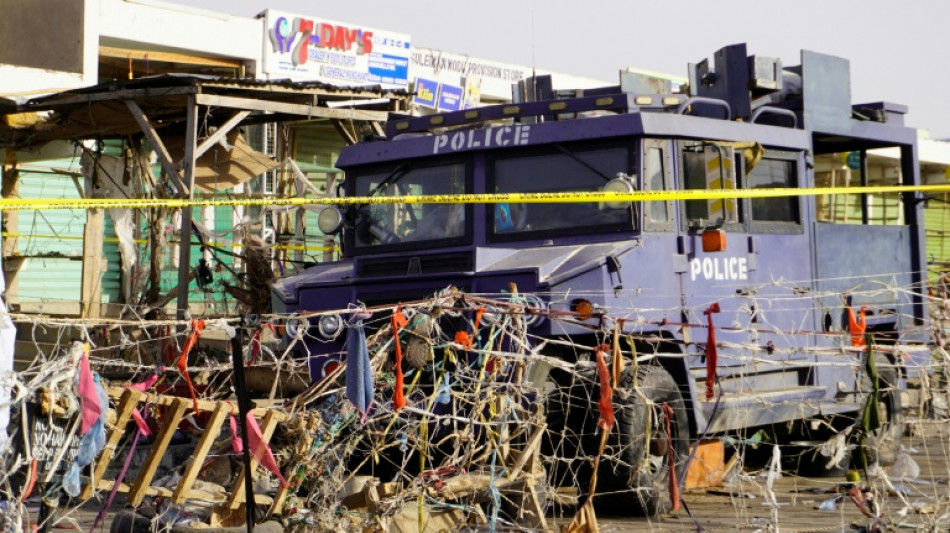
Maiduguri bombings follow surge of jihadist violence in Nigeria / Photo: - - AFP

 Gobena and Jepchirchir power to Sydney Marathon victories

 Iceland in suspense after close EU vote

 Wallabies hold on for victory in Argentina

 Juve notch second straight win, Fiorentina's centenary party falls flat

 Rybakina eases injury fears ahead of US Open
 Djokovic kicks off latest Grand Slam quest under US Open lights

 'Sorry' De Zerbi won't panic after Spurs shambles

 UN, Nepal warn of climate threat after deadly floods
 USTA boss says structure of new player council not yet set

 Tiny Elversberg stun Leverkusen on Bundesliga debut, Dortmund beat Hamburg

 Court orders JIPMER assessment of Durai Dayanidhi before money-laundering trial

 Police appeal for footage after life-threatening Stratford assault

 Family searches for Boston engineer missing after Nepal-Tibet floods

 Dolly Parton’s Imagination Library leaves global children’s reading legacy

 BMC rejects negligence claims in three Rajawadi Hospital maternity cases

 Chembur man held over alleged poisoning of woman’s soft drink
 Andhra Pradesh Speaker seeks stronger sports quota and school facilities

 Kolkata police register new FIR against Mamata Banerjee over rally timing

 India and China have not named two new border meeting sites

 Five college football games that could shape the 2026 season

 New finds strengthen case for Bethsaida at Sea of Galilee site

 Felony assaults on older New Yorkers rise sharply, police data show

 Tamil Nadu goalball team’s national silver highlights need for wider support

 Chennai councillors unite across parties to demand ward development funds

 Rural Tamil Nadu students present 64 technology projects at IIT-M research park
Nigeria's defence chiefs visited Maiduguri Wednesday after one of the deadliest attacks in the Borno state capital in years, in a show of defiance.
But the triple suicide bombing Monday in the northeastern city, which killed 23 people, shows that Nigeria still has a way to go in defeating a long-running jihadist conflict.
The 17-year-old insurgency is in flux, as suicide bombers once again target urban centres, gunmen launch coordinated raids on multiple military posts at once, and front lines shift from the war's northeastern epicentre.
In the countryside, where the violence has largely been contained to since its peak a decade ago, jihadist tactics are changing and new armed groups -- including from the neighbouring Sahel region -- are entering the fray.
"The (military) response is not matching the mobility, the adaptability of these armed groups," said Taiwo Adebayo, an Abuja-based researcher for the Institute for Security Studies.
In Borno state, the epicentre of Nigeria's insurgency since Boko Haram's 2009 uprising, attacks from Boko Haram and splinter Islamic State West Africa Province (ISWAP) "significantly increased" last year, according to the Armed Conflict Location and Event Data Project, a US-based monitor.
ACLED recorded 401 military confrontations, 104 bombings and 141 attacks on civilians in Borno in 2025 -- cumulatively, "the most since 2020", Ladd Serwat, senior Africa analyst, told AFP.
Monday's attack was blamed on Boko Haram and follows a similar December mosque bombing -- both of which harken back to the conflict's deadly peak a decade ago. Some 71 suicide bombings were recorded in 2015, according to ACLED, a number that in recent years had ticked down to fewer than five per year.
ISWAP since last year has stepped up assaults on military bases, attacking four installations Sunday evening into Monday, the army said. Similar "coordinated" attacks on military sites were reported the week before.
In another assault, overnight into Wednesday on a military position in Mallam Fatori, the army said it killed more than 60 jihadists, who attacked with "multiple armed drones" -- a tactic on the rise in Nigeria and the Sahel.
"The military has become accustomed to facing ISWAP," Adebayo told AFP. But now there is a "resurgence" from Boko Haram, as well as new jihadist fronts opening elsewhere -- and the military "is not prepared for that".
He noted that Nigerian forces are also stretched thin, attending to southeastern separatists, armed "banditry" in the northwest and farmer-herder conflicts in central states.
- Expanding front lines -
High-profile attacks last year highlighted jihadist groups' increased presence outside the northeast, which they've cultivated for years.
In western Nigeria, groups from the Sahel have made inroads, while "long-dormant Nigerian jihadi cells have been reactivating... or simply relocating to remote patches of forest," James Barnett, a conflict researcher, wrote in a recent report published by the Combating Terrorism Center at West Point, a US military academy.
A mass kidnapping of schoolchildren in Niger state, which security sources told AFP was conducted by a Boko Haram faction, underscored jihadists' long reach.
In December, the United States, with Nigerian assistance, bombed northwest Sokoto state, targeting Islamic State Sahel Province (ISSP) fighters usually found in neighbouring Niger, along with Mali and Burkina Faso.
Also targeted, the Nigerian government said, were fighters from Lakurawa, a shadowy group whose links with ISSP are debated by researchers.
Meanwhile, fighters from the Al-Qaeda-affiliated JNIM claimed an attack in western Kwara state, on the Benin border, after years of researchers warning that the jihadist conflict ravaging the Sahel risked spreading south towards coastal west African states.
In Maiduguri, chief of defence staff General Olufemi Oluyede pledged "in the future this will not repeat itself."
Whether the bombings will attract increased national attention, however, remains to be seen. Though they made international headlines, many Nigerian news stations -- long used to covering daily violence -- had moved on by Wednesday morning.
President Bola Tinubu meanwhile continued his scheduled state visit to the United Kingdom -- where security cooperation, among other issues, was on the agenda.
O.Salvador--PC