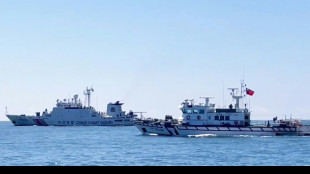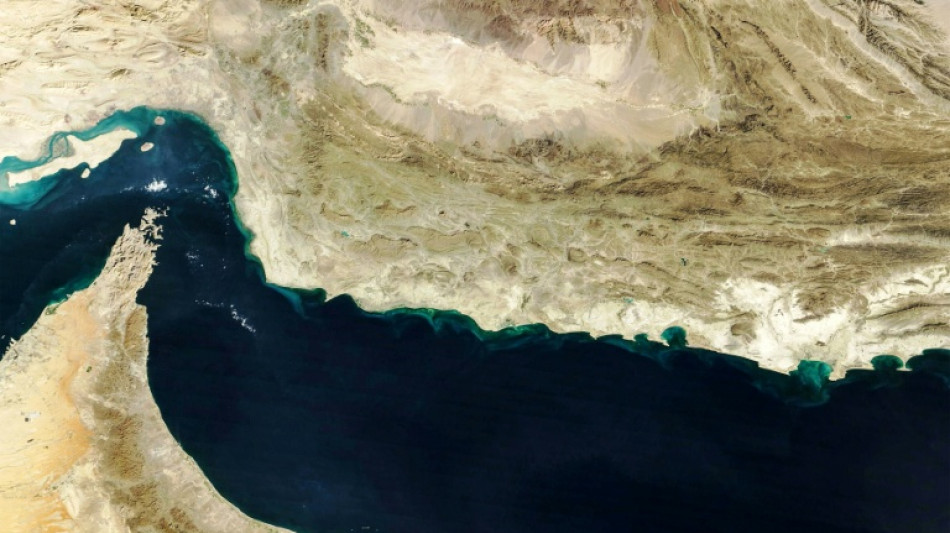
French, Japanese ships cross Strait of Hormuz in first since war / Photo: - - NASA Earth Observatory/AFP/File

 UEFA set to withdraw FIFA boycott threat ahead of Champions League draw

 Sumo moves to beat Japan summer heat as temperatures rise
 'Be more honest': Markets crave clarity from cryptic Fed chair

 Climate change leaves its mark on America's largest reservoir
 CIA director warned Russia not to attack NATO members: US media

 Search for missing after Nepal-Tibet floods kills at least 160

 Meta, US states agree $18 bn settlement in landmark teen safety case

 What scientists know so far about Nepal's deadly floods

 US general visits Colombia to discuss war on drugs

 Meta settlement puts social media industry on notice: 'There will be more'

 NFL owners approve record Seahawks sale

 Nigerian armed groups net nearly $6 mn in ransoms: study

 Savio scores on debut as Spurs advance in League Cup

 Mbappe hits treble as Real Madrid thrash Real Sociedad

 At Dollywood, superfans honor the late singer and local hero

 Stocks mixed as oil drops, US inflation stays high

 Bolivia's Paz appoints new economy minister amid bailout talks

 US designates UK-based Palestine Action as foreign 'terrorist group'

 'Rocky Horror Picture Show' star Tim Curry dead at 80
 American Moll wins women's pole vault at Zurich city event

 As Canada takes on US tariffs, what's behind the David and Goliath fight?

 UEFA 'likely' to drop threat to boycott FIFA tournaments: source

 US disrupts platforms allegedly used by Chinese hackers

 The foreign tourists missing in Nepal's flash floods

 Hundreds missing after Nepal-Tibet flood kills 98

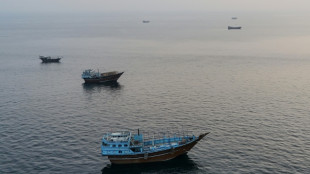
One French- and another Japanese-owned vessel are among a handful of vessels to have crossed the war-torn Strait of Hormuz, maritime tracking data showed Friday.
The passage, a vital maritime route for oil and liquified natural gas, has been virtually blocked by Iran since the start of the war.
But both ships made the crossing on Thursday, according to ship tracking company Marine Traffic's website.
The Maltese-flagged Kribi belonging to the French maritime transport group CMA CGM crossed the waterway to leave the Gulf on Thursday afternoon, Marine Traffic's data showed.
By early Friday, it was off Muscat, Oman, still broadcasting the message "owner France" on its transponder system in the field usually used to give the destination.
The vessel's navigation data showed it had crossed via an Iranian-approved route through its waters, dubbed the "Tehran Toll Booth" by leading shipping journal Lloyd's List.
- Southern route -
In addition, three tankers -- including one co-owned by a Japanese company -- crossed the Strait of Hormuz on Thursday by taking an alternative, southern route.
They hugged close to the shore of Oman's Musandam Peninsula -- a first in nearly three weeks according to Lloyd's List.
Before the war, which started more than a month ago, about a fifth of global oil and liquefied natural gas (LNG) passed through the Strait.
All three ships signalled they were an "OMANI SHIP" in the message broadcast by their transponder as they crossed the strait.
The Sohar LNG, which was empty when crossing, is co-owned by Japanese shipping company Mitsui O.S.K.
That makes it the first Japanese vessel to exit the Gulf since the start of the war, according to a company statement quoted by Japanese media.
The Hong-Kong flagged New Vision, which crossed the strait on March 1 right after the war started, is expected in the French port of Le Havre on Saturday evening.
Since the conflict started however, that has dwindled to a trickle as Iran selectively attacks ships and energy facilities throughout the Gulf in retaliation for US and Israeli attacks.
A few commercial ships crossing the Strait of Hormuz recently have passed through the Iranian-approved route in the north of the waterway.
- Down to a trickle -
Just 221 commodities vessels have crossed the Strait of Hormuz since March 1, some more than once, according to Kpler data up to Friday morning.
In peacetime, the same waterway handles around 120 daily transits, according to Lloyd's List.
Of the vessels that made the crossing, 60 percent either came from Iran or were heading there.
The other countries whose vessels -- of origin or destination -- made the crossing, were in decreasing order: the United Arab Emirates, China, India, Saudi Arabia, Oman, Brazil, and Iraq.
It was not clear from the data how many had been cleared to make the crossing by Tehran.
But it did show that, among the 118 crossings by ships carrying cargo, 37 had left the Gulf carrying crude oil.
Most of those oil tankers -- 30 of them -- came from Iran or sailed under the Iranian flag. And most ships carrying Iranian oil did not specify their destination on their transponder.
Of those who did, all but one reported they were heading to China.
In the early days of the war, transponder data showed dozens of ships broadcasting messages such as "Chinese crew" or "Chinese owner" in the field usually used for their destination.
This appeared to be an attempt by the ships to avoid being targeted by Iran.
dvz-jah-ys-lmc-lcr/jj
A.F.Rosado--PC