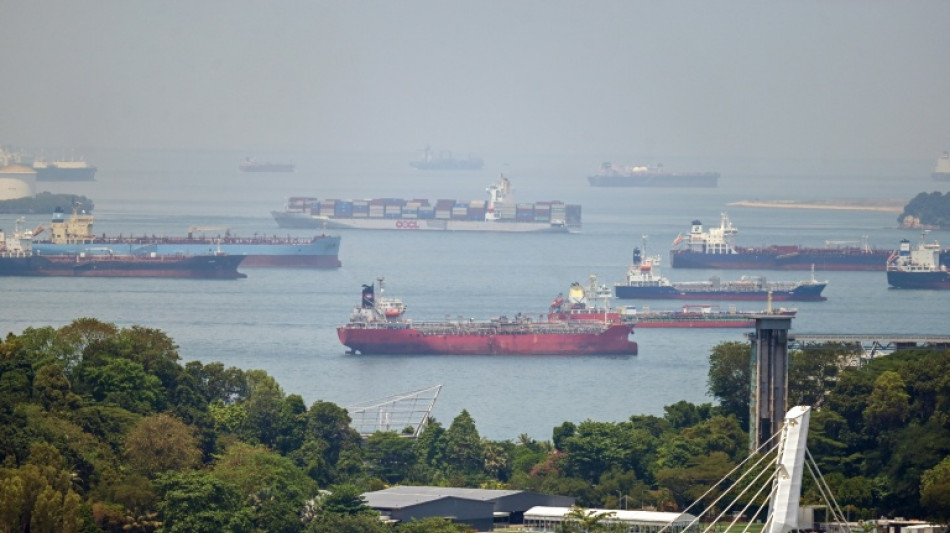
Iran's shadow oil trade endures near Singapore despite war / Photo: Roslan RAHMAN - AFP

 Spurs splash out £75 million for Man City's Savinho

 IntellectEU Introduces Catalyst Core
 Stocks rise and oil slips as traders eye Iran threat, Nvidia results

 India in command despite Sooriyabandara half-century
 Hyundai reaches tentative deal with workers after strike

 Trees 'giving up': climate change hammers historic English gardens

 Malian songbird keeps age-old sounds alive at 88

 Canada to announce response to Trump's new tariffs
 Stocks stagger and oil rises as traders eye Iran threat, Nvidia results
 Families of detained Chinese Christians cling to faith in legal limbo

 Trump veers from boredom to denial after six months of Iran war

 Cool Japan: Human fridge chills workers in extreme heat

 Tens of thousands flee fire near US city of Reno

 LiberNovo Support Week Goes Live: Up to 44% Off on Maxis, Omni SE and Omni Pro Ergonomic Chair Series

 Despair and anger erupt after deadly Guinea landfill collapse
 Tornado tears through French village, dozens injured

 Federer looks forward to brief return to Arthur Ashe stadium

 US removes Syria from state sponsor of terrorism list

 Facebook, TikTok promoted Colombian armed groups' content to recruit children: HRW
 Palmeiras agree to sell Allan to Manchester City: source

 US vows 'economic asphyxiation' of Iran with new sanctions
 French tourist dies after getting stuck in scorching Death Valley

 US proposes expanding UN Sudan arms embargo to entire country

 Ceasefire verification mission heads to east DR Congo
 Carse dropped from England squad after nightclub incident

Near Singapore, thousands of miles from the Strait of Hormuz, ship-to-ship transfers of Iranian oil have continued during the Middle East war, helping Tehran evade sanctions and maintain trade with China.
Nearly 400 tankers are sanctioned by the United States, the European Union or Britain for their activities related to Iran -- which is now facing off against the United States during a tense ceasefire.
The ageing vessels that make up Iran's "ghost fleet" operate clandestinely, exploiting opaque ownership structures, false flags, a lack of insurance and manipulation of GPS data to keep a low profile.
Ship-to-ship (STS) transfers on the high seas allow them to "launder" cargoes, disguising their origin.
An area off Malaysia and Singapore, about 100 kilometres (60 miles) southeast of the Malay Peninsula, has emerged as a strategic hub for moving Iranian crude.
Each week, dozens of transfers between tankers -- not only Iranian -- can be seen from the air, an AFP analysis of satellite imagery found.
"It's really the main hub," said Amir Handjani of the US-based Quincy Institute for Responsible Statecraft. He described the STS situation there as "total anarchy".
These transfers have continued during the war, despite a temporary easing of US sanctions.
On March 20, Washington authorised the sale of Iranian oil already stored on vessels before that date. The authorisation is due to expire on April 19.
But faced with "contradictory activities" by the United States -- easing sanctions then blockading Iranian ports -- "it's safer to keep exporting Iranian oil using shadow vessels and then STS transfers than it is to try to export that oil legitimately," said Elisabeth Braw, an expert at the Atlantic Council.
- Destination China -
Iranian tankers leave the Gulf via the Strait of Hormuz having loaded with crude, usually at Iran's strategic Kharg Island, according to analysis of several maritime tracking platforms.
They then skirt the Indian subcontinent and pass through the Strait of Malacca to Singapore on a two- to three-week journey, before anchoring and waiting for another tanker to take their cargo.
Since March 1, at least 37 Iran-linked tankers have transferred their cargo at sea in the area, amounting to at least 62.3 million barrels of crude, according to data from maritime tracking firm Kpler analysed by AFP.
When specified, the final destinations of these cargoes were ports in China's northern provinces of Shandong, Liaoning and Jiangsu.
Most of the vessels left the Gulf before war broke out on February 28, but at least six Iranian tankers -- among 26 that have crossed the Strait of Hormuz during the conflict -- have transferred their cargoes (totalling 10 million barrels) in recent weeks near Singapore.
The Silvia 1 loaded one million barrels at Kharg in February, passed through the Strait of Hormuz on March 3, arrived in the Singapore area on March 21, and transferred its cargo around March 25 to the Yug.
The Yug then took on the cargo of a second Iranian tanker, the Seastar III, on April 3.
The destination of the Yug is unknown, but the Comoros-flagged tanker is accustomed to STS transfers and generally delivers its cargoes to ports in Shandong, according to data compiled by Kpler and the NGO Global Fishing Watch.
- Iranian oil stored at sea -
Two other cargoes that left the Gulf on the Hilda I and the Amber were transferred to other tankers near Singapore at the end of March, and are expected to arrive at the ports of Yantai (Shandong) and Lianyungang (Jiangsu) on Thursday and Friday, according to Kpler.
Cargoes sometimes undergo several STS transfers.
The cargo of the Amber (two million barrels) transferred to the Medna on March 31, then to the Star Pine on April 4, before heading for China.
Kpler cannot rely on ships' automatic identification systems (AIS) transponder signals, which are switched off at key moments, to estimate cargoes and identify transfers within this shadow fleet.
Instead, the company uses algorithms comparing ships' AIS signals with past routes and analysing their draught, which can indicate when cargo has been offloaded.
STS transfers are likely to thrive due to the US blockade of Iranian ports that started on Monday, especially as "there's a lot of Iranian oil still on the water as floating storage," Naveen Das, an analyst at Kpler, told AFP.
F.Cardoso--PC