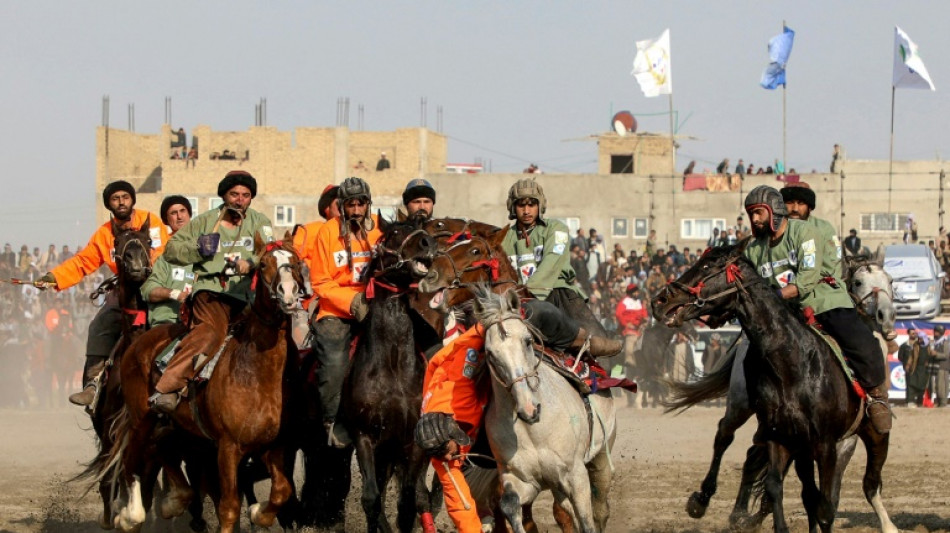
The pain and money behind the Afghan game of buzkashi / Photo: Atif ARYAN - AFP

 France's debt climbs to highest since 1978: ministry
 McIlroy two shots off the lead at Wentworth after eagle on 18
 Martinez brace saves Inter in Serie A top-two clash with Roma
 Rosenior abused but guides Paris FC past old club Strasbourg
 Seven-try Lyon beat Pau, climb to Top 14 summit
 Brighton defeat a 'big lesson' against complacency for Arsenal, says Arteta
 Thousands protest inaction over climate crisis in Switzerland

 Carapaz out of cycling world championships
 'Fragile' Tottenham beaten by Aston Villa despite late rally
 Mourinho hails Real Madrid grit before Atletico derby clash
 Martin wins Austrian MotoGP sprint after Acosta crash
 Japan edge Fiji to win Pacific Nations Cup
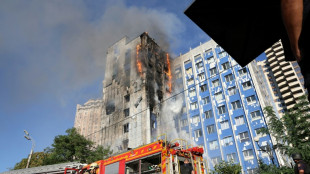
 Black smoke, flames rising near Riyadh airport: residents to AFP
 UK actor Naomi Watts honoured at Spain film festival
 Japan emperor declares Asian Games open after turbulent build-up
 Asian Games open with unity message after troubled build-up
 Denmark hails 'binding' Greenland deal with Trump
 We don't want Games host Japan losing money, says Asian Olympic official
 Ed Sheeran returns to stage after Palestinian controversy

 Asian Games to open in Japan after troubled build-up

 Drone owners rush to offload devices ahead of Beijing ban

 Trump's beef policies irk Texas ranchers, testing their loyalty

 Nvidia, OpenAI CEOs to attend Xi dinner at White House

 Anthropic picks Accenture for in-house AI safety evaluation

 Balogun returns as Monaco beat Lens to continue strong Ligue 1 start

Afghan rider Sarwar Pahlawan blinked away pain from the fresh stitches between his eyes as his buzkashi team chased victory in a tournament for an ancient sport still steeped in risk but now offering modern-day rewards.
Played for centuries in Afghanistan's northern steppes, the national sport at the heart of Afghan identity has evolved from a rough, rural pastime to a professionalised phenomenon flush with cash.
"The game has changed completely," the horseman, soon to turn 40, told AFP after returning home victorious from the tournament final in the northern city of Mazar-i-Sharif earlier this month.
After 20 years as a buzkashi rider, or "chapandaz", Sarwar welcomes the changes to the game, which is played across Central Asia and features elements akin to polo and rugby.
"They used to pay us with rice, oil, a carpet or a cow," he said, but today the chapandaz have professional contracts.
The best players can now earn $10,000 per year, with winning teammates sharing $35,000, three camels and a car offered by sponsors after clinching the title.
Traditionally, buzkashi is played with the headless body of a goat.
Today, more often a 30-kilogramme (66-pound) leather sack stands in for the carcass that riders try to pull from a fray of horses and drop in a "circle of justice" traced on the ground after doing a lap of the arena at full gallop with competitors in hot pursuit.
Training has changed too as the national league's top teams have evolved.
Robust horsemen no longer hang from trees or split wood to build muscle -- they lift weights in gyms.
"Before, when we returned from a tournament, cold water was poured on our shoulders, now we have hammams (bath houses) and saunas," said Sarwar, known as "the lion" for his strength.
Being one of the league's best players has also filled Sarwar's coffers.
"I didn't even have a bike, and now I have a car. I had almost no sheep and now I have many. I had no house, and now I have two."
But he says he remains "a simple man". Between tournaments, he cultivates his land and raises his sheep.
- Fresh investment -
Oil tycoon Saeed Karim, who splits his time between Mazar-i-Sharif, Dubai and Istanbul, is the biggest financier of the new buzkashi.
The Afghan businessman set up the winning team that bears his company's name, Yama Petroleum, five months ago.
Karim acquired the two best chapandaz in the country, including Sarwar, and around 40 competition horses, which can cost up to $100,000 each.
"In this team, we invested around a million dollars in horses, riders, stables and other equipment," he told AFP.
"I just want to serve my people," he said. "When my team wins, it's an honour for me."
It can cost around $300,000 a year to take care of the team's stallions, fed on barley, dates, carrots and fish oil, as well as 15 riders and 20 grooms.
For the comfort of his men -- who commonly suffer broken ribs, fingers and legs -- Karim had a four-hectare ranch built for recuperation and stabling horses.
While Karim's homeland in northern Afghanistan remains the centre of buzkashi in the country, the sport has made recent inroads in the south -- the birthplace of the Taliban authorities, who banned the sport between 1996 and 2001 but have allowed it since returning to power in 2021.
"Buzkashi is this nation's passion," the president of the Buzkashi Federation, Ghulam Sarwar Jalal, told AFP.
"The Taliban know that it makes people happy, that's why they authorise it."
They also collect taxes from the professional league, started in 2020, which includes 13 teams from 10 provinces.
Likewise, some order has been brought into the brutal contests, and yellow or red cards rain down in the event of a foul.
- More money, more fans -
But above all, the influx of money has transformed buzkashi.
"More fans come because they know there are more good horses and good teams have been added to the field," said Karim.
Ten thousand men filled the Mazar-i-Sharif stadium for the final, braving Taser shocks or blows from club-wielding Taliban authorities tasked with holding back the crowds.
The spectators -- devoid of women, who are kept away by both cultural stigma and government restrictions -- said they feel safer attending matches, as security has improved since the Taliban ousted the Western-backed government and ended their two-decade insurgency.
"People can now come without fear," said Mohammad Yama Razaqyar.
"Businessmen's investment is effective for the game. The arrangements are surprisingly good for the matches," added Razaqyar, who works for a tournament sponsor.
Federation president Jalal said since the return of the Taliban, the sport has grown -- from between 100 to 200 riders to at least 500 nationwide -- "because younger people are taking an interest".
"This year, 20 entrepreneurs contacted us," he said, adding he expects $4-5 million to be invested in new teams.
"We want to make it a sport as colourful as football or cricket," Jalal said.
"The more commercial it is, the more international it will become."
V.Dantas--PC