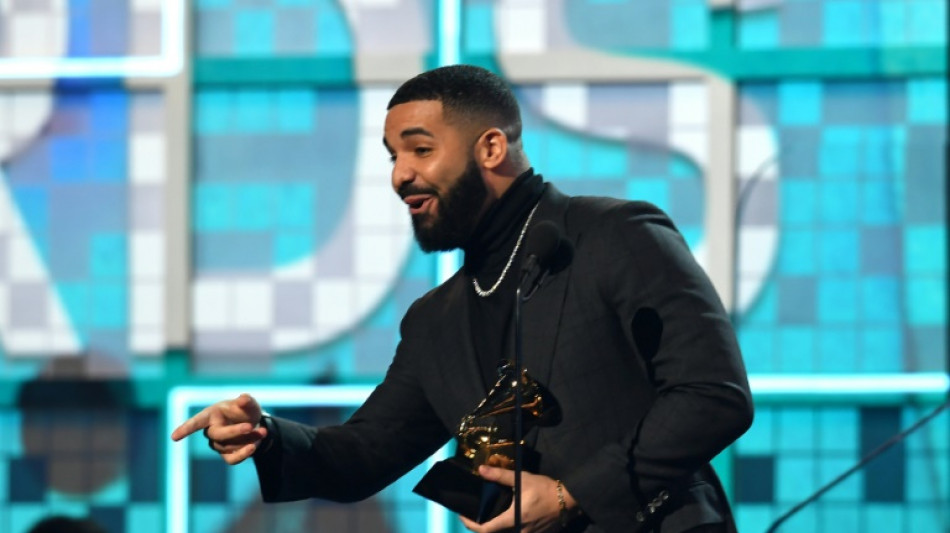
Did the AI Drake song breach copyright? / Photo: Robyn Beck - AFP

 #IAmJaneDoe: online support campaign in US university rape case
 Brazil shine on Selecao's first visit to India

 Zverev sets up Djokovic quarter-final at China Open, Rybakina out

 Happier at home, Bordeaux hammer Lyon in Top 14

 Lula, Bolsonaro in final push for votes ahead of knife-edge election

 Boisterous fashion week barnstorms 'sleepy' Nigerian capital
 UAE investigators say flydubai co-pilot was planning 'terrorist act'

 Rahul smacks century in India v Windies ODI
 Daryz seeks to join exclusive club of dual Arc winners

 Russia warns diplomats to leave Kyiv over new strikes threat

 Olympic champ Zheng rebukes rowdy home crowd at China Open
 World No.1 Sinner pulls out of Shanghai Masters to delay return

 Red Bull's Verstappen grabs pole position for Bahrain GP

 India beat Pakistan in blockbuster as golfer Kim wins 'crazy' gold

 India beat arch-rivals Pakistan to win Asian Games cricket gold

 Ethiopia's Tigray rebels abandon regional capital as govt advances: journalist

 Tom Kim powers to Games gold and exemption from military service
 Split loyalties for Indian football fans at Brazil friendly

 India-Pakistan blockbuster brings cricket fever to Japan baseball field
 Wong waiting on Rafa after winning Asian Games tennis gold

 With Russia next door and rising costs, Latvia goes to the polls

 Penalty hero rues empty seats as Games hosts Japan win football gold

 North Korea fires ballistic missile after Seoul's apology demand

 US regulator finds Boeing 737 MAX software bug 'not a safety concern'

 Ohtani 'managing' injuries as Dodgers launch MLB post-season
A viral AI-generated song imitating Drake and The Weeknd was pulled from streaming services this week, but did it actually breach copyright as claimed by record label Universal?
Created by someone called @ghostwriter, "Heart On My Sleeve" racked up millions of listens before Universal Music Group asked for its removal from Spotify, Apple Music and other platforms.
However, Andres Guadamuz, who teaches intellectual property law at Britain's University of Sussex, is not convinced that the song breached copyright.
As similar cases look set to multiply -- with an uncanny AI replication of Liam Gallagher from Oasis causing buzz -- he spoke to AFP about some of the issues being raised.
- Did the song breach copyright?-
The underlying music on "Heart On My Sleeve" was new -- only the sound of the voice was familiar -- "and you can't copyright the sound of someone's voice," said Guadamuz.
Perhaps the furore around AI impersonators may lead to copyright being expanded to include voice -- rather than just melody, lyrics and other created elements -- "but that would be problematic," Guadamuz added.
"What you're protecting with copyright is the expression of an idea, and voice isn't really that."
He said Universal probably claimed copyright infringement because it is the simplest route to removing content, with established procedures already in place with streaming platforms.
"Most of the time, these issues are not resolved by law, but just by record companies making a stink with the platforms. It's easier for the platform just to comply," said Guadamuz.
- Were other rights breached?
An AI-generated impersonator may be breaching other laws.
If an artist has a distinctive voice or image, this is potentially protected under "publicity rights" in the United States or similar image rights in other countries.
Bette Midler won a case against Ford in 1988 for using an impersonator of her in an advert. Tom Waits won a similar case in 1993 against the Frito-Lays potato chips company.
The problem, said Guadamuz, is that enforcement of these rights is "very hit and miss" and taken much more seriously in some countries than others.
And streaming platforms currently lack straightforward mechanisms for removing content seen as breaching image rights.
- What comes next?
The big upcoming legal fight is over how AI programmes are trained.
It may be argued that inputting existing Drake and Weeknd songs to train an AI programme may be a breach of copyright -- but Guadamuz said this issue was far from settled.
"You need to copy the music in order to train the AI and so that unauthorised copying could potentially be copyright infringement," he said.
"But defendants will say it's fair use. They are using it to train a machine, teaching it to listen to music, and then removing the copies.
"Ultimately, we will have to wait and see for the case law to be decided."
But it is almost certainly too late to stem the flood.
"Bands are going to have to decide whether they want to pursue this in court, and copyright cases are expensive," said Guadamuz.
"Some artists may lean into the technology and start using it themselves -- especially if they start losing their voice."
F.Cardoso--PC



