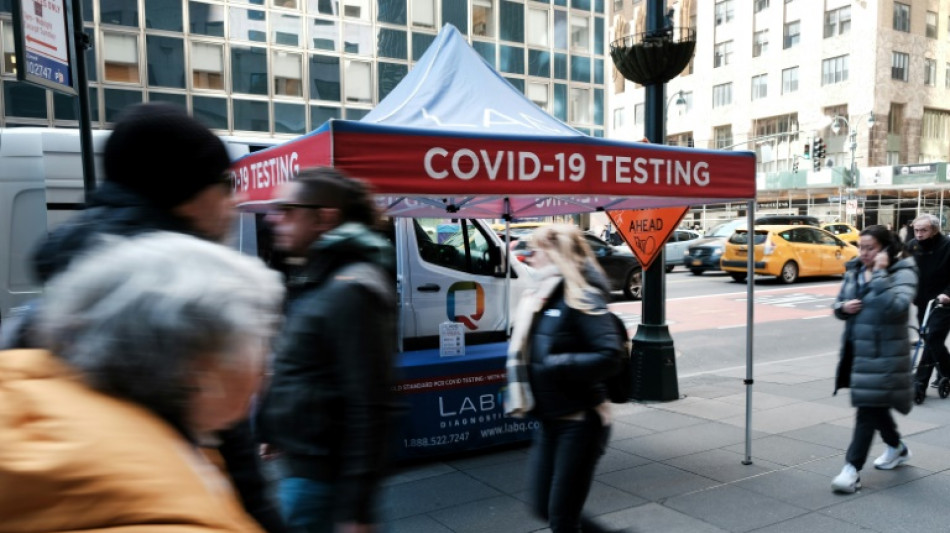
Scientists develop mobile printer for mRNA vaccine patches / Photo: SPENCER PLATT - GETTY IMAGES NORTH AMERICA/AFP

 #IAmJaneDoe: online support campaign in US university rape case

 Brazil shine on Selecao's first visit to India

 Zverev sets up Djokovic quarter-final at China Open, Rybakina out
 Happier at home, Bordeaux hammer Lyon in Top 14

 Lula, Bolsonaro in final push for votes ahead of knife-edge election

 Boisterous fashion week barnstorms 'sleepy' Nigerian capital

 UAE investigators say flydubai co-pilot was planning 'terrorist act'

 Rahul smacks century in India v Windies ODI

 Daryz seeks to join exclusive club of dual Arc winners

 Russia warns diplomats to leave Kyiv over new strikes threat
 Olympic champ Zheng rebukes rowdy home crowd at China Open

 World No.1 Sinner pulls out of Shanghai Masters to delay return
 Red Bull's Verstappen grabs pole position for Bahrain GP

 India beat Pakistan in blockbuster as golfer Kim wins 'crazy' gold

 India beat arch-rivals Pakistan to win Asian Games cricket gold

 Ethiopia's Tigray rebels abandon regional capital as govt advances: journalist

 Tom Kim powers to Games gold and exemption from military service

 Split loyalties for Indian football fans at Brazil friendly

 India-Pakistan blockbuster brings cricket fever to Japan baseball field

 Wong waiting on Rafa after winning Asian Games tennis gold

 With Russia next door and rising costs, Latvia goes to the polls

 Penalty hero rues empty seats as Games hosts Japan win football gold

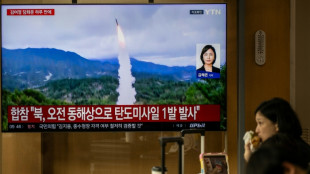 North Korea fires ballistic missile after Seoul's apology demand

 US regulator finds Boeing 737 MAX software bug 'not a safety concern'

 Ohtani 'managing' injuries as Dodgers launch MLB post-season

Scientists said Monday they have developed the first mobile printer that can produce thumbnail-sized patches able to deliver mRNA Covid vaccines, hoping the tabletop device will help immunise people in remote regions.
While many hurdles remain and the 3D printer is likely years away from becoming available, experts hailed the "exciting" finding.
The device prints two-centimetre-wide patches which each contain hundreds of tiny needles that administer a vaccine when pressed against the skin.
These "microneedle patches" offer a range of advantages over traditional jabs in the arm, including that they can be self-administered, are relatively painless, could be more palatable to the vaccine-hesitant and can be stored at room temperature for long periods of time.
The popular mRNA Covid-19 vaccines from Pfizer and Moderna need to be refrigerated, which has caused distribution complications -- particularly in developing countries that have condemned the unequal distribution of doses during the pandemic.
The new printer was tested with the Pfizer and Moderna jabs, according to a study in the journal Nature Biotechnology, but the goal of the international team of researchers behind it is for it to be adapted to whatever vaccines are needed.
Robert Langer, co-founder of Moderna and one of the study's authors, told AFP that he hoped the printer could be used for "the next Covid, or whatever crisis occurs".
Ana Jaklenec, a study author also from the Massachusetts Institute of Technology, said the printer could be sent to areas such as refugee camps or remote villages to "quickly immunise the local population," in the event of a fresh outbreak of a disease like Ebola.
- Vacuum-sealed -
Microneedle patch vaccines are already under development for Covid and a range of other diseases, including polio, measles and rubella.
But the patches have long struggled to take off because producing them is an expensive, laborious process often involving large machines for centrifugation.
To shrink that process down, the researchers used a vacuum chamber to suck the printer "ink" into the bottom of their patch moulds, so it reaches the points of the tiny needles.
The vaccine ink is made up of lipid nanoparticles containing mRNA vaccine molecules, as well as a polymer similar to sugar water.
Once allowed to dry, the patches can be stored at room temperature for at least six months, the study found. The patches even survived a month at a balmy 37 degrees Celsius (99 Fahrenheit).
Mice which were given a vaccine patch produced a similar level of antibody response to others immunised via a traditional injection, the study said.
The printed patches are currently being tested on primates, which if successful would lead to trials on humans.
- 'A real breakthrough'? -
The printer can make 100 patches in 48 hours. But modelling suggested that -- with improvements -- it could potentially print thousands a day, the researchers said.
"And you can have more than one printer," Langer added.
Joseph DeSimone, a chemist at Stanford University not involved in the research, said that "this work is particularly exciting as it realises the ability to produce vaccines on demand".
"With the possibility of scaling up vaccine manufacturing and improved stability at higher temperatures, mobile vaccine printers can facilitate widespread access to RNA vaccines," said DeSimone, who has invented his own microneedle patches.
Antoine Flahault, director of the Institute of Global Health at the University of Geneva, said that production and access to vaccines could be "transformed through such a printer".
"It might become a real breakthrough," he told AFP, while warning that this depended on approval and mass production, which could take years.
Darrick Carter, a biochemist and CEO of US biotech firm PAI Life Sciences, was less optimistic.
He said that the field of microneedle patches had "suffered for 30 years" because no one had yet been able to scale up manufacturing in a cost-effective way.
"Until someone figures out the manufacturing scale-up issues for microneedle patches they will remain niche products," he told AFP.
A.Aguiar--PC



