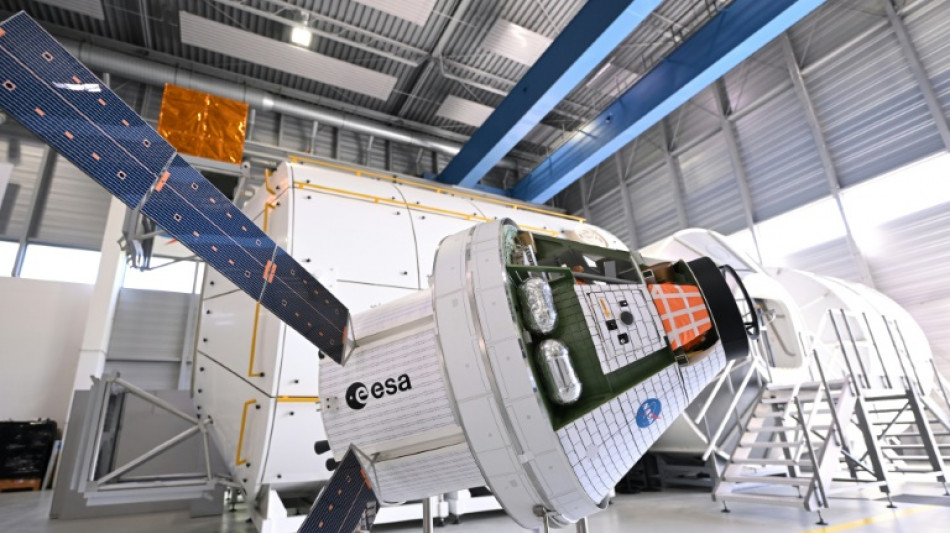
Prep in the pool for Europe's next astronauts / Photo: Ina FASSBENDER - AFP

 Tuchel hails 'complete' England after Croatia demolition

 Fury to invite Trump to lead ring walk before Joshua showdown

 Fashion industry in 'precarious moment', says Vivienne Westwood supremo
 Seventh heaven for England in Nations League rout of Croatia
 Storms, flooding cause chaos on Greek holiday island of Crete
 #IAmJaneDoe: online support campaign in US university rape case
 Brazil shine on Selecao's first visit to India
 Zverev sets up Djokovic quarter-final at China Open, Rybakina out
 Happier at home, Bordeaux hammer Lyon in Top 14
 Lula, Bolsonaro in final push for votes ahead of knife-edge election
 Boisterous fashion week barnstorms 'sleepy' Nigerian capital
 UAE investigators say flydubai co-pilot was planning 'terrorist act'

 Rahul smacks century in India v Windies ODI
 Daryz seeks to join exclusive club of dual Arc winners
 Russia warns diplomats to leave Kyiv over new strikes threat
 Olympic champ Zheng rebukes rowdy home crowd at China Open
 World No.1 Sinner pulls out of Shanghai Masters to delay return
 Red Bull's Verstappen grabs pole position for Bahrain GP
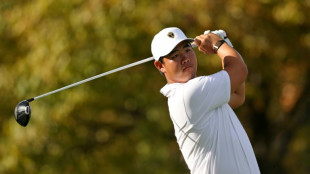
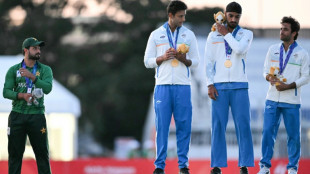 India beat Pakistan in blockbuster as golfer Kim wins 'crazy' gold
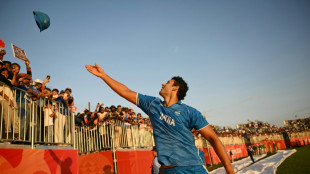 India beat arch-rivals Pakistan to win Asian Games cricket gold

 Ethiopia's Tigray rebels abandon regional capital as govt advances: journalist
 Tom Kim powers to Games gold and exemption from military service
 Split loyalties for Indian football fans at Brazil friendly
 India-Pakistan blockbuster brings cricket fever to Japan baseball field
 Wong waiting on Rafa after winning Asian Games tennis gold

A new cohort of astronauts at the European Space Agency's training centre in Cologne, Germany, can expect to see time in both the pool and the classroom as they get ready to head into orbit.
Trainees dive into the water to emulate the experience of working in zero gravity, as well as studying a variety of subjects from medicine to geology.
The aim of the curriculum is to prepare the group for service on the International Space Station (ISS) and later on a potential mission to the moon.
"The biggest challenge is to learn so many different things in a very short period of time," British astronaut Rosemary Coogan, 31, told AFP in an interview.
Along with four other hopefuls, Coogan in April began the 13-month course and will have finished by May 2024.
By then, the group will know who among them will be the first to climb aboard the low-orbit station in 2026.
For French candidate Sophie Adenot, 40, the "variety of the training" is part of the pleasure.
"It is everything from theoretical science to operational training. I am astounded by everything we have done in the last month," she told AFP.
Graduates from the course could be headed for the moon, in the scope of the Artemis mission, which hopes to return astronauts to the rock within a decade and to establish a permanent base on Earth's natural satellite.
- Woman on the moon -
The current cohort of astronauts includes the highest number of women to date after a push by the ESA to make space travel less masculine.
The agency encouraged more women to apply for the opportunity to go to space. In all, almost a quarter of candidates in 2021 were women, up from 15 percent in the last round in 2008.
"More than just having women in the team, what is important is diverse backgrounds and professions," said Adenot.
"A doctor will have a different way of thinking than an engineer or a pilot... it's important to have various ways of thinking in the team," she said.
Adenot, herself a helicopter test pilot, is joined in the group by Swiss doctor Marco Sieber, Belgian neuroscientist Raphael Liegeois and Spanish aeronautical engineer Pablo Alvarez Fernandez.
In addition to the five candidates, the ESA has also appointed a "parastronaut" -- an astronaut with a handicap -- 41-year-old Briton John McFall, who will take part in the training.
McFall's presence will allow the ESA to study the feasibility of sending an astronaut with greater physical limitations into space.
- Pool time -
The training course seeks to prepare the future astronauts for any situation they could be confronted with in space.
In the pool, 10 metres underwater, the team practice what to do if a colleague falls ill in space and how to communicate with them.
"Astronauts have to have a very sound judgement," said Coogan.
"When you get to space, there are often very unpredictable things and it can be to do with your day-to-day activities or an emergency situation. And that’s where you need to stay calm."
After 13 months of training, only the candidate chosen to go to the ISS will begin a separate two-year programme tailored to the mission.
Despite the limited space onboard the rocket, the team at the ESA work well together.
"We are like a team of highly trained athletes. The demands of space missions are so high that you can only match them by working together," said Adenot.
"When one of us is selected for a mission, whether it is on the International Space Station or the moon, we will all be behind them."
P.Serra--PC